I’m 54 Today. Apparently, That’s Old.
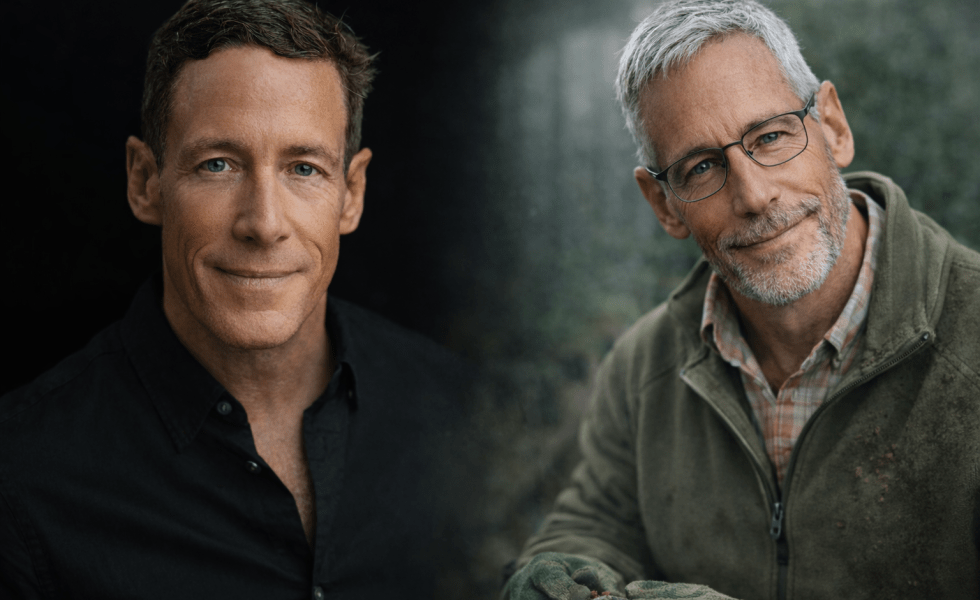
I’m 54 today. That’s the age my father was when he retired.
Retirement? Now? It’s not even faintly on my radar. And not simply because I don’t enjoy the luxury of a public-sector pension.
Beyond the time I’ll need to work, I want to work. I want to maintain the mental sharpness, the purpose, the modernity of ideas that comes from being immersed in business. I want to continue to be physically engaged and professionally curious for as long as I can. The idea of winding down feels deeply unnatural.
But 54 today is not what 54 was thirty years ago. And it certainly isn’t what it was for the generation before that.
I remember my grandparents in their mid-fifties. They were old. They were elderly. They needed “looking after”. We were mindful of their years, their frailty, constant instructions to be careful not to exhaust them, aware that they were firmly in life’s final act. And yet, all but one lived well into their nineties.
At 54, my dad wasn’t old. But he was retired, and ready for it. Past his peak. His shift complete. He had earned the right and was unquestionably ready to move into life’s third phase. Thirty years on, he’s still going strong, still quietly (and sometimes not-so quietly) defying his age. But his working life pivoted; perfectly justifiably.
At 54, I don’t feel old in any meaningful sense of the word. I’m certainly not ready to slow down. I love what I do. I have balance, perspective, autonomy and flexibility with enough life luxuries to truly enjoy that balance, but I don’t feel as though I’ve “finished my shift”.
I’m not even close to being done with phase two of my life, let alone ready for phase three. I’m still learning, still exploring, still getting things wrong and gaining knowledge & wisdom from those mistakes. I don’t even feel quite grown-up in the way I always saw my dad as being.
Physiologically, I’m in the best shape of my life.
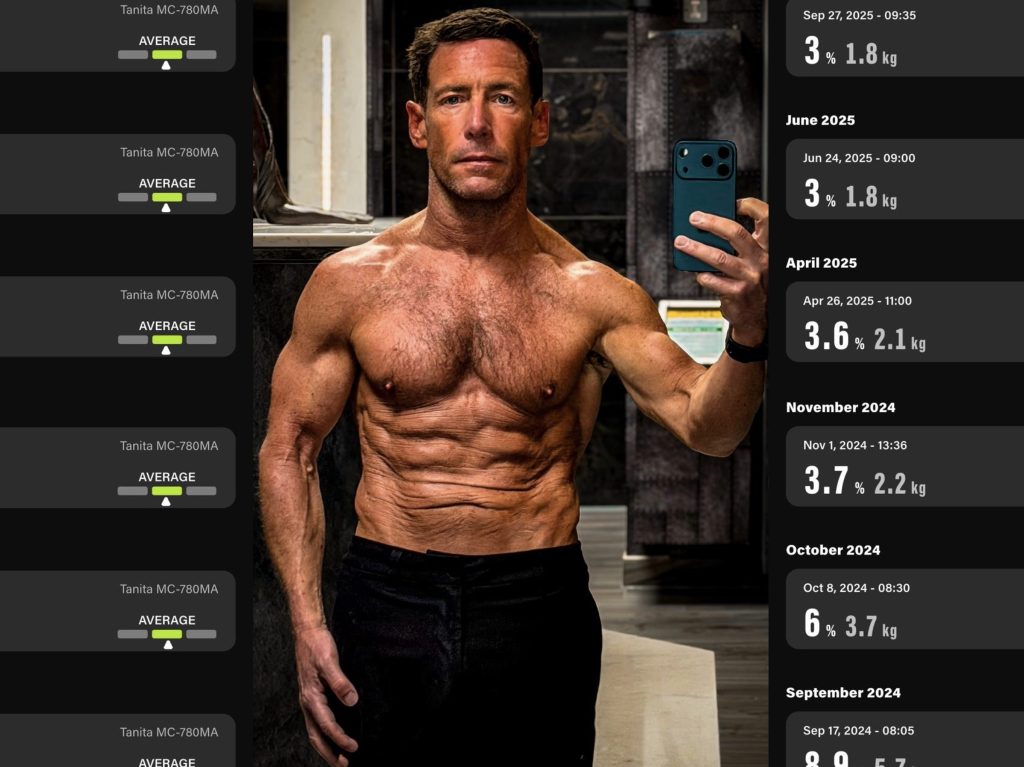
I’m fitter than I’ve ever been, with a lower body-fat % than I’ve ever been. Lighter than I can remember, but carrying more muscle than at any previous point I’ can remember’ve measured.
My VO₂ max, the gold standard measure of cardiorespiratory fitness, was measured last month at 70.2 mL/kg/min, a level more commonly associated with elite athletes decades younger. At 54, the average person records around half that level.
I train seven days a week. Strength/resistance training for 6-8 hours a week plus 8-12 hours of cardio, mostly Zone 2. (read why here)
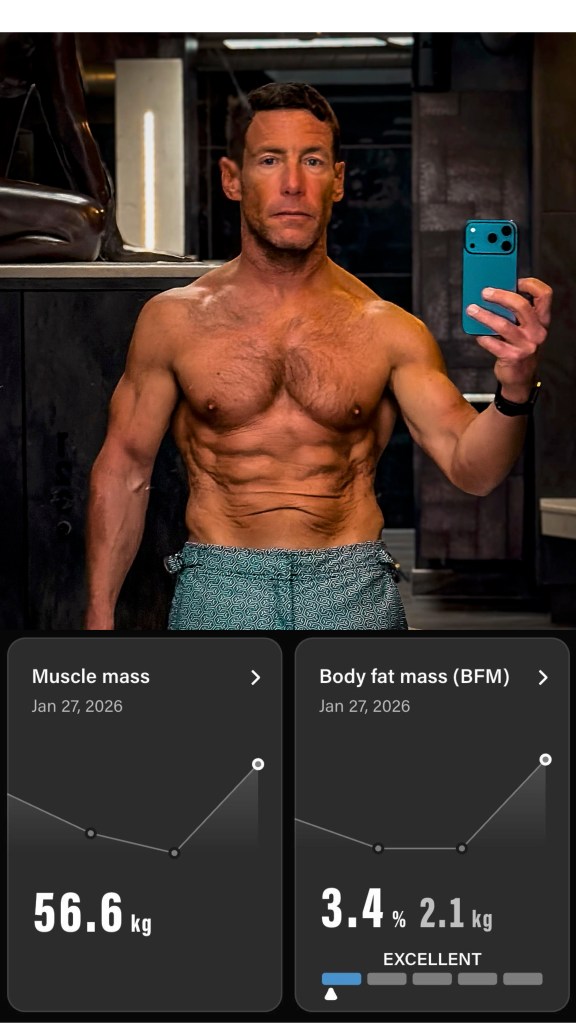
None of this is accidental. And none of it feels like decline
I get annual bloodwork done. Every single marker in my last test was the best it has ever been, including markers that track cognitive decline & early predictors of Alzheimer’s/Dementia, as well as Cardiovascular risk, atherosclerosis and insulin resistance.
…I don’t even have grey hair to speak of. (Then again, neither does my 80-year-old mother.)
So, is 54 old?
Ask any recruiter or hiring manager and you’ll get the correct, legally compliant answer: age is not a factor. Ask them again, quietly, off the record, and you’ll often get a look, an eyebrow raise, not hostile, just knowing, the suggestion that it will be a factor, even if not a demonstrable one.
I know this because I’ve lived on both sides of that equation.
When I started in recruitment at 21, the 50-plus-year-old contractors I placed felt old to me. They seemed to be easing their way out of their full and professional career, using short-term roles as a gentle glide path toward retirement.
Four years later, in permanent recruitment, and later still in executive search, the mid-fifties remained a psychological barrier for many clients. Officially, it was about longevity. Unofficially, it was about energy, drive, relevance.
And yet, here I am, at exactly that age, with nothing slowing down. If anything as attested above, the opposite.
Over the past decade, the average age of people I’ve placed has steadily risen, from 44 in 2014 to 51 in 2023. Last year marked the first dip, driven entirely by two exceptional late-thirty-something C-suite hires. Without them, the average would have crept above 52.
The oldest person I placed last year was weeks away from her 65th birthday. You’d be hard-pressed to place her a day over 50.
History, too, rebuffs the idea that 50-something is a professional twilight.
- Gordon Bowker was 54 when he co-founded Starbucks.
- John Pemberton was 55 when he created Coca-Cola.
- Ray Kroc was 52 when he transformed McDonald’s into a global empire.
- Arianna Huffington was 54 when she launched the business that would later sell for $300 million.
- Taikichiro Mori was 54 when he founded Mori Building Company, 20 years later he was the world’s richest man.
- Charles Ranlett Flint was 61 when he founded the company that became IBM.
- Colonel Sanders was 61 when he started KFC.
These aren’t anomalies. They’re reminders.
Age bias persists not because it’s true, but because it’s convenient.
It allows organisations to confuse youth with potential, and familiarity with relevance. But in a world where careers now routinely span forty or even fifty years, writing people off in their early fifties isn’t just unfair, it’s a catastrophic waste of capability.
The real risk in modern business isn’t hiring someone “too old”.
It’s failing to recognise someone who is still in ascent.
So maybe the real question isn’t whether 54 is old.
Maybe the question is why we continue to design careers, hiring decisions, and expectations around an idea of ageing that no longer exists. Because if experience is still compounding, energy is still there, and ambition hasn’t expired, then writing people off by age isn’t just lazy.
We pretend this is about risk. It isn’t. It’s economically illiterate.
And one day — if we’re lucky — every one of us will find ourselves on the wrong side of that assumption.
The real risk in modern business isn’t hiring someone ‘too old’.
It’s failing to recognise someone who is still in ascent.
Other Fitness / Wellness / Healthspan Subjects:





 garychaplin.com