
Benefits of 16:8 Intermittent Fasting Explained
My Experience, The Science, and Why It Works
I wasn’t blessed with the genetics of a naturally lean frame. Most of my family are what you’d politely call “comfortably built”, carrying a little extra padding, too easily prone to tipping into the overweight/obese shading on the body composition graph; Endomorphic body types, to use the Sheldon somatotype scientific term.
So, for me, staying in shape has never been something that just happens. I have to work at it. And because I’m vain, I do work at it. Over the years I’ve tried most approaches: ketogenic, plant-based, low-GI, all on top of a strict exercise routine.
That’s why, after an enjoyable summer with more travel than usual (Ravello, Sorrento, Sani and Marbella), more rich food than usual, definitely more alcohol than usual, and less exercise than usual, I wasn’t shocked to find myself 3kg heavier. It doesn’t sound much, but at 53yrs old, those kilos stick differently than they did in my 30s. And with a normal bodyweight of 62–64kg, it was a noticeable 5% gain; a belt notch bigger.
Determined to reset & redress, I turned to Intermittent Fasting; more specifically, the 16:8 Time-Restricted Eating (TRE) method, having read so much about it, particularly from Peter Attia.
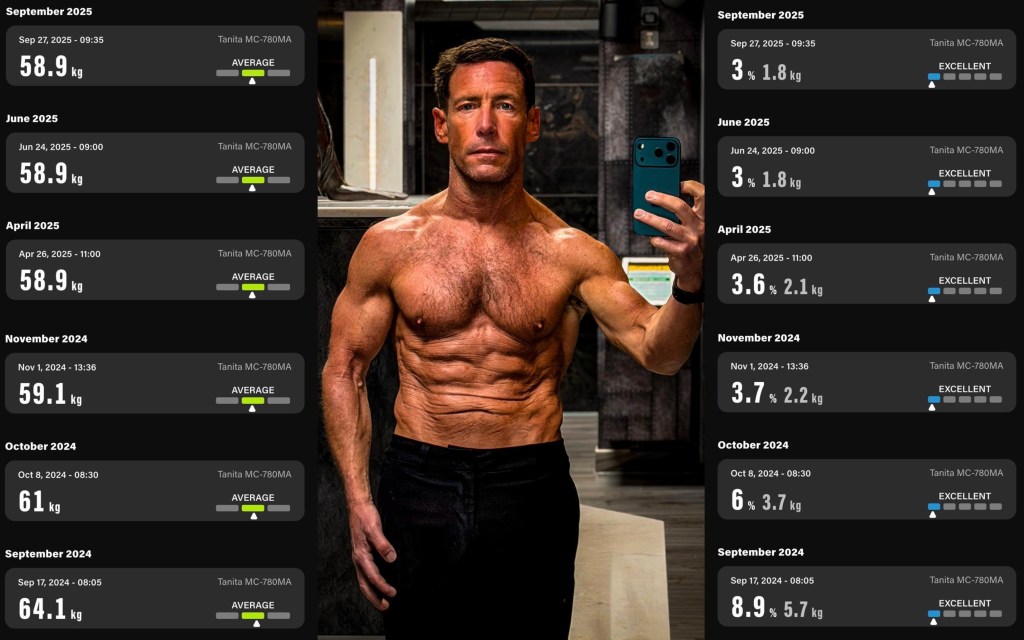
The results surprised even me. Within six weeks I’d lost 5kg, slipping not only below my pre-summer weight but down to 60kg, and with body fat around 4% (measured on a TANITA Body Composition Analyzer – calliper assessment would likely be a little higher). I was the leanest I’d ever been, not bad for my mid-fifties.
I’ve kept the routine up since, adding more protein, and now hover happily at 58–59kg with body fat between 3–4%. It has easily become part of daily life.
What is Time-Restricted Eating (TRE)?
Time-restricted eating is a style of intermittent fasting focused on when you eat, not what. It limits food intake to a daily window with the remainder spent fasting.
The most popular protocol is 16:8: fast for 16 hours, eat for 8. Others experiment with 14:10, 18:6, or even shorter eating windows. Unlike prolonged fasts of 24–72 hours, TRE fits into daily life and is sustainable long-term.
Humans already practice a form of fasting overnight. TRE simply extends that fasting window. For example, finishing dinner at 7pm and eating breakfast at 7am is a 12-hour fast. Stretch it to noon, and you’ve moved into 16:8 territory.
Here’s what my routine looks like:
– Fasting window: 16 hours daily (last meal around 8pm, then nothing until after 12pm). Only water, selected supplements and the occasional espresso during the fast.
– Training: 1½-2 hours of cycling plus an hour of strength/resistance training, six days a week, always in a fasted state.
– Nutrition: Normal meals, balanced macronutrients, heavy focus on protein and BCAAs. A mix of plant-based and animal protein.
– Lifestyle: Alcohol in moderation(ish!), sauna and infrared sauna twice a week, ice bath and cryotherapy also twice a week.
– Supplements: Multivitamins, omegas, vitamin D, glucosamine/MSM, Nicotinamide Riboside, Liver GI, Perfect Amino, Celery Seed & pre/probiotics and AG1 (now moved to IM8).
Why It Works: The Science
Metabolic Switching
After 12–16 hours without food, the body depletes glycogen (stored carbohydrate) and flips to burning fat for fuel, a process known as metabolic switching. Instead of constantly running on incoming calories, fasting gives the body time to access fat stores.
Insulin Sensitivity
Every time we eat, insulin rises. Constant eating means insulin is constantly elevated, which over time can blunt its effectiveness and contribute to type 2 diabetes. TRE provides long periods of low insulin, helping to restore sensitivity and keep blood sugar steady.
Circadian Rhythms
Our metabolism isn’t constant through the day. We process food more efficiently in daylight hours. Eating late at night, when the body is winding down, disrupts these rhythms. TRE, especially when the eating window ends earlier, helps sync eating patterns with our natural clocks.
Cellular Repair
Fasting triggers autophagy, the body’s way of clearing out damaged cells and recycling components. While human research is still emerging, animal studies suggest fasting can reduce inflammation, support tissue repair, and even extend lifespan.
Exercise and Muscle
Many fear fasting means losing muscle. But when paired with strength training and adequate protein, research shows fat loss happens while muscle is preserved. One study found men on an eight-hour eating window lost 15% body fat while keeping strength gains.
My own experience mirrored this: only a small, temporary lean mass dip that was quickly reversed with more protein.
Healthspan over Lifespan
One of the most compelling arguments for time-restricted eating isn’t just its impact on weight or body composition, it’s its promise for improving Healthspan, not merely lifespan.
As Dr. Peter Attia emphasises, it’s not enough to live longer if we spend those extra years in illness or decline; the real goal is to live more years in robust health. Through mechanisms like metabolic switching, ketone-induced signaling, and enhanced stress-resistance pathways, TRE may help delay the onset of chronic diseases (such as cardiovascular disease, neurodegeneration, cancer, and metabolic syndrome).
In his own work and public discourse, Attia views fasting not simply as a weight-loss tool, but as a lever in the broader longevity toolkit, one that, when paired with movement, sleep, nutrition, and biomarker tracking, can help us age better, not just longer.
What the Research Says
Even beyond weight/fat loss, evidence demonstrates wider reaching benefits:
– Weight Loss: Studies report 3–5% bodyweight reductions in just 10–12 weeks on 16:8 schedules.
– Heart and Metabolic Health: Studies show TRE lowers LDL cholesterol and blood pressure. Results are often mixed, but the trend is positive when combined with weight loss.
– Blood Sugar: People see improvements in fasting glucose and insulin, others see little change. Those with prediabetes may benefit most.
– Cognition and Longevity: Early studies link fasting to sharper memory, reduced cognitive decline/dementia and longer lifespan.
Practical Tips
1. Start gently: Begin with 12-hour fasts, then extend to 14 or 16. I found it challenging for the first 2 or 3 days but soon found a rhythm. I’m now very seldom hungry when I break my fast, and often go up to 18 hours before eating.
2. Hydrate: Water, tea, and black coffee are fine, they help blunt hunger.
3. Prioritise protein: Supports muscle maintenance. Perfect Amino supplements are great for this during the fasting window.
4. Exercise fasted: Most people adapt quickly and even find workouts feel sharper.
5. Don’t binge: The eating window isn’t an excuse for poor diet. Focus on good, balanced whole foods.
6. Adapt your window: Morning or evening, choose what fits your life.
Conclusion
For me, TRE delivered results I never thought possible in my mid-fifties, or before. Leaner, lighter, stronger, without extreme restrictions.
Science backs the idea that when you eat matters. It can reset metabolism, support insulin sensitivity, and help the body run more efficiently, and for longer. Combined with training and balanced nutrition, TRE becomes more than a diet, it’s a sustainable way to live in sync with biology and still fully enjoy life (and Negronis).
Expert Voices on Time-Restricted Eating
“The goal isn’t just a longer life, it’s a better one. Extending lifespan without extending healthspan is of limited value. Time-restricted eating isn’t just about body composition; by engaging metabolic switching and ketone signalling, it may help delay the onset of chronic disease and add more years of robust health.” Peter Attia, MD – Outlive / Healthspan First
“When you eat is as powerful as what you eat. Restricting food intake to consistent daily windows strengthens circadian rhythms and improves metabolic health — even when calories remain the same. The real secret is consistency: the body thrives when your eating window is predictable.” Dr. Satchin Panda – The Circadian Angle
“Time-restricted eating provides pleiotropic benefits — not just weight control, but improved glucose regulation, reduced inflammation, and enhanced resilience to metabolic disease. By giving the body more than 12 hours daily without nutrient exposure, TRE supports cellular repair and healthy aging.” Valter Longo – Beyond Weight Loss
“Time-restricted feeding coordinates daily gene expression across multiple organs, suggesting that when we eat acts as a powerful synchroniser of whole-body physiology.” Panda et al., Cell Metabolism
“Emerging evidence suggests that restricting food intake to defined hours of the day can prevent and even reverse obesity and cardiometabolic disease, independent of calorie intake.” Panda & Melkani, J Physiol
“Time-restricted feeding and caloric restriction share overlapping benefits, but TRE uniquely reinforces circadian regulation, offering a practical tool for long-term metabolic health.” Chaix, Methods Mol Biol
“Time-restricted feeding exerts health benefits that extend beyond caloric restriction alone — including enhanced insulin sensitivity, reduced inflammation, and potential neuroprotection.” Wang et al., Nutr Rev
“By aligning eating patterns with circadian rhythms, time-restricted feeding helps prevent metabolic disease through improved glucose regulation, lipid metabolism, and inflammatory control.” Zeb et al., Nutrition

Other Fitness / Wellness / Healthspan Subjects:





Comments? Suggestions? Anything else you’d like to see?


The Negroni Files






The Best Negronis in…..






Hotels
Check out my thoughts on some of my favourite hotels










Gary
 garychaplin.com