Unlocking Longevity: The Benefits of Zone 2 Training
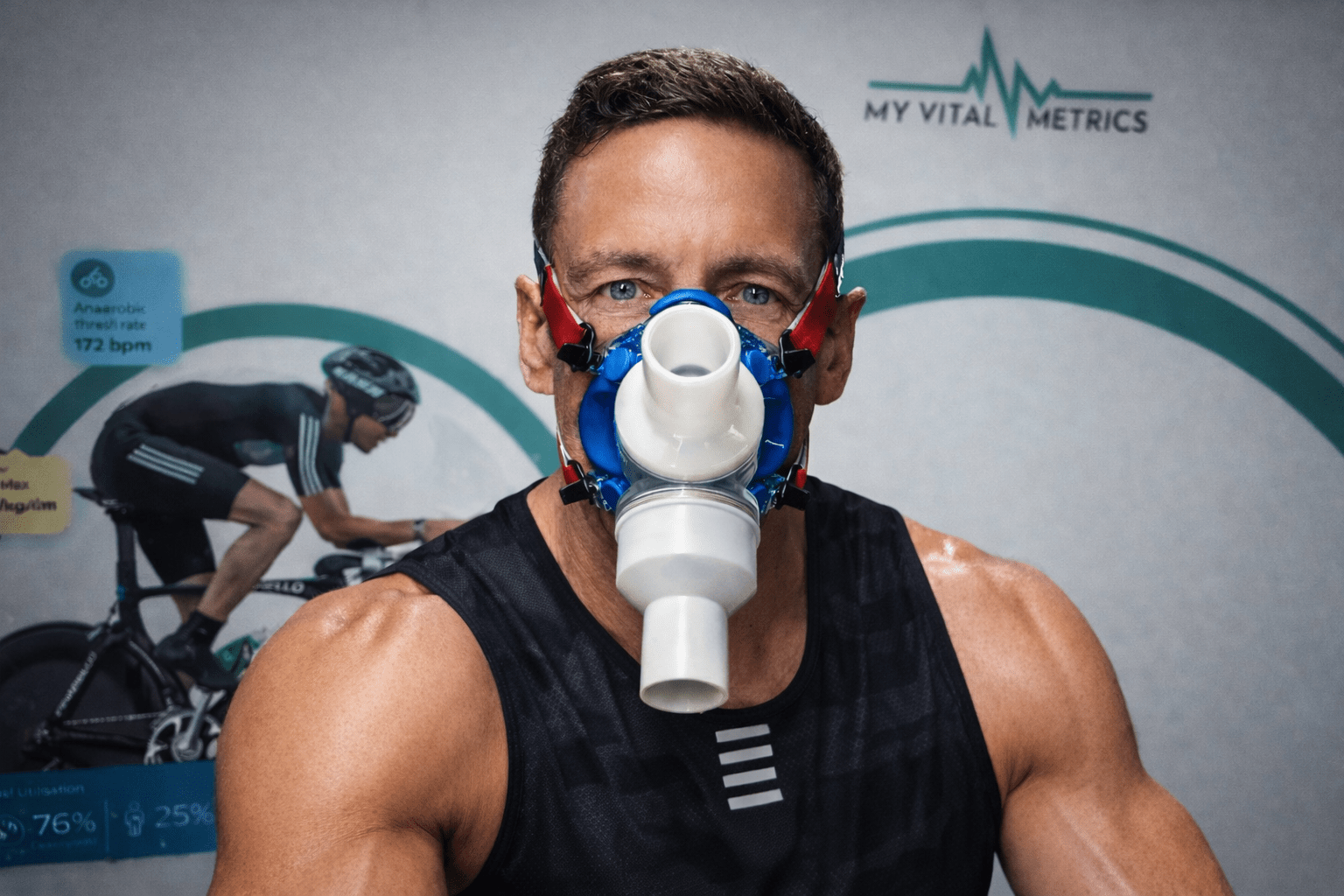
I’ve always done a lot of Zone 2 training. More by accident than design. Early mornings on an indoor bike, 90-120mins before the school run and going to the gym.
Sitting at 110-120bpm, usually watching something on TV to make the time pass, training at a level that avoids building lactate, muscles rely primarily on mitochondrial respiration, the oxygen-dependent process that burns fat efficiently and produces energy with minimal metabolic stress. Perfect when training fasted.
It became a bit of a joke, and not just amongst friends. Zone 2 training was the tag given to any training that wasn’t hard. But it turns out it’s hugely beneficial.
Peter Attia talks a lot about it, specifically as one for the core pillars for fitness.
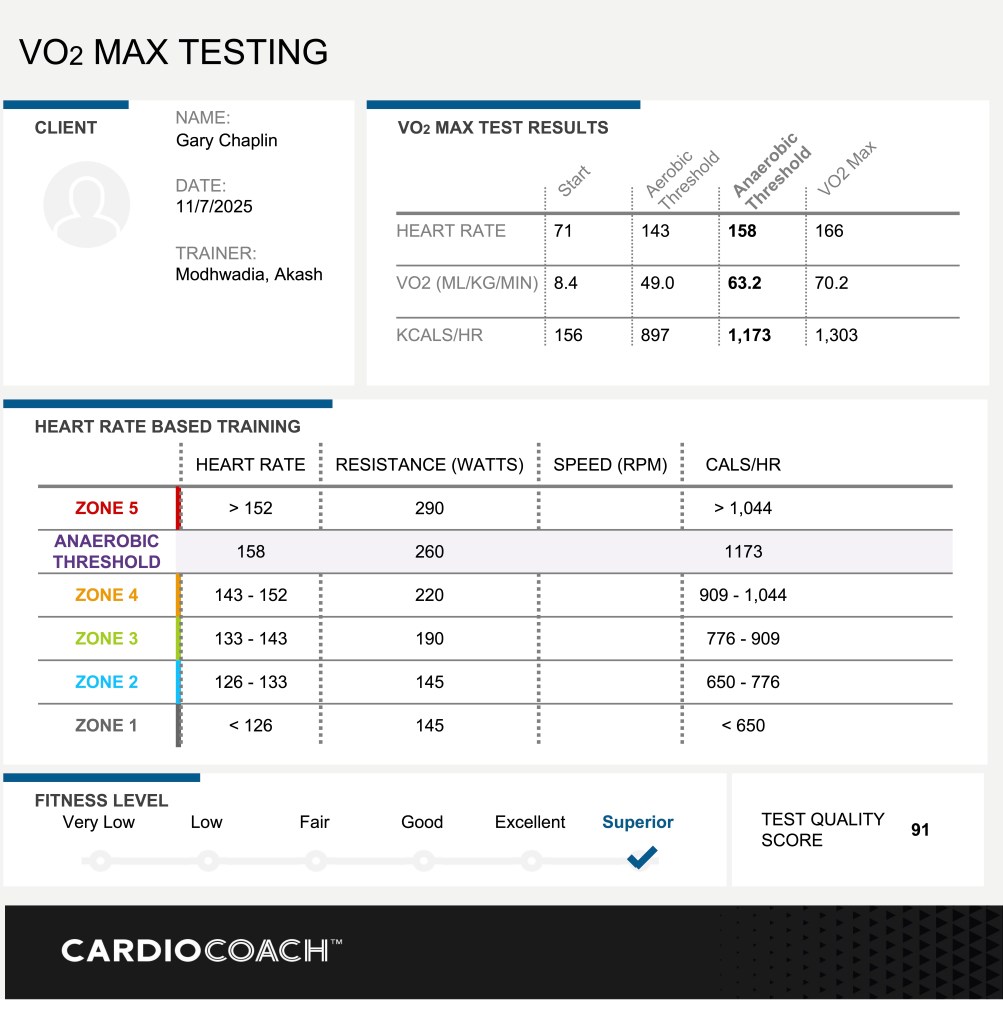
Then I did a VO2 Max test. A average score for my age would be mid-30s (ml/kg/min). Very good would be early-40s. Anything above 60ml/kg/min would rank me as an elite athlete.
My score was 70.2ml/kg/min.
I was staggered, then the doctor who tested us asked about my training. As soon as I mentioned the ‘Zone 2’ he just stopped. “Thats it”.
It meant my cardiorespiratory system was extremely strong.
Modern fitness culture, and Instagram, has trained us to equate progress with suffering. Breathless intervals, punishing circuits, red-lined heart rates, these are the sessions that feel productive. If it hurts, it must be working.
Yet the longer you stay in training, whether you’re 25 or 65, the clearer a different truth becomes. The workouts that build the most durable fitness are rarely the most dramatic. They are the ones that quietly strengthen the systems that keep you capable, resilient and metabolically healthy for decades.
This is where Zone 2 training enters the picture, not as a trend, but as a re-orientation of how we think about endurance, health and longevity.
Zone 2 is not glamorous. It doesn’t leave you sprawled on the gym floor. But it may be the single most powerful form of exercise for sustaining performance, protecting longevity/healthspan, and extending the years you can live actively and independently.
A New Way to Think About Fitness
For athletes, fitness has always been about performance. For most of us, however, fitness is really about something else: capacity.
Capacity to work.
Capacity to recover.
Capacity to adapt.
Capacity to age well.
That capacity depends less on how hard you can push today, and more on the health of a microscopic network inside your muscles, the mitochondria. These cellular power plants govern how efficiently you produce energy, how flexibly you use fat and carbohydrate, and how resilient your metabolism remains under stress.
Zone 2 training is the most reliable way we know to protect and expand that system.
What Zone 2 Really Is (and What It Isn’t)
Ask ten people to define Zone 2 and you’ll get ten answers: heart-rate percentages, coloured bands on a watch, vague descriptions of “easy cardio.” Most of these miss the point.
Zone 2 is not a number.
It is a metabolic state.
Specifically, it is the highest level of effort you can sustain without a net accumulation of lactate in the blood. At this intensity, your muscles rely primarily on mitochondrial respiration, the slow, oxygen-dependent process that burns fat efficiently and produces energy with minimal metabolic stress.
Once intensity rises above this threshold, the body increasingly turns to faster, less efficient systems that generate lactate faster than it can be cleared. That shift is useful for performance and power. But it does not build the same foundation of metabolic health.
In simple terms:
- High intensity trains speed and power.
- Zone 2 trains endurance and efficiency.
Longevity depends far more on the second than the first.
Why Mitochondria Matter More Than Muscles
We often talk about fitness in terms of muscles, lungs and hearts. But the deeper story is cellular.
Mitochondrial health is now recognised as central to:
- insulin sensitivity
- metabolic flexibility
- inflammation control
- cardiovascular resilience
- and even the biology of ageing itself
Declining mitochondrial function is a feature of ageing, but it is also a feature of sedentary living. The two compound each other.
What makes Zone 2 training so powerful is that it addresses both. It slows the age-related decline and reverses the inactivity-related loss. And unlike many health interventions, its benefits compound quietly over time.
This is why clinicians increasingly describe Zone 2 not as fitness training, but as metabolic maintenance.
The Paradox of “Easy” Work
One of the biggest barriers to embracing Zone 2 is psychological. It feels too easy to matter.
You are not gasping.
You are not drenched.
You are not crushed.
And yet, beneath that calm exterior, the adaptations that matter most for long-term health are taking place: increased mitochondrial density, improved fat oxidation, greater aerobic efficiency, enhanced insulin sensitivity.
Elite endurance athletes understand this instinctively, they spend most of their training time well below maximal effort. What is new is the recognition that the same approach may be even more valuable for the general population.
Not because we all want to race.
But because we all want to last.
How to Know You’re in Zone 2
In laboratories, Zone 2 is identified by lactate testing. In real life, that is interesting but not wholly necessary.
For most people, the goal is not precision but consistency, being in the right neighbourhood often enough to stimulate adaptation.
Three tools work well together.
1. Perceived exertion
If you can sing, you are below Zone 2.
If you cannot speak at all, you are above it.
Zone 2 is where conversation is possible but uncomfortable.
You could answer the phone, but you would rather not.
2. Heart-rate guidance
If you know your maximum heart rate, Zone 2 often falls around 70–80% of max HR, depending on fitness level.
If you don’t, a simple estimate to calculate your Zone 2 (using Phil Maffetone’s guide) is:
180 minus your age, adjusted slightly for conditioning.
For a 40-year-old, that suggests Zone 2 is around 140 bpm.
For a 60-year-old, closer to 120 bpm.
These are not rules, only reference points.
3. Common sense
Many wearables define Zone 2 too conservatively. If your watch says Zone 2 but you feel you could stroll all day, you are probably below the metabolic threshold that matters.
Why This Matters for Longevity
As we age, two changes become increasingly important:
- Aerobic capacity declines, and with it, independence.
- Recovery slows, making repeated high-intensity stress harder to tolerate.
This is why Zone 2 becomes disproportionately valuable in midlife and beyond. It allows you to build and maintain fitness without accumulating excessive fatigue or injury risk.
But its relevance is not confined to those over fifty.
Zone 2 is best understood as longevity training, not because it keeps you alive longer in isolation, but because it preserves the systems that allow you to live well as the years pass.
The earlier you build this base, the more protection you carry forward. The later you start, the more essential it becomes.
How Much Zone 2 Is Enough?
There is no universal prescription, but patterns from both clinical and athletic settings converge on a few principles:
- Two sessions a week may maintain fitness.
- Three sessions usually improve it.
- Four or five is ideal for long-term development.
Duration matters as much as frequency. While beginners benefit from shorter efforts, meaningful mitochondrial change tends to occur when sessions reach 45–90 minutes at a steady intensity.
That does not mean every workout must be long. But at least one longer session each week can dramatically accelerate adaptation.
Choosing the Right Modality
Zone 2 training works best when intensity can be controlled.
That makes some activities naturally suited to it:
Best choices
- stationary bike
- treadmill walking with incline
- stair climber
- steady outdoor cycling on flat terrain
Possible with experience
- rowing
- lap swimming
Less reliable
- trail running
- hiking on steep terrain
- team sports
The more variable the environment, the harder it becomes to stay in the metabolic “sweet spot” long enough to generate the desired effect.
Why “Almost Zone 2” Isn’t the Same
Many people assume that if a workout averages out to Zone 2, it counts.
Physiologically, it doesn’t.
Zone 2 training works because it creates a continuous signal to the mitochondria. Frequent spikes above the threshold generate lactate that interferes with fat oxidation and blunts that signal.
A steady 60-minute Zone 2 session is not equivalent to a 60-minute workout that includes only intermittent time in that zone. Consistency of intensity matters as much as total time.
Where Zone 2 Fits in a Complete Programme
Zone 2 is not a stand-alone solution. It is the foundation.
For long-term health, four elements matter:
- Stability and balance
- Strength and muscle mass
- Aerobic efficiency (Zone 2)
- Peak capacity (VO₂ max)
Zone 2 builds the base of the pyramid.
High-intensity work sharpens the peak.
Strength stabilises the structure.
Neglect any one, and the system weakens.
Zone 2 and High-Intensity Training: The Right Relationship
A common fear is that slow training will blunt fast gains. In reality, the problem is not mixing intensities, it is mixing them poorly.
High-intensity work performed before Zone 2 raises lactate and compromises mitochondrial signalling. High-intensity work performed after a Zone 2 session does not negate its benefits, provided the session then ends.
For most non-athletes, a sustainable pattern looks like this:
- Zone 2 as the core of endurance training
- One or two high-intensity sessions per week
- Strength work on separate days or later in the day
The aim is not to exhaust the system, but to stimulate it intelligently.
Nutrition, Hydration and Medications
Zone 2 training reflects how the body uses fat and carbohydrate. That means context matters.
Training after a carbohydrate-heavy meal suppresses fat oxidation. Training after a few hours of fasting often produces a clearer metabolic signal. Hydration status influences blood volume and therefore aerobic performance.
Medications can complicate heart-rate guidance:
- Beta-blockers lower heart rate.
- Beta-agonists raise it.
In both cases, perceived exertion becomes the most reliable guide.
The Great Misunderstanding: Fat Loss
Zone 2 is often sold as a fat-burning strategy. That framing undersells its value.
While Zone 2 improves fat oxidation, it has only modest direct effects on body composition compared with resistance training or dietary change. Its real benefit lies deeper: metabolic flexibility, the ability to switch efficiently between fuels, resist insulin resistance, and maintain energy across long days and long years.
Think of Zone 2 as training the engine, not reshaping the bodywork.
What a Sustainable Week Might Look Like
For someone training for long-term health rather than competition:
- 3–4 Zone 2 sessions
- 2 strength sessions
- 1–2 short high-intensity efforts
- daily low-level movement
But crucially, the best programme is the one that fits into real life and can be repeated not for weeks, but for years.
Why This Matters More With Age, But Matters to Everyone
Zone 2 training becomes especially valuable after 50 because it allows people to continue building fitness without accumulating excessive wear and tear. It protects aerobic capacity, supports recovery, and reduces injury risk, all crucial as resilience naturally declines.
But its relevance is universal.
If you care about:
- staying sharp at work
- maintaining energy through long days
- ageing without surrendering independence
…then Zone 2 belongs in your life.
Not as a retreat from intensity.
But as the foundation that makes intensity sustainable.
Final Thought: The Quiet Power of Patience
High-intensity training delivers excitement.
Zone 2 delivers insurance.
Its effects are not dramatic at first. They are cumulative, compounding, almost invisible, until one day you realise that you can still do the things others quietly stop doing.
Climb hills.
Recover quickly.
Travel without fear.
Live actively, not cautiously.
In a world obsessed with speed, Zone 2 reminds us that the most powerful form of fitness is not about how hard you can push, but about how long you can keep going.
And in the long game of health, that may be the only metric that truly matters.
Other Fitness / Wellness / Healthspan Subjects:





Comments? Suggestions? Anything else you’d like to see?


The Negroni Files






The Best Negronis in…..






Hotels
Check out my thoughts on some of my favourite hotels










 garychaplin.com