What’s Twitter Worth (to you?)….Spoiler: More than you think!
Posted on October 14, 2014 13 Comments
Twitter is everywhere. Individuals and businesses alike herald it as one of the best engagement/communication/collaboration/information sources around.
But what is it worth? And is it worth your time invested?
As of today, Twitter is worth $31.3bn, increased from $24bn on IPO last year (but down from $44bn earlier this year). With 271m active monthly users (source: Twitter), that’s $115 per user.
But what is Twitter worth to you? More or less than $115 (£70)? …and what is Twitter to you?
This whole blog came from laying by the pool on holiday, over summer. Our daughter  was in the kid’s club and we were enjoying the rare day’s opportunity to switch off and lay by the pool.
Now days off when you run a small business aren’t really days off, you still have to keep a casual check on things, so I will always check emails every hour or two – my premise being that spending 2 minutes ensuring everything is fine means I can truly switch off for a couple of hours.
Flicking through my phone whilst my wife read, both laid in the sun, I got a sarcastic comment about being on my phone. My defence of “it’s business”  was countered with “but you’re on Twitter”…
“Twitter IS business” was my retort, at which point she went back to reading ‘A Widow’s Guide to Sex & Dating’ by Carole Radziwill (I’m assured it’s fiction, not an instruction manual).
But it got me thinking…. What is twitter worth to MY business?
I lay back and systematically worked through all the businesses I had won/done/completed in the year to date. That was June. My year to date had been just over £110k invoiced. What impact had Twitter had? The results staggered even me. Only one piece of business was NOT directly or indirectly because of Twitter (instead coming from a long standing contact). Twitter was worth, to me, £100,000 in c6 months alone.
Three months on and that metric has been near maintained, but more dramatically so. 2 roles have been picked up from long standing contacts, all the remainder, in a busy summer, could be attributed to Twitter. But this now includes even more from previously unknown, never before met contacts.
What about the previous year, my first year? My first year’s turnover was, as you would expect for a first year, a lot leaner. Months of waiting for covenants to expire, start-up momentum and invoice delays waiting for notice period’s to wane at the end of processes meant that my full year turnover was less than my Yr2 H1 turnover – but how much had Twitter impacted that? Less dramatic than Yr2, but still almost 50% coming from Twitter, the larger proportion coming from my own existing contact base (itself now being added to, dramatically, with contacts made through Twitter).
How?
The ways in which Twitter wins business is varied. The two most common routes are relationships that originated from Twitter, or that originate from introductions via people known/met through Twitter. Those relationships still have to be nurtured and developed, but the Social Media site has been the catalyst.
However, two pieces of work concluded and three more under-way, and one currently being pitched for have come directly through approaches from Twitter.
Equally effectively is Twitter’s ability to source candidates/executive Talent. I get dozens of candidates applying to the roles I post on my website after promoting them on Twitter (but doing so humanly, not just a blind list of #JOBS).
Furthermore, I will get 5-10 approaches per day from execs/candidates wanting to ‘stick their toe in the water’ in getting a new role. Twitter has made me a ‘go to’ person for career advice.
First steps
It is 4 years since I first looked at Twitter. My then employer was skeptical and, as many, saw it as a great (potential) business risk with no obvious upside – an opinion shared by many.
I immediately entered the world of tweeting as a business tool. I shunned having my own name and instead made my ‘handle’ descriptive of my profession – @GC_HeadHunter.
The first lesson you learn is that it is a slow start. I took the strategy of listening and observing some of the regular/respected users for six months to understand how they used it, benefitted from it and thus develop my own style, approach and strategy.
Very quickly I realised that it humanised every person I followed and whose style/strategy I wanted to emulate. The Social in Social Media was the key. They also informed and shared knowledge rather than preached….engaged rather than sold. They became, to me, thought-leaders. Through their styles, I built respect for them, wanted to engage with them. Without even meeting them, I trusted them.
It took me 4 months to break through 50 followers. Then a year to get to 500, then a further 3 months to get to 1,000. I now sit at a still modest 4,500, but even that network gave me 69,900 ‘impressions’ and almost 1,500 interactions in the last week alone [w/e 10.10.14 – via Dan at Great Marketing Works]
More importantly, that network has fuelled my business to the extent that in coming up two year in business, I have still not made a ‘Business Development’ call. Imagine that – a recruitment business that has been working at (over) 100% capacity that has never made a DB call. A generation of 90s Recruitment business owners are turning in their career grave.
The whole process harks back to my marketing degree lectures. “Don’t sell to your customers. Get them to buy from you”. That was 20years ago, before the notion of Social Media was a glimmer in the internet’s eye.
Engage, don’t sell.
You have to approach Twitter (or the Twittershere/Twitterverse) in the same way you would a cocktail party or a networking event. You engage; You interact; You show interest in others peoples’ lives; You converse; You get to know the people you meet……
……You do not solely talk about what you do…..You to do not just turn up for 1% of the event then proclaim it doesn’t work…..and you would not walk into such an event, go up to the first person you meet and launch into “My name’s XXXXX, I run training courses and if you agree to use me right now I’ll give you 20% off”
And yet so many businesses/people do just that on Twitter. So many will just sell, just talk at their audience and just stick a list of personality devoid sales messages.
Instead, you need to be interesting, be engaging, be human – just as you would at a physical business introduction.
Twitter Vs LinkedIn
LinkedIn was always seen as ‘The Business One” of social media. But not anymore. LinkedIn is dramatically losing it ability to promote engagement, its getting too big and is just, really, a large database. I have almost twice the connection on LinkedIn that I have on Twitter, built up over twice as long, and yet the impact on my business is tiny.
It is good at candidate generation – 4 of this years role have had shortlisted candidates that have been sourced through promoting roles on LinkedIn (compared with 7 on Twitter). Twitter, done right, is a far superior business generation tool, because it promotes engagement!
When asked, a selection of my Twitter followers voted 70/30 in favour of Twitter (LinkedIn followers voted 80/20 in favour of LinkedIn)
My Rules/My Tips:
Be Human. People buy from People.
I very quickly followed a basic 80/20 rule. 80% ‘Business’/20% ‘Personal’. Many people run two accounts – a personal and a business. For me, I am me. People who follow me, know me – the real me, not a corporate persona. They know everything about me. My family; My passions; My politics; My motivations; My opinions; My Life. Marketers talk about Brand Engagement, but the truth is, people would rather interact with real people.
The biggest Social complement I frequently get paid on meeting someone is “You are authentic, exactly as I thought you would be from knowing you on Twitter”.
Engage…it’s not all about you!
For Twitter to be really beneficial you have to engage. Without engagement, Twitter is an egotistical mouthpiece or merely a voyeur information tool. You will never get to know people by only listening to them, or only talking at them. Too many businesses use their Twitter output as a one-way pipe without any attempt to engage with their audience (aka, their customers). Think of Twitter as being like a party – you can RSVP, but you actually have to turn up and get involved to get something from it.
Don’t be Beige….Be Different
From your profile picture to your output, stand out. Be different. Just as with real-world networking, if you stand in the corner not talking, you’ll not make any connections. Stand up, be noticed, rock the boat. Don’t play it too safe, you don’t have to be conventional to succeed on Twitter. Your opinions may be counterintuitive and/or controversial, but as long as you present them in an intelligent and articulate manner, you will make your Twitter world more interesting.
Be Open. Be Authentic.
I’ve always been an open, ‘heart on my sleeve’ individual. That demeanour comes across on Social Media. Know and relay what you stand for; Know and relay how you spend your time; Know and relay what your ‘why’ is. As Phil Jones has said to me: “If you don’t know your within, you go without”
Be Positive.
Don’t use Twitter to whinge. Yes you have to be authentic, but you do have to promote the appropriate image for your business/objectives. Be the person that people want to learn from and engage with. Just as when you first greet someone in a day, be energetic, be upbeat, be enthusiastic.
Understand your aims.
Twitter to me was initially a conduit to the drive traffic to a website. I then quickly realised my twitter account was a platform in it’s own right, performing an omni-channel structure with the corresponding website. To me, and to most, Twitter is low-level PR. It informs the world you are there, what you stand for and gives in insight into you as a person, a business and a potential partner.
Be informative; Be a Thought Leader.
It is important to underpin your profile with ‘thought leadership’. Tweet content is great, but for real insight, you need to go beyond 140 characters. Blogs are a great way of putting your opinions forward and detailing what you stand for. All thought leaders are also bloggers. It isn’t a co-incidence.
Share content.
…but to follow the above, Spread the Love. Don’t just promote your own content….Mix it up with other peoples content and opinions. Share blogs, share articles. The subject and tone (and your comments) help mould what people see in you and think of you. Just make sure you attribute the author – do it well, and that will provide further engagement.
Sell but don’t Sell.
Twitter is not a licence to spam. Use Twitter to introduce your business/yourself to potential customers, but do so with the intention of getting them to engage with you and buy from you. Remember the adage of walking into a dinner party, you wouldn’t immediately launch into a sales-pitch with the first person you meet.
Dress to Impress
Remember the First Impressions blog? Same thing with your Twitter profile, daily. You will ‘meet’ people, your potential customers, everyday. Remember that your Twitter presence is, and needs to be, an extension of your brand.
DIY
Social Media has to be SOCIAL above being MEDIA. My advice is to do it yourself. Agencies can do it for you, alongside doing dozens of others, but if you want to engage with people, as a person, let your personality shine though – do it personally.
Commit the time.
Twitter doesn’t have to be time intrusive. The only defined time I spend on twitter is 10-15 minutes first thing in the morning planning, and scheduling tweets. The rest of the time is opportunistic, using dead time in coffee shop queues, waiting on hold, or just reacting to something in your life. The benefit of 140 characters is that it doesn’t take long to write it.
Don’t give up.
Using Twitter as part of your commercial strategy is not a quick win. You will need to give it time, you will need to keep at it. A timeline not updated for a month can sell against you.
Accept the detractors.
You’ll get plenty of detractors, plenty of people that will denigrate what you do on Twitter – such is life on a public platform. I get them weekly. Ignore and remember it’s done through ignorance, and often envy.
Have Fun!
Enjoy the social interaction, the information gathering, the creativity and the development of your social network. If you do, it will be obvious. And magnetic.
My current year & the impact of Twitter
PR Agency – Operations Director.
Direct approach from Twitter follower
Technical Consultancy – Managing Director
Introduction/Recommendation from Twitter follower
Polymer Compound Manufacturer – International Business Director
Met CEO on Charity Bike Ride, but re-introduced by Twitter follower
PE-Backed NanoTech Group – NED Chairman
Introduction from Twitter follower
Marketing & Events Agency – Client Services Manager
Direct approach from Twitter follower plus placed candidate is Twitter follower
Retail – Chief Operations Officer
Introduction via contact first met through Twitter
Property Management – Operations Director
CEO first introduced via Twitter
Retail – Trading Director
Pre-Existing Client, initially met through Twitter
Retail – CRM Director
Pre-Existing Client, but role triggered due to tweeted blog plus placed candidate is Twitter follower
Omni-Channel Retail – Marketing Director
Introduction via contact first met through Twitter – placed candidate is Twitter follower
Biological Testing Group – Managing Director
Recommendation from Twitter follower
Consumer Finance Group – Customer Relations Director & Finance Roles
Introduction from Twitter follower turned contact
High Street Retail – Senior Category Manager
Long-term client, introduced via Twitter contact. Placed candidate from Twitter
Construction Group – Business Development Director x2
Personal contact but one placed candidate is Twitter follower
Twitter impact on current Live Roles
Managing Director (Marketing Agency)…. £80-100k + Equity
Introduction from contact first met through Twitter
Trading Director (High Street Retail)…. £90-£130k + Package
Long-term client, introduced via Twitter contact. Half of LongList is from Twitter
Director of Custom Fabrication…. £100k + Package
Direct approach from Twitter follower
Sales/Marketing Director (Sports Nutrition)…. £80-100k + Package
Introduction from contact first met through Twitter
Retail Operations Director (High Street)…. £80-125k + Package
Introduction from contact first met through Twitter
Sales/Marketing Director (Fashion Label)…. £80-100k + Package
Long-Term contact, placed into role gain through Twitter
Commercial Sales Director (Professional Electronics/AV)…. £75k + Package
Direct approach from Twitter follower
Senior Finance Analyst (Technology Group)…. £50-60k + Package
Direct approach from Twitter follower
Follow ME on Twitter: @GC_HeadHunter!
Recruitment Lessons from The Savoy
Posted on September 29, 2014 22 Comments
We are lucky enough to have just enjoyed a weekend at The Savoy in London, to celebrate my wife’s Birthday. Of all the uber-premium hotels in London, The Savoy ranks high on anyone’s list, especially after a £220m refurbishment ready for it’s 125 year anniversary this year. Coupled with arguably the coolest list of former guests of  any hotel, the place has the very best of reputations.
3 days there and it’s clear that reputation is truly well deserved. We were fortunate to enjoy a 6th floor suite with views over The Thames and The Shard beyond. Every aspect was as near faultless as I have ever seen. Small touches to huge features – all designed to offer the best surroundings possible.
But there is more than just the quality of the Art Deco building and fittings you are surrounded by, more even than following in the wraithlike footsteps of Monet & Whistler, through Edward VII to Sinatra, Monroe, Hitchcock, Chaplin (Charlie!), Hepburn, Olivier, Chanel & Brando. And yet the real difference is almost ethereal.
The difference is the people. Sat having breakfast each morning, with the unusual ![We are lucky enough to have just enjoyed a weekend at The Savoy in London, to celebrate my wife’s Birthday. Of all the uber-premium hotels in London, The Savoy ranks high on anyone’s list, especially after a £220m refurbishment ready for it’s 125 year anniversary this year. Coupled with arguably the coolest list of former guests of any hotel, the place has the very best of reputations. 3 days there and it’s clear that reputation is truly well deserved. We were fortunate to enjoy a 6th floor suite with views over The Thames and The Shard beyond. Every aspect was as near faultless as I have ever seen. Small touches to huge features – all designed to offer the best surroundings possible. But there is more than just the quality of the Art Deco building and fittings you are surrounded by, more even than following in the wraithlike footsteps of Monet & Whistler, through Edward VII to Sinatra, Monroe, Hitchcock, Chaplin (Charlie!), Hepburn, Olivier, Chanel & Brando. And yet the real difference is almost ethereal. The difference is the people. Sat having breakfast each morning, with the unusual luxury of having time to reflect as a family, no pressing appointments/engagements/business/ballet classes to cloud our minds, we were able to observe, reflect and engage with the myriad of people serving us. People whose attention was second to none, but who had a presence that was virtually none-existent. From the second we arrived under the world famous Savoy Stainless-Steel sign (added to the hotel in 1929, one of the first ever uses of Stainless Steel along with the Chrysler Building in New York), we were greeted by doormen and concierges before being passed over to one of the welcoming hosts, before in turn being passed over to our private butler. The personalities and levels of service were impeccable, but it was the whole demeanour and aura of every single person that struck the chord. Likewise in all the bars, restaurants and even those just present in general areas; the standard of employee was unlike any I have seen. Some were interns, some had travelled around the world just to take up the job. Some were still at college, some were months away from retirement. Some had been there less than 2 weeks, some had been there (significantly) more than 2 decades. We got talking to one of our breakfast waiters about his induction and the level of training he received. Most premium hotels we have stayed in will place new recruits onto intensive training programs to ‘turn them into’ the nature of employees they, and their customers expect. Our favourite hotel in Edinburgh, the overtly opulent Prestonfield, where we not only got married but have spent countless birthdays, anniversaries and Christmases since, takes great pride in ensuring that every new recruit is fully ‘Prestonfield-ed’ and approved by owner James Thompson before they are let loose on guests. We were staggered then that our breakfast waiter told is that he was literally thrown in at the deep-end (resplendent in his freshly provided tailcoat) on his very first shift despite no previous hospitality-sector exposure, straight into serving breakfast (at £70 per couple)…..before the top-pressure serving of The Savoy’s famous Champagne Afternoon Tea (£138 per couple). That story was replicated by the young lady that served our afternoon tea, and again by our dinner waiter in the Savoy’s riverfront restaurant, Kasper’s (who also also took the time to explain the legend of Kasper the Cat [see below for details]…and then bring our daughter a soft-toy Kasper of her very own to keep). Our butler had the same tale of his introduction to his Savoy career…etc. On our last morning, the hotel’s ‘Thames Foyer Manager’, Rajat Sabharwal came over to thank us and ensure everything had been satisfactory – once again with perfect customer engagement skills. We took the opportunity of asking about their ability to attract, recruit and retain such class leading talent, and ‘let them loose’ with no real training. He spoke of just one skill – their ability to recruit and select staff that were intrinsically the right fit for The Savoy. Even where the individual has no relevant experience, or if there are no roles in the area for which they have applied; if they ‘fit’, they are offered employment. Their process was thorough, 2 or 3 meetings, various psychometric profiles and a number of ‘taster’ days, where selected recruits got to see the service levels The Savoy expects. All this on hospitality staff that are interns and/or paid minimum wage. The strength and power of this process is abundantly evident. Every single team member is outstanding, so much so that my 5 year old daughter spent much of the taxi journey back to Euston station in tears as she was already missing “all the wonderful people she had met”. Staggering then that businesses in all sectors take a significantly less serious approach to recruitment of their key members of staff, especially at management, senior management and executive levels. Equally staggering that so many HeadHunters focus exclusively on skills and experience, all but ignoring personality and chemistry fit in favour of needless formality and ‘control’ in a process. With few exceptions, businesses structure interviews to be more formal than the usual working environment. First interviews typically conducted in a closed office, over a desk, a very one-sided interrogation of the individuals career-to-date and experience in the quest for the interviewer to cross-examine the interviewee and contrast answers given with the supplied CV, that the interviewee is discouraged from having in front of them. Even modern competency-based techniques are one sided and interrogatory. “Tell me…”, ‘Give me….”. Little wonder that interviewees are overcome by nerves, or do not give a good account of themselves with such a defensive and intimidating situation. And yet…..on the basis of such a one-sided, formulaic, impersonal interrogation, majority of the interviewees will be rejected, usually citing ‘fit’ as the reason. Some businesses will blindly assume that because they have engaged a recruitment business, or a headhunter, or worse still used a web-based selection tool/database (wittingly or unwittingly), the cultural assessment/selection has been made. Seldom the case. Client pressures on time & cost have turned the majority of contingent/database recruiters into CV-factories where, in a competitive environment, CVs are sent simply as soon as possible. Even those few recruiters that do meet all candidates will seldom really take the time to get to know the individuals on their databases so as to assess the fit with each different client company, and will still be more focused on ensuring they send CVs before their competitors. This is where retained executive search comes in; Or should do. Each candidate subjected to a specific criteria-based interview designed for that specific recruitment process. And yet, majority of Search Consultants/HeadHunters will adopt that similar personality-devoid assessment. A formal (usually overly formal) interview, in an office, in an intimidating environment again focusing on just skills, experience, the ‘whys’ and ‘whens’ of the individual’s career moves. The interviewer sat in a suit, protected in their kingdom behind a desk, often a boardroom table for maximum intimidation. They may throw in a half-hearted “Tell me about you away from work” style question in the last 5 minutes of an interview, but the truth is, the decision has already been made. Others may introduce a Psychometric Profiling exercise, or a ‘lunch’, but only after the experience/skills interrogation has been concluded and potentially filtered out those great fits. Sad fact is, majority of interview and selection processes work against understanding chemistry fit, focusing solely on backgrounds and skills/experience. Almost everyone we spoke to at The Savoy that surpassed even the high expectations we had would have failed selection processes based on background and experience – indeed many had been rejected from positions with other, lesser hotel chains. Businesses neglect Chemistry Fit at their peril. Virtually every great hire is great because of their attitude, their personality…..their chemistry fit. Assessing this is very easy. Turn your recruitment process into a less formal, more human based structure. Start the selection process with a conversation. Choose a less formal, less intimidating environment. Understand the person’s fit. Get that right and, within reason, the skills and experience becomes academic. …..however, ignore that chemistry fit and you risk recruiting Kasper. Great at making up the numbers, but not much else. The Legend of Kaspar the Cat. The story begins in 1898 when Woolf Joel, a South African guest at the hotel, gave a dinner party to which only 13 were able to attend. He laughed off the old superstition that tragedy would fall upon the first guest to rise from such a gathering, and so the dinner continued. His friends' fears were soon justified, when Woolf was fatally shot following his return to Johannesburg. After this incident, the hotel always provided a Footman if a party had 13 guests to balance the number. However, as some of the dinner conversations were often of a confidential nature, Kaspar (a 3 foot high ‘wooden-eared’ black cat scuplture, made by Basil Ionides in the 1920s from a single piece of London Plane tree.) was conceived to become a convenient 14th guest, a tradition which remains to this day (Kaspar can be seen in a glass cabinet just of the main lobby area, when he is not dining). When hosts find their private dinner parties attended by the unlucky number of 13 guests, they can request the pleasure of Kaspar's company as the "14th guest." The handsome cat is seated in a chair, draped with a dinner napkin, and is served each course as though he were one of the diners.](https://garychaplin.com/wp-content/uploads/2014/09/img_7676.jpg?w=112&h=150) luxury of having time to reflect as a family, no pressing appointments/engagements/business/ballet classes to cloud our minds, we were able to observe, reflect and engage with the myriad of people serving us. People whose attention was second to none, but who had a presence that was virtually none-existent.
luxury of having time to reflect as a family, no pressing appointments/engagements/business/ballet classes to cloud our minds, we were able to observe, reflect and engage with the myriad of people serving us. People whose attention was second to none, but who had a presence that was virtually none-existent.
From the second we arrived under the world famous Savoy 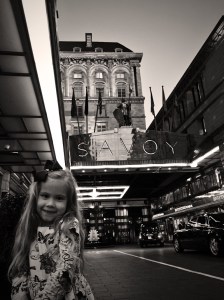 Stainless-Steel sign (added to the hotel in 1929, one of the first ever uses of Stainless Steel along with the Chrysler Building in New York), we were greeted by doormen and concierges before being passed over to one of the welcoming hosts, before in turn being passed over to our private butler. The personalities and levels of service were impeccable, but it was the whole demeanour and aura of every single person that struck the chord.
Likewise in all the bars, restaurants and even those just present in general areas; the standard of employee was unlike any I have seen. Some were interns, some had travelled around the world just to take up the job. Some were still at college, some were months away from retirement. Some had been there less than 2 weeks, some had been there (significantly) more than 2 decades.
We got talking to one of our breakfast waiters about his induction and the level of training he received. Most premium hotels we have stayed in will place new recruits onto intensive training programs to ‘turn them into’ the nature of employees they, and their customers expect. Our favourite hotel in Edinburgh, the overtly opulent Prestonfield, where we not only got married but have spent countless birthdays, anniversaries and Christmases since, takes great pride in ensuring that every new recruit is fully ‘Prestonfield–ed’ and approved by owner James Thompson before they are let loose on guests.
We were staggered then that our breakfast waiter told is that he was literally thrown in at the deep-end (resplendent in his freshly provided tailcoat) on his very first shift despite no previous hospitality-sector exposure, straight into serving breakfast (at £70 per couple)…..before the top-pressure serving of The Savoy’s famous Champagne Afternoon Tea (£138 per couple).
That story was replicated by the young lady that served our afternoon tea, and again by our dinner waiter in the Savoy’s riverfront restaurant, Kasper’s (who also also took the time to explain the legend of Kasper the Cat [see below for details]…and then bring our daughter a soft-toy Kasper of her very own to keep). Our butler had the same tale of his introduction to his Savoy career…etc.
On our last morning, the hotel’s ‘Thames Foyer Manager’, Rajat Sabharwal came over to thank us and ensure everything had been satisfactory – once again with perfect customer engagement skills. We took the opportunity of asking about their ability to attract, recruit and retain such class leading talent, and ‘let them loose’ with no real training. He spoke of just one skill – their ability to recruit and select staff that were intrinsically the right fit for The Savoy. Even where the individual has no relevant experience, or if there are no roles in the area for which they have applied; if they ‘fit’, they are offered employment.
Their process was thorough, 2 or 3 meetings, various psychometric profiles and a number of ‘taster’ days, where selected recruits got to see the service levels The Savoy expects. All this on hospitality staff that are interns and/or paid minimum wage. The strength and power of this process is abundantly evident. Every single team member is outstanding, so much so that my 5 year old daughter spent much of the taxi journey back to Euston station in tears as she was already missing “all the wonderful people she had met”.
Staggering then that businesses in all sectors take a significantly less serious approach to recruitment of their key members of staff, especially at management, senior management and executive levels.
Equally staggering that so many HeadHunters focus exclusively on skills and experience, all but ignoring personality and chemistry fit in favour of needless formality and ‘control’ in a process.
With few exceptions, businesses structure interviews to be more formal than the usual working environment. First interviews typically conducted in a closed office, over a desk, a very one-sided interrogation of the individuals career-to-date and experience in the quest for the interviewer to cross-examine the interviewee and contrast answers given with the supplied CV, that the interviewee is discouraged from having in front of them. Even modern competency-based techniques are one sided and interrogatory. “Tell me…”, ‘Give me….”.
Little wonder that interviewees are overcome by nerves, or do not give a good account of themselves with such a defensive and intimidating situation.
And yet…..on the basis of such a one-sided, formulaic, impersonal interrogation, majority of the interviewees will be rejected, usually citing ‘fit’ as the reason.
Some businesses will blindly assume that because they have engaged a recruitment business, or a headhunter, or worse still used a web-based selection tool/database (wittingly or unwittingly), the cultural assessment/selection has been made. Seldom the case. Client pressures on time & cost have turned the majority of contingent/database recruiters into CV-factories where, in a competitive environment, CVs are sent simply as soon as possible, time being the sole focus. Even those few recruiters that do meet all candidates will seldom really take the time to get to know the individuals on their databases so as to assess the fit with each different client company, and will still be more focused on ensuring they send CVs before their competitors.
This is where retained executive search comes in; Or should do. Each candidate subjected to a specific criteria-based interview tailored around that specific recruitment process. And yet, majority of Search Consultants/HeadHunters will adopt that similar personality-devoid assessment. A formal (usually overly formal) interview, in an office, in an intimidating environment again focusing on just skills, experience, the ‘whys’ and ‘whens’ of the individual’s career moves. The interviewer sat in a suit, protected in their kingdom behind a desk, often a boardroom table for maximum intimidation. They may throw in a half-hearted “Tell me about you away from work” style question in the last 5 minutes of an interview, but the truth is, the decision has already been made. Others may introduce a Psychometric Profiling exercise, or a ‘lunch’, but again, only after the experience/skills interrogation has been concluded and potentially filtered out those great fits.
Sad fact is, majority of interview and selection processes work against understanding chemistry fit, focusing solely on backgrounds and skills/experience. Almost everyone we spoke to at The Savoy that surpassed even the high expectations we had, would have failed selection processes based on background and experience – indeed many had been rejected from positions with other, lesser hotel chains.
Businesses neglect Chemistry Fit at their peril. Virtually every great hire is great because of their attitude, their personality…..their chemistry fit. Assessing this is very easy. Turn your recruitment process into a less formal, more human based structure. Start the selection process with a conversation. Choose a less formal, less intimidating environment. Understand the person’s fit. Get that right and, within reason, the skills and experience becomes academic.
…..however, ignore that chemistry fit and you risk recruiting a Kasper. Great at making up the numbers, but not much else.

The Legend of Kaspar the Cat.
The story begins in 1898 when Woolf Joel, a South African guest at the hotel, gave a dinner party to which only 13 were able to attend. He laughed off the old superstition that tragedy would fall upon the first guest to rise from such a gathering, and so the dinner continued. His friends’ fears were soon justified, when Woolf was fatally shot following his return to Johannesburg.
After this incident, the hotel always provided a Footman if a party had 13 guests to balance the number. However, as some of the dinner conversations were often of a confidential nature, Kaspar (a 3 foot high ‘wooden-eared’ black cat scuplture, made by Basil Ionides in the 1920s from a single piece of London Plane tree.) was conceived to become a convenient 14th guest, a tradition which remains to this day (Kaspar can be seen in a glass cabinet just of the main lobby area, when he is not dining).
When hosts find their private dinner parties attended by the unlucky number of 13 guests, they can request the pleasure of Kaspar’s company as the “14th guest.” The handsome cat is seated in a chair, draped with a dinner napkin, and is served each course as though he were one of the diners.

Has the Elevator Pitch been replaced by the #TweetPitch?
Posted on March 3, 2014 7 Comments
Short is good. It’s been a life mantra of mine for years ever since my sub-5 foot Grandmother reminded me that “you don’t get diamonds as big as boulders”; …but brevity is becoming ever more important.
Modern life is more immediate. We no longer want to wait; immediacy is key. 25 years ago we would willingly wait for hours whilst a computer game loaded from a clicking and beeping C90 cassette. Nowadays if our broadband speed dips below 50mbps and an entire movie takes more than seconds to load we have convulsions.
I joked about the ‘playstation generation’ not understanding the concept of patience in my 2012 blog ‘What happened to the job for life’, but the truth is, it’s no joking matter. We crave information and understanding of every kind immediately.
We will no longer be prepared to wait for even early editions of newspapers to get our news as, thanks to the internet in general, and especially social media, we often hear the news before the journalists do. [which means newspapers have to either offer intelligent comment, or seek salacious content/scandal to gain bandwidth/circulation, but that’s a whole different subject matter….]
Witness how we search/Google. BIA/Kelsey predict that this will be the year when mobile device internet searches overtake desktop – more and more of us want that immediate information…..but that information has to be critically succinct. How many words will you read on your phone or tablet-based ‘google’ search to understand if you have your answer, or your quest for information has been satisfied?
Never has the need to be succinct more pressing than in business. The ability to transfer information, and importantly have that information understood, as quickly as possible is vital in the modern world.
Elevator Pitch
For decades, business execs and sales people have been taught ‘The Elevator Pitch”.  Even as recently as 2007 Bloomberg described it as “A skill every business-person needs.”
The Elevator Pitch is a succinct summary of the unique aspects of your service or product in a way that excites others. The notion being that should you find yourself in an elevator with your target client’s CEO, you should have the ability to detail who you are, what you are and why you are different in two minutes.
Execs were trained and timed on perfecting this 2 minute pitch, including maximum impact, maximum detail/product/service coverage and leave the audience wanting to hear more/ask questions.
The perfect Elevator pitch was the following:
Answer the question “What can you do for me?”
Introduce yourself and address a problem right out of the gate. Explain the benefits your company can offer, which is ultimately a real solution.
Make it easy to want to listen. Grab attention by mentioning competitors and market leaders that you work with. “If they are, why aren’t you?”
Leave them wanting more. Give brief details. Benefits you offer, not a tailored solution.
Have a call to action. Ask for the follow-up conversation/meeting.
Be natural. Talk, don’t lecture. Don’t over practice so it sounds pre-recorded. Have passion, but show some restraint. And relax!
I, and thousands of others, were trained and perfected in this technique. ….and yet, when I asked a number of newer generation client facing/business/sales professionals (i.e. 10-15 years younger than me) about the elevator pitch this week, very few had ever heard of it, let alone used it.
It’s a great tool to get across what you do….and for anyone that networks informally or formally, it’s a vital skill to be able to succinctly detail what you do.
…….but is even the 2 minute Elevator Pitch becoming passé?
In the world of immediacy, will you really give someone 2 minutes on a casual meeting? Unlikely. As with all things you need to grab attention quickly….you need to offer far higher impact.
The most common opener in any form of an initial professional meeting, event, introduction or encounter will be “What do you do?” When asked that simple question, most people will talk for a minimum of 30 seconds, often for well over a minute. Staggeringly, most will start the response with the word “Well, ……”. When was the last time meaningful, succinct information was communicated having begun that way?
Respondents will then give a version of an elevator pitch, but with content all about them. By the time they’ve finished, the listener has often been told nothing….and often has no desire to ask further!
Five Words
You need to be able to describe what you do in five words….or less. Whether responding to the question “What do you do” or opening a conversation. Five words maximum. Could you? Try it.
Now what do those five words tell a prospective client/contact/investor/supplier/customer? I asked three different people last week to tell me who and what they were within the magic five words. Their responses were:
“A Chartered Accountant”
“Public Company Director”
“Retail Operations Director for XXXXX”
The first two descriptions told me nothing. The first implied that the individual had sat and passed his ICAEW/ICAS exams some decades earlier. The second meant he fulfilled one of dozens of roles in a listed business of indeterminate sector/size/scale/etc.
The third told me everything, was a conversation starter and made me want to find out more.
Refine your five word introduction. You will be staggered at the impact it has.
My response to the question is simply “I’m a Head-Hunter”. It never fails to elicit further questions, yet I have heard dozens of my contemporaries respond to the same questions “(Well,….) I’m a Manager/Director for a recruitment business based in XXXXXXX, running a team of consultants focusing on the market, and….etc etc…”. The disinterest is commonly palpable.
Be innovative but be interesting. You want to make it impossible for listeners not to want to ask for more.
I asked 30 people to give me their five word summary. The results are amazing and inspirational (and funny….and giving you a great list of inspiring people to follow….). See the bottom of this blog for the list
Five word rule in recruitment.
The Five Word rule is also essential when you place yourself on the job market – the ultimate sales pitch. Being able to succinctly describe yourself to readers of your CV or interviewees will, without question, give you the competitive advantage.
I’ve gone on record to say that I will process between 100 and 150 CVs in an hour at the initial screen. That means that most CVs will get 15-20 secs before I place them in the ‘Yes’, ‘No or ‘Maybe’ pile (more proof of immediacy in modern business). That 15-20 seconds will be spent on name, location, reading the first line of a profile/summary and briefly reviewing the last 2 positions held.
When recruiting for an AsiaPac Polymer Compound Sales Director, CVs with the profile that began “Last XX years as a Polymer Industry Sales Director” got automatic inclusion into the next round. Those that began “An outstanding, visionary senior executive with broad commercial exposure and a class leading track record allied to astute strategic leadership capability…..blah blah blah” are more likely to get passed by.
The #TweetPitch
 However….regardless how effective and important the Five Word rule is, it is never going to replace the Elevator Pitch. Five words should be enough to detail what you do, but it is unlikely to be a pitch, nor open doors. You need just s little more. The Tweet Pitch.
For the non-tweeters amongst you – Twitter is the fast growing Social Media platform, IPO’d last year at a market value of $15bn on 7th November, and today sits with a market cap on $30bn. It has 700m users, 230m of whom use it regularly posting 500m ‘tweets’ per day. Ignore it at your peril. Check out my Twitter Feed here
It allows tweeters to converse, engage and post messages using a maximum of 140 characters. It has also become a highly effective business generation tool, and professional introduction vehicle – so much so that Twitter now stands as by far my most effective business generation tool outside of my own network – and certainly more in the last year than I have had in 10 years of Elevator Pitches.
Such an idea is immensely useful to be very focused about how you ‘sell’ your business. It expands the principle of the Five Word rule developing it from just description into an informative introduction. A pitch.
The ability to succinctly introduce your business using under 140 characters (or rather under 100 characters allowing for the tagging in of other party/ies) is a highly valuable tool. But not just on Twitter. Such brevity is extremely attractive to your customers, contacts and potential clients….on and offline:
Online, from your website(s) to your social media platform, especially on Twitter, the means of being able to get your message across (in an engaging, a non-direct sales manner) in 140/100 characters is a powerful tool, especially when highlighting your USPs. It is the same as the best advertising straplines you have seen – engaging, informative, setting yourself apart….eliciting customer follow-up.
….but equally importantly, offline. When meeting face-to-face, if you can get your message, your ‘pitch’, your USPs, your commercial advantage and most importantly your name across to your target audience quicker and with more impact than anyone else, you will win more. Simple.
Work on your sub-100 character tweet pitch(es).
Factual Message: “I’m a Head-Hunter. Recruiting for and into every seat around the boardroom table”
USP: “A headhunter, focusing on chemistry fit, guaranteeing the effectiveness with a 12 month guarantee”
Sales Message: “An Unparalleled Network of Exceptional Executives. Finding the people you didn’t even know existed”
We talk about innovating businesses, of disrupting sectors – do the same to the way you introduce yourself and talk about you business.
Short IS good!
Tweet me your #TweetPitch or your 5 word summary (include that hashtag and @GC_HeadHunter). I’ll put them all up here…..and let Manchester chose it’s favourites.
Manchester’s (and beyond) Elite chose their Five Word Summaries:
Phil Jones @PhilJones40 “Inspire people to be great”
James Welch @jameswelch_net “Innovative, relentless, honest network scientist”
Steve Kuncewicz @SteveKuncewicz “Applying law to real life.”
Dave Thackeray @DaveThackeray “I make people superheroes.”
Michael Di Paola @MichaelDiPaola “Help brands to genuinely standout”
Rionne Williams @rionnewilliams “Make grey marketing more colourful.”
Al Mackin @almackin “Son, Brother (in-law), Cronut Seeker, Rule-breaker (see word count)”
Holly Yates @hol_yates “Optimistic, creative, reliable, problem solver.”
Lauren Dale @Social_Lauren “JFDI”
C @RTSChants “I find and fill gaps!”
Hannah Swarbrick @HannahSwarbs “Create experiences and smiles!”
Dr Tara Swart @TaraSwart “Only one in the world”
Simon Calderbank @simoncalderbank “I help people make money.”
Richard Venables @Rich_Venables “Digital marketing not from 2008”
Steve Kennedy @wilmslowmail “I’m Steve, I DO things.”
Nick Moore @NickmNick “Gives businesses a profitable future”
Oli Randell @OliRandell “Enterprise Value creator for Businesses”
Emma Cottam @emmacottam “Slicker than your average”
Tom Cropper @TomCropper13 “Put logic back into logistics!”
Red House Farm @redhousefarm “Making kids parties real fun!”
Malcolm Evans @FundEnterprise “Big, Bald, Bold, Bolshy, Bearded, Bad at maths”
Elizabeth Donevan @elizadonevan “Find stories and tell ’em.”
Laura Featonby @LaurasTravel “Making Travel dreams come True”
Chris Longbottom @ChrisLongbottom “Service driven solutions with support”
Andy Johnson @AndyPJo1 “BBC presenter now media consultant”
Tom Donnelly @tomdglumedia “Nobody does it better”
Keeley @phat_cupcake “I encourage people to understand”
Nigel Sarbutts @NigelSarbutts “PR problems can do one”
Paul Yates @paulryates “Kind successful businessman proven results”
Stefan Powell @StefanPowell “Breathing new life into leaders”
Marian Arnold @MarketingMaz “Making Networking Fun for Everyone!”
Tom Cheesewright @bookofthefuture “Explain technology and its impact”
Krista Smith @kristalasmith “Helping women find themselves again”
Gillian Andrews @Gillysue82 “Walking talking brand ambassador LV”
BadMan Media @BadManMedia “Ambitious social Driven Honest Company”
Chris Marsh @marsh80 “friendly face of tech industry”
David Edmundson-Bird @groovegenerator “Try and build people’s futures”
Andy Hall @Handyall “Mentor and coach to entrepreneurs”
Lucy Noone @Lucinoone7 “Vegetarian selling burgers and dreams”
Rob Weatherhead @RobWeatherhead “Deliver Business Growth Through Digital”
Rob Illidge @robertillidge “Marketing extraordinaire producing the impossible”
Sara Bryan @sara_louise_b “Super extension of your team”
Jonathan Ward @jonathan626537 “Solve companies’ business challenges digitally”
Simone Spina @sim1spin “i.create(art, digital, software)”
Naomi Timperley @naomitimperley “Opportunity engineer delivering inspiring enterprise”
Simon Bowers @StokieSimon “Leader and server; happy people”
Gabrielle Iskandar @Gabiskandar “Hardworking, caring, meticulous, friendly facilitator!”
Oli Dunn @Oli_Dunn_Choc “Creative opportunist chocolatier loving life”
racheldiane @racheldianebell “Creative, Different and passionate!”
Carlos Oliveira @carlosatshaping “#PublicSector #Innovation #Cloud #Agile”
Simon Swan @Simon_Swan “Chancer. Learning as he goes.”
Rob Wilcocks @RobWilcocks “Alternative, Financial Advisor: Truth-teller”
Michael Levy @MichaelHLevy “People performance improvement – tangible results”
Matt Walmsley @MattWalms “Make smart pricing strategies reality”
Kristian Burrill @KristianBurrill “Inspire innovative communication #peopleanalytics”
Christian Mancier @mancier “proactive practical commercially savvy lawyer”
intoto wilmslow @intotowilmslow “Creating Inspirational Kitchens for lifestyles in homes”
Olympian Buildings @OlympianSheds “Working with you to create aspirational Garden Buildings”
….and possibly the best to date:
Jennifer Smith @JenSmith1850 “32, GSOH, WLTM rich man”
Get Serious (or buy a Jester hat)
Posted on January 23, 2014 1 Comment
For weeks on end, for 10 years, millions of TV viewers have watched Simon Cowell and his successors publicly berate dozens and dozens of people, all with a quest to exploit their talent in the name of success. Many people proudly stride onto the X-Factor stage, convinced their talent is world class only to be ripped to shreds and tossed on the unwanted pile. Yet despite perfect knowledge that over 90% of applicants end in that same way, 100,000s of people arrive each year to be subjected to the high-waisted-trousered music mogul’s critique. Are they just wanting fame through public humiliation?
Or do they recognise that praise and acceptance from someone so straight-talking and so serious about his business really means something? (as opposed to the Louis Walsh ‘PC’ model of just loving everyone, especially the underdog).
For many it is the fame at all costs approach…..but those who are serious about furthering a career in the music industry recognise that if you get accepted by Simon Cowell, you really do have talent and really do have a chance at furthering your career. What’s more, if Simon likes you so much as to offer advice as to how to improve your chances yet further, the serious person will take such counsel as gospel, and benefit from it. Serious approach, honest appraiser, straight-talking feedback, believable outcome.
Is that only relevant for those wishing to further a music career? Or is it true, and available in any profession?
This side of finding the “Simon Cowell of Recruitment” and creating a career-accelerating reality TV show, the options would appear limited.
Walk into any high-street agency and you will typically get a faceless individual offering you a generic application form with 99 questions, the majority of which are more concerned with demonstrating an anti-discrimination stance through questioning your ethnicity and overall demographic profile. You may get to meet a real human being, who may give you some actual attention and may even spout some well-rehearsed corporate lines to you about the state of the market and how great they are at getting people a job and how your skills are so fantastic there really is no need to go and see a competitor. You might even hear from them again afterwards.
So execs move up the food chain to more experienced, genuine and credible Executive Search businesses/consultants. Anyone realistically approaching such a Head-Hunter will typically be seeking a £six-figure salary. That in itself is serious, and warrants a serious response. No time for lip-service, just straight talking.
A serious approach will elicit a serious response, and a serious service. Bluntly objective and honest feedback on you, your realistic chances of progression through a process, and of the outcome of every stage. Find the right, highly connected Head-Hunter, and you will get introduced to high-quality, synergistic business leaders within their network to open further doors for you and as minimum, extend your own network. But such a service will demand commitment from the job seeker.
If your head-hunter is prepared to meet you at all hours of the day, and more usually, all hours of the night, and introduce you to key members of his/her network of contacts he/she will expect commitment and a high level of seriousness in your approach, the format of your covering email, the style of your CV (tips here) and a desire to look for alternative opportunities.
The blanket approach (aka ‘Spray-and-Pray’) that some execs adopt will, without question, work against you. Just this week, I have advertised two roles:
- One a Chief Operating Officer role, operationally focused, £400m business in the retail sector, salary around £150,000, package over £250,000.
- The other a manufacturing Sales Director role, focused on the Far East & Middle East, salary £80-100k, package of £150-180,000.
It is difficult to get two more disparate roles…..and yet 19 people have applied for both. Unsurprisingly, all were suitable for neither. They are not taking their career search (and their career?) seriously, and the message it sends out is highly detrimental.
Unlike the X-Factor applicant, with the crowd sat behind Simon Cowell et al, prospective candidates will not have public support from the comments made by their blunt and starkly objective appraiser, nor will they get the chance of 3-out-of-4 yes votes. But again, getting positive comments and an acceptance to work with you, qualified praise and overall commitment from a straight-talking head-hunter is a great accolade.
That same serious, objective, qualified approach is an immense and vital asset when you are recruiting. Over 70% of mandates I have undertaken have been vastly altered through consultation with the Hiring Manager/Director, HR Director or entire Board of Directors. Challenging the realism of procuring the skills you want at the remuneration level you are prepared to pay is the easy bit, gaining a true understanding of what is being sought and more crucially, what the role/individual is to deliver can be a highly contentious process.
Consulting (and at times arguing) on appointee backgrounds, levels, reporting lines, qualifications, demographic background needs a straight-talking partnership between head-hunter and client. It also needs a serious attitude and above all commitment from the hiring manager. Salaries, packages and employment costs of a Senior Exec can be well into Capital Expenditure levels – commitment and bluntly objective discussion is essential from both parties.
Recruiting business leaders is serious business. Accept 80% in place of 100% and you water down the quality of your leadership team. Allow these 80%-ers to recruit at 80% of their competence and before you know it, your next generation of management will be only 50% as capable as you want, and need.
Easy to see why then the bulk of the country’s leading head-hunters, and indeed leading businessmen/women, are bluntly objective, place substance over style and above all demand seriousness from their partners.
Demonstrate a lack of seriousness and commitment at that vital initial impression stage and you can expect to be kicked off before you even reach ‘Boot-Camp’, let alone the ‘Live Finals’.
To Get Serious about your search, contact me
21 reasons why there is more to Head-Hunting than using LinkedIN
Posted on January 7, 2014 3 Comments
“We’ve decided not to appoint a headhunter, we’re going to have a look on LinkedIN instead.”
Possibly the most increasingly common thing I have heard from businesses with a need to recruit in the last year or so. LinkedIN has, without doubt, revolutionised people’s ability to network and to forcibly expand their own networks of contacts (much as the premise of LinkedIN was to simply connect you with existing contacts, the commercial pull of being able to act as a search engine was too much to ignore – witness revenues increasing 56% from Q3 2012 to Q3 2013!).
There is no doubt that LinkedIN has revolutionised the head-hunting sector, and forced it to increase its average service offering to the level that the best of us delivered anyway – this is a good thing. But it has also caused some recruitment businesses to be sheer lazy. The industry completion rate for retained mandates has dropped in the last 5 years from over 80% to barely over 70% (although some of us have maintained 100%!) – LinkedIN is a part of that demise. Why?
Charge a 33% retainer, do a search on LinkedIN, submit a second-rate shortlist, along with a 2nd invoice this time a 33% shortlist fee. By the time the hiring manager has realised the shortlist is second rate, he/she has been invoiced two-thirds of a fee and even if they realise it, will be contractually bound to paying.
Against a backdrop of such poor service from second-rate search firms (and generalist recruiters purporting to be search firms), it is easy to see why businesses will attempt to use LinkedIN themselves to complete on a role. So why do majority fail?
Not everyone is there.
Social Media is still a relatively new science. LinkedIN and Google undertook research in 2013 and discovered that only c15% of leading organisations’ management grade employees are on LinkedIN – the data being so reliable that Google now base their search engine technology on that premise. This can be verified individually, looking at the names of the ‘just joined’ everyday demonstrates how many people are yet to immerse themselves in Social Media, including LinkedIn. Over 30% of the people I have placed in the 18 months are STILL not active on LinkedIN. For C-Level professionals, that increases to over 50%.
Even moreso, try doing a search for FTSE-350 main board directors – how many of the 3000+ individuals can you see on LinkedIN? (Clue: Less than 500 are there in total)
How connected are YOU?
As LinkedIN gets more savvy (read that as commercial), only those people in your 1st or 2nd degree network are fully visible (unless you pay a premium, premium rate). Take a look at your own LinkedIN stats as to how many of your total network is 1st or 2nd degree. My LinkedIN network has just under 27,000,000 in it, almost 10,000 are first degree and just over 922,000 are first or second degree and thus fully visible (and only 280,000 are in the UK). This means that I can’t see more than 26,000,000 of my own network.
It effectively means that unless you know someone that knows the person you are looking for, you can’t see them. If you only have 500 connections, your accessible network can be comparatively small and you will miss not only those who aren’t on LinkedIN, or don’t use LinkedIN, you won’t even know about 99% of people that are!
Dormant.
It is estimated that over 40% of LinkedIN profiles are dormant. i.e. people registered having received an invitation, but have not accessed their account for in excess of 12 months. Again, of the people I have placed in the last 18 months, less than 40% have truly active LinkedIN accounts, and half of those admit to not really giving it any real attention.
Data out of date.
Managing your social media footprint takes time, time that the majority of execs simply do not have. In a recent exercise we undertook, 2 out of every 5 profiles was out of date in terms of current employer, current job title and crucially, contact details. Almost 40% of those we looked at had an out of date email address – many their email at a former employer!
Understanding who to target.
Without knowledge of the wider market, and minimal understanding of competitor businesses, knowing who to target is close to impossible – you are basing your search purely on job title with no understanding of what that person does. Task: What does a Technology Research Manager do? And what would he/she be earning? (Free CV re-write for anyone that gets the correct answer!).
Understanding what you want/What you can get.
Every single role we undertake gets challenged and ultimately changed, by us. Sometimes only slightly, sometimes a totally different role. This is based on our knowledge of what is out there/available, salary levels and simply being able to challenge your thought process. Specialist, independent engagement is vital.
Do you know me?
Knowing the name of your target’s business, and their job title will tell you precious little about them. Unless you have done research on each target before contacting, your chance of being ignored is immense.
Playing the game.
Websites used to try and trick Search Engines by attaching an exhaustive list of tags on their pages, often repeated. Active job seekers will knowingly or otherwise do the same thing on LinkedIN. Keyword searches will highlight those words irrespective of the relevance. These same keywords are what you would use to find candidates for your role.
PR/Impression of your business.
It is acceptable to undertake junior recruitment via LinkedIN, however even at middle management, approaching execs through LinkedIN smacks of cost cutting, “cheap” and not putting the attraction of talent as a serious consideration for your business.
Senior managers and even more so Directors & C-Level professionals (even if you DO manage to get through to them) will be positively turned-off a business who uses what they will see as an HR Junior to make speculative approaches rather than engaging a respected Head-Hunter. Two of the Main Board placements I have made in the last 12 months had initially been approached by In-House recruitment functions for the same role and had dismissed the opportunity. Another had been dismissed by the HR Asst!
Automatic dismissal of emailed approaches.
What percentage of unsolicited emails get opened? You are lucky if it’s 5%. LinkedIN emails will typically be up to three-times higher than that, but that will still be less than 1-in-5 people that you are able to find, will even read the approach let alone action it. The typical default response to an unrequested email is to delete (even I have learned that now!).
Lack of independence.
Head-Hunting is a two way process, a head-hunter needs to be able to advise why the targeted exec will benefit from the potential role. A non-targeted approach from an HR function in a specific business will be very one dimensional. If the target has a preconceived opinion of your organisation, you are unlikely to be given the opportunity to put your case forward. Handling the objections created by a pre-formed opinion will be infinitely easier as an independent, seen as being able to give objectivity.
Our independence can also help you scope out your role, factoring in what is available/attainable/in demand.
No real market knowledge.
As an ‘internal’, your knowledge of the overall recruitment/search market will be hugely limited and second-hand. Accordingly you will have no real-world benchmarking information on alternative opportunities, salaries, career prospects etc
Make me feel special.
A faceless message, or worse still, a non-personalised ‘invitation’ is not the way to begin a professional relationship. A professional approach needs to be professional. It doesn’t tell your target ‘why them’.
Time.
On the assumption that you are not going to be so crass as to simply fire off the standard, prewritten invitation to the segment of your accessible network, each approach takes time. The same as when a professional headhunter (or their researcher) approaches people. You will have a far smaller list to sift through, but each individual will take time to investigate if they are worth your approach. If you don’t investigate, it will be obvious.
Took your time.
The average time taken to respond to LinkedIN requests is over 6 weeks. For those not as active on the site, and most senior execs fall into that category, it can easily be double that – just to make that initial contact. By that time, a search consultant will have successfully completed the process (and eradicated risk through a 3 month guarantee, or in our case 12 month guarantee) and your appointee will be a significant way into their notice period, or even approaching their start date with you.
No Sell.
Businesses have to sell themselves to get any interest from quality candidates. Your initial contact will offer little scope to sell if it is through LinkedIN. Preconceived ideas about your business will be the majority decision-making trigger on whether to even respond.
Get them to say “Yes”.
On average, 80% of people we short-list said no on first approach. That is likely to be even worse for an in-house approach. Knowing how to turn that around takes not only skill and experience, it also needs the perception of independence and the integrity that brings.
Drop-out rate.
An approach made though LinkedIN will not be taken seriously, and even if you do get an initial “yes”, the potential of drop out mid-way through the process increased exponentially.
Opportunity Cost.
However you go about it, using LinkedIN is a laborious process. Even with the minimal window of execs you can genuinely access, the hours/days/weeks of speculative approach can certainly be better utilised by senior managers.
Too Big?
LinkedIn is at danger of becoming a victim of its own success, it is becoming too big. With almost 300 million users (over 30% of which are in the US alone) and a public user target of 3 billion, it is at risk of being unmanageable. Add in the imperfect information risk as mentioned above and the results are impossible to realistically use. I 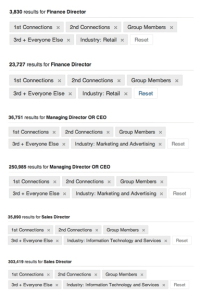 tried three simple searches for the purpose of this blog. Finance Directors currently (or claiming to be) in retail, MDs/CEOs currently Marketing/Advertising and Sales Directors currently in IT.
Results are in the image opposite, but showed there were:
3,830 Retail FDs within an hour’s commute of my office (23,727 available to work in the UK)
36,751 Marketing/Advertising MDs/CEOs within an hour’s commute (250,985 in the UK)
35,890 IT Sales Directors within an hour’s commute (303,419 in the UK)
Be linked in, not LinkedIN.
The final and biggest issue of all, is the network of contacts your head-hunter will have. I have over 9,000 personal contacts in my ‘little black book’ (nowadays held on an iPhone/iPad/iDevice/iCloud). I have spent 20 years meeting between c15 people per week, plus group/networking encounters. Even allowing for re-meetings, that will be over 15,000 professionals met, and increasing!
That network, the market knowledge it brings and the benchmarking it facilitates cannot be replaced through any form of short-term solution. In every position I have been retained on, at least one ultimately shortlisted candidate was thought of within a couple of hours of the process starting. In many circumstances, that person/those people have been submitted immediately and the process completed within days – and we’ve not even charged more for such a fast-track solution….! It’s not what you know, it’s who you know.
Use it to YOUR advantage.
LinkedIN undoubtedly has a huge place to play in recruitment. For more junior roles, those which are not business critical and for those businesses who adopt a ‘bums on seats’ strategy to part of their recruitment, LinkedIN can save you a lot of time and contingent recruitment fees (many contingent recruiters will use LinkedIN as a key part of their strategy anyway). This leaves greater financial resource to engage a proper process for more important/critical/senior roles.
But if you genuinely want high quality staff, there is still no substitute for an experienced Head-Hunter. Don’t believe me? Try it.
What to do WHEN you get HeadHunted….
Posted on January 6, 2014 4 Comments
We’ve all been HeadHunted. It’s flattering, but when that all important call comes from a true Corporate HeadHunter…are you ready? This could be a genuinely life changing experience, many of these calls I have made have ended up making the recipient a (multi)millionaire.
 ….So how do you make sure you are not caught off-guard, pre-screened out of a search before you are genuinely considered or even worse…..had that call stopped by a gate-keeper not even giving you the chance to prove yourself?
Be Available.
Don’t fall at the first hurdle. One of my biggest surprises (and frustrations) is executives simply not returning calls or even worse, allowing “tenacious” gate-keepers; assistants/receptionists/etc to refuse to put the call through to the executive themselves, or even passing the message. If you have any interest in developing your career, make sure you tell the right people that you do accept calls from search consultants and get calls forwarded through accordingly.
Find out who’s calling.
Establish who the caller is, and importantly, the nature of the call up front. Is the caller a genuine Corporate HeadHunter or just a database recruiter? Are they simply “fishing” the market on a speculative basis or are they calling regarding a specific opportunity? In the age of the internet, verifying the validity, status and reputation of the firm is easy. Ask your ‘HeadHunter’ for their website URL, don’t be afraid to load up their website whilst on the phone. A very quick look at their site and current opportunities will tell you if they are genuine and relevant for you.
Be an opportunity engineer.
Make the most of the call and of the opportunity. A true HeadHunt call will be for one of two reasons (or often both). As a “Source” or as a “Prospect”.
Whether you are a “source” (someone of value to the search firm in directing them to suitable candidates, company leads or general market/industry/company insight) or as a “prospect” (someone the search firm has identified as a potential fit for the position), the call is a unique opportunity to build a relationship with a HeadHunter and with the Exec Search Market in general (The most commercial of us all talk to each other and share ideas…!). Maximise your own benefit from the call by being as helpful to the consultant as you can. Even if that specific call amounts to nothing, by being helpful and proffering valued information will set you in good stead for a relationship in the future.
Devil in the Detail.
Assuming your call is about a specific opportunity, the HeadHunter should usually give you good and in-depth details of the opportunity, reporting relationships and scope & prospects of the job and usually the name of the company (or the specific reasons for confidentiality – in which case enquire about an NDA). If this information is not offered, ask.
Be Frank.
If the opportunity is not of interest, say so. A genuine HeadHunter will be more appreciative of early candour. A good HeadHunter will try a second time though….Around 75% of shortlisted candidates said no on that first call! If you are genuinely not interested in the role, or in any role explain why and point the recruiter to other relevant sources or candidates. Doing this will gain respect and benefit the relationship to ensure the next time a suitable assignment arises, you will remain on the recruiter’s radar and assure you of an early call!
Keep in touch.
At the end of the call, you should exchange contact information and ask if you can send a copy of your CV to the recruiter. If you are a genuine ‘prospect’ the consultant will want it. If you are not a headline contender, the interest displayed in proffering your CV and key data within it can easily increase your prospect of being long-listed. CV Tips: HERE
No means No.
The HeadHunter has a huge vested interest in submitting the best shortlist possible to his/her client. If they disclose that you are not a prime fit, they will detail why. These reasons will be genuine and with exception of the rare occasions when specific exposure may be overlooked, it is advised to accept such reasons and focus on building the relationship with the HeadHunter. Arguing implausible reasons as to why Retail Banking is a highly valid fit for a High-Street Retail Operational Lead role may give the impression of desperation and is more likely to cause long term damage to the relationship; it may subsequently hinder your chance of being approached for a more valid opportunity.
Follow-up.
After the call, research the hiring company (if provided) and email the HeadHunter with your reflective thoughts and comments about the opportunity, highlighting specific skills fit and areas of particular attraction to you. Confirm your interest.
Allow him/her to ‘Wet Their Beak’.
Finally, whether the call elicits your inclusion in a specific mandate or not, highlighting the benefit to the HeadHunter of developing your relationship will be a personally advantageous move. Whether it is acting as a source, providing market information or facilitating their inclusion into a ‘Beauty Parade’ or nominations committee selection process, you are likely to gain beneficial/reciprocal favour in doing so!
For further information contact me
Getting Noticed by and Networking with HeadHunters
Posted on January 3, 2014 7 Comments
Would you sell your car and walk home if someone offered you enough money for it?
If you wouldn’t, you are unlikely to be commercial in your life, or your career.
Same is said for building a relationship with Corporate HeadHunters. Whether you are actively seeking to add to your own team, actively searching for a new job or just sensibly managing your own career progression and development; building relationships with proven executive search consultants, ‘HeadHunters’, is an essential element to a successful career strategy. Over 50% of the C-Level placements I have made in the last 5 years have been individuals I had known for over a year prior to the appointment.

It is therefore vital that modern executives establish a means of targeting appropriate search consultants but being specifically mindful of the risks of HeadHunters who work solely within specific functions, industries or regions – those with a broader network will proffer a far greater spread of opportunities or individuals.
CC’ing 400 consultants…
Sending a mass email to all the consultants you can find is strongly discouraged, (and runs the risk of receiving a direct, straight-talking but ultimately less than helpful response….!). It will very quickly place you on any consultant’s list of executives who do not fully understand the formal search process and will most certainly provide the impression that you are not serious about your search. With a search consultant typically working 7 days per week , and often be clocking up 80-100 hours work each week, executives who do not take their own search seriously will almost certainly be passed over.
When reaching out to select executive search consultants, it is vital to be aware that first impressions count, and last! Personal referrals to a search consultant through colleagues/business associate/alumni who have existing relationships with the consultant will always be preferable – although it is also important to be aware how you differentiate yourself from your peer referrer. If they have the relationship and have a virtually identical background, what benefit is there in your recommendation?
Choose the path least trodden
It may well be worth your while forging your own relationships, or certainly facilitating your own introductions. Understand the approach you desire. Do your homework. Don’t solely target known SME/Entrepreneurial specialist consultants if you seek a FTSE-50 move, and Vice-Versa. Similarly, if you seek a far more mature, very old-school approach, more staid search consultant, target accordingly. Likewise if you desire a lither, more modern approach, target younger, more socially (and/or social media) accessible consultants – But be aware that a variety of styles and approaches is a very good thing.
Most consultants will likely be happy to respond to you and you can begin to build your relationships and expand your network. Find out which industry events and seminars your targeted consultants will be attending, and if possible, join that audience and prepare for an in-person introduction. Understand their activity on Social Media, introductions through Social Media are still one of the best means of rapid introduction.
Remember that most search consultants are not career advisors or basic employment agencies – they may consider you for active searches, but they will not usually search for a job on your behalf. Unless they also offer specific Individual Career Planning, Executive Search Consultants are unashamedly client focused. They are engaged by, work for and are paid by their client…the hiring company.
Furthermore, unless they offer such services, do not ask for assistance with your resume, general interview tips, or initial guidance in deciding your next career move, you should have a very good idea of that prior to contacting the consultant.
Majority of search consultants prefer to receive a short and simple email from those executives seeking to develop a relationship. Attaching an up-to-date copy of your resume/CV in word format remains the best route. Briefly introduce yourself and include minimal information on your current role and future career plans.
Two way street
Make sure to offer yourself as a useful source or contact to the consultant. HeadHunters themselves network for two reasons, find high quality talent for current and future searches, but also to win new business. If you have spent a career avoiding recruiters and HeadHunters when business developing, or hiding behind HR Departments/Preferred Supplier Agreements, don’t be surprised when HeadHunters themselves become less receptive to your approach/personal enquiry. A contact who gives a HeadHunter the chance to pitch for business within their current employer will be valued.
Finally, highlight your connections in your industry and detail how you could assist a HeadHunter with any searches they are working on that are not suitable for yourself. This will position you and the search consultant in a mutually beneficial relationship.
Quick tips for networking with recruiters:
- Do not send a mass email to all search consultants you can find.
- Be aware of targeted consultants Social Media presence, use it to gain an understanding of their strengths, engage with them and where to find them.
- Send a personal email to a small, select number of search consultants highlighting why you are keen to work with them.
- Keep the introduction brief and to the point. Be concise about what you want from the consultant.
- Detail your background and aspirations in ‘Elevator Pitch’ brevity.
- Attach your CV
- Ensure the relationship is two-way.
- Remember HeadHunters work for, and get paid by the hiring company, not you.
CV Tips: 20 Things to do…..20 Things to avoid!
Posted on January 2, 2014 10 Comments
Let’s start by blowing a myth away. The 2 page rule is nonsense. Do NOT try and fit 20 years into 2 pages by using font size 4 and margins measured in millimetres. Follow the below rules and your CV will be the perfect length, whether 1 page or 7.
Your CV is your Sales Document, it is not your opportunity to demonstrate how easily you can rival War & Peace, nor your chance to use every one of the over-4-syllable words you learnt from your word-a-day thesaurus desk calendar.
Your CV will get 20 seconds, if you are lucky, before the reader decides if you are worthy of a 2nd view, or destined for a polite (and politically correct, EU legislation appeasing) “Thanks but please don’t contact us again” rejection email.
Think of the best Sales Literature you have seen, and why it worked. Chances are it was simple, informative, credible, accurate, factual, objective, captured your attention and told you just what you wanted to know without waffle, or children’s names.
Your CV should be the same.
A professional CV is the absolute key to a successful job search; fall at the first hurdle and you are out before the tournament as started, a bit like Man City. Be Relevant, Be Credible, Be Professional.
Structure should be simple. Don’t try and overcomplicate: Personal Details (and contact details!), Qualifications, Career History, Achievements, Interests.
Personal Details: Name, Contact details(!), Date of birth (controversial – see below).
Qualifications: Professional Qualifications (real ones). Masters/Post-Grads/Degrees, A-Levels/O-levels/GCSEs/etc.
Career History: Reverse chronological order, Keep it simple: What you did, where you did it, when you did it, what you were responsible for, what you achieved. No gaps, no stories, no humour. Consistent format. Relevant info only. Include facts & figures, show growth/change in % terms. Show all detail for last 3 roles/10 years, then decreasing data.
Interests: Relevant, interesting, concise. Be aware what it says about you (Female shot-putters/male-flower arranger). Chose interests which have added to your character, and where you have achieved or committed.
Do…
- Keep it simple. Straight and to the point
- Tailor your CV for each role you apply for, ensure responsibilities/achievements are relevant
- Use a sensible, modern font and a small to medium font size
- Make sure your CV gives the right impression of your skills and achievements
- Be positive: do not give details of anything you are not good at
- Focus on quality not quantity (forget 2 page ‘rule’)
- Be clear and concise, use note form English, not prose
- Use bullet points where necessary to reduce blocks of text and word count
- Include your Date of Birth (see below)
- Detail qualifications & grades, but only A Level subjects if relevant (and not O’level/GCSE)
- Include relevant, recognised, vocational training courses. (Don’t include LearnDirect ‘Intro to IT’)
- Check thoroughly for spelling and grammatical errors (don’t just rely on spellcheck)
- Give a brief description of each business you’ve worked for
- Focus on achievements, detail the (positive) impact on the organisation
- Ensure transferability of skills without referring to them as ‘Transferable skills’
- Decrease the information detailed in more distant career history
- Check how your CV displays on another computer AND on an iPad/Tablet
- Get someone who doesn’t know you to proof read. If they don’t understand, change it
- Assume your CV will initially be read/assessed by a 16yr school leaver in HR. Make sure key data is obvious
- Turn ‘track changes’ off – it will highlight all your draft mistakes
Don’t…
- Put ‘Curriculum Vitae’ as the title, use your name
- Forget contact details on the CV itself (be wary of Social Media ‘names’ unless content appropriate for prospective employers to read)
- Put a photograph on your CV (and if you must, make it from the current decade)
- Include your children’s names/ages/education/career objectives
- Include non-academic/non-professional qualifications unless relevant. No Age7 swimming awards!
- Include any qualification you have to explain i.e. XXXX – seen equivalent to an MBA in Liechtenstein
- Use inappropriate email address (Jimmy5Bellies@… Looks crass; JobResponses@… Looks desperate)
- Use a profile unless VERY relevant, VERY succinct & VERY accurate
- Summarise 20yrs achievements together then repeat in career (lose the summary – looks like you are hiding something)
- Use tables/Textboxes/bizarre spacing – it is unlikely to retain its formatting
- Try and squeeze too much on a page. 3 sensibly spaced pages looks better than 2 crammed/4 over-spaced)
- Actively seek to hide your age by removing dates/omitting earlier positions/tweaking qualifications
- Don’t use abbreviations or jargon, unless sure the recipient of your CV understands
- Use the word ‘I’ too much
- Use logos/hyperlinks – they can get blocked by email servers and/or cause formatting issues
- Leave gaps in timeline, if earlier career not relevant, show by title only
- Be negative about anything – i.e. reasons for leaving/highlighting where achievements went un-rewarded
- Explain why your experience is relevant, if it isn’t obvious, it won’t count
- Include bland interests. We can all read/swim/socialise. It isn’t noteworthy
- Blindly upload your CV to Job Boards/Public websites – anyone can see it
Contentious subjects
Date of Birth
The Human Rights brigade will bang on about NOT putting ages on CVs due to Age Discrimination. Age Discrimination is wrong, and the measures to avoid it are just and correct. However, the issue is discrimination over age, not the knowledge of. If you wilfully (seek to) hide your age, it gives the impression you have the issue with your age – it also runs the risk of annoying the reader.
My advice: be straight. Be proud of your age and the experience it means you have. Stick it on (Date of Birth, NOT age).
Profiles
A comparatively recent trend, telling me what you think of yourself. In theory, a great strategy; in reality, highly risky. Profiles always read too positive, demonstrating an extremely high, one-sided opinion and being wholly non-objective. CVs should be factual, objective & historical; Profiles seldom are. Even if the reader does like it, you will have a far harder task of matching let alone exceeding expectations. Furthermore, if your career history and achievements do not leave the reader with the same impression as you profiles dictates, either your achievements, or your profile are poorly written!
My advice: If you want a profile, put a factual one-line summation – an elevator pitch, or even just a Tweet size
Interests
Many will tell you that they are irrelevant on a professional/exec/C-Level CV. I disagree. The biggest challenge in recruiting talent is finding that chemistry fit (hence why human, professional head-hunters will always beat CV factories/automation…but that’s another blog). Interests give that insight into the person behind the professional; i.e. the person the reader will be working with, spending 10/12/14 hours per day with. It is also your chance to standout and/or be memorable. Your interests can demonstrate great social responsibility, charitable action, strong teamwork, natural leadership, energy, a sense of adventure, motivation etc. It also makes you seem human. If nothing else it is a conversation starter for a nervous interviewer and a way to build rapport.
My advice: Put interests down, as long as they are appropriate, give a positive message, are something notable…and can be quantified. If you have nothing notable to put down…..do more with your life!
For Pro-Bono, basic CV advice/comment, please feel free to contact me.
For more comprehensive, bespoke advice, career planning, interview training and assessment see here
CV Stats
A recent Survey amongst over 1000 HR Professionals also made the following CV recommendations:
*Incompletely or inaccurately addressed CVs and CV cover letters were rejected immediately by 83% of HR departments.
*72% of HR departments said they didn’t like (or ignored) personal profiles on CVs.
*62% of HR departments said they ignored summaries and relied on relevant information being in the body of the CV.
*68% of HR professionals admitted they didn’t read covering letters/emails.
*CVs and cover letters addressed to a named person were significantly favoured over those addressed to a generic job title by 55% of HR departments.
*63% of HR departments said that the inclusion of a photograph with the CV adversely affected their opinion of the applicant.

Christmas Chemistry Lessons.
Posted on December 30, 2013 4 Comments

Christmas Morning…Santa has been.
We are lucky enough to have just returned from our Christmas break; Four magical days at the venue of our wedding reception, the incomparable and opulent Prestonfield in Edinburgh.
The setting could not have been better for an enchanted festive family break to reward for a busy year. A country estate built for the Lord Provost in 1687, now a unique, luxurious Boutique Hotel owned by renowned restaurateur, James Thomson MBE of The Witchery fame, still filled with 17th Century accouterments. Sat by the roaring fire, Christmas presents under the tree, the scene was more reminiscent of the mystical land of Narnia than a Scottish hotel.
 Despite becoming a Bi, Tri or even Quad-Annual pilgrimage, our visits to Prestonfield are always a highlight – never moreso than this latest visit, our first Christmas at Prestonfield. But it wasn’t the surroundings that made our (and makes every) visit so special….it is the people.
We sat with 3 other couples after being over-fed (and almost over-faced) by award-winning chef, John McMahon’s multi-course Christmas dinner, with tongues loosened via contents of The Whiskey Room and discussed what made Prestonfield, and it’s staff so special.
Our fellow residents were all business owners and/or mass-employers. One was a successful carpet-maker who had built, then sold a multi-£million business; another a Cairo-based property and leisure Entrepreneur and last but not least, a global medical devices market leader. All of us had stayed in a selection of other 5-star hotels around the world, but all agreed that Prestonfield was in a class of its own in ambience, setting….and people.
Many businesses significantly overlook the importance of fit and style of their people, yet it is one of the first things external parties, customers especially, will notice. The utilisation of automatic screening processes, faceless job boards and interviews conducted by minimally trained personnel, all in the name of efficiency, have seen staff retention ratios plummet….often with the reason of ‘not fitting in’. And yet businesses, and even recruiters, frequently place minimal importance on personal fit.
I have long maintained that the biggest impact I have on a recruitment process (and the biggest failing many in my sector have) is not the finding of people, nor it is the skills assessment, but the ability to match ‘Chemistry Fit’.
The best employees any business had/has are usually not the ones who started with the business with a perfect skill-match; They are the ones who fit with the business, it’s culture, it’s values….and it’s people.
It is for that reason that I never interview in an office. Doing so creates an overly formal setting where all interviewees immediately adopt ‘interview mode’, a state of over-caution, over-defensiveness and a lack of exposing to their true personality. Instead I create a disarming, open, friendly and discursive environment to get to the know the person, rather than solely getting them to read through, and corroborate their own CV.
Many of my contemporaries insist on farcically formal interviews, wanting to portray a reputation for conducting the toughest interview with the hardest questions in a destructively serious, power-struggle, control-vying format and style. When these headhunters are faced with the client question of ‘What’s he/she like?’….all they can answer is that ‘they interview well’ and that their CV is accurate.
Back to Prestonfield. I’ve spoken at length to James Thomson about his means of recruitment – he still meets every single person that his business employs in any of his  Restaurants/Hotels/Businesses. As a long-standing patron and knowing my profession, the newly promoted Hotel Manager sought my opinion on the culture of the hotel and specifically the people working within. He likened their training to that of passing a driving test. You pass, can technically drive, but it takes 100s of hours of practical exposure to really become a competent driver.

The note, sent up the chimney, written by our 4 yr old to let Santa know where she was.
Likewise his, and all of James’ staff. They pass their training, but it takes several weeks until they become fully ‘Prestonfield-ed’, but a more critical aspect is the diligence of those allowed in in the first place. Prestonfield headcount include former military personnel; others handpicked from other 5-star hotels; former childcare workers, PAs and even former Disney stars. And it shows. It’s not necessarily a standard that needs to be taught/learnt, it is a chemistry fit that is either present, or not. If it is present, it becomes apparent without necessarily looking or testing for it. The challenge is often then understand where to best use and utilise that person/talent/personality.
Many businesses have fantastic means of assessing cultural fit. For many it is simply taking the chosen candidate out for lunch/beers with his/her future colleagues to ‘make sure they all get on’. Others use more scientific means. UK Fast famously uses their Snowdonia Training Centre to observe (and help) new recruits outside of their comfort zone, in a disarming setting, and being ‘assessed’ by all manner of people to understand their cultural fit…and where in the organisation they would/will fit. I think it is great and works well for them.
But Chemistry Fit becomes important from the very beginning of the process, not just as a final check for the chosen candidate or lead contender. The first part of any retainer search process I undertake is to spend half a day, or a full day working in a client’s office. Partly meeting stakeholders and reporting lines to and from the position, but mostly to understand the culture (with 360 vision), the expectations for the person and above all, the Chemistry Fit required. Once that is done, I can spot the right fit with the people I headhunt, speak to and meet.
For many businesses, my assessment of their culture/chemistry is enlightening, as many external assessments can be. But if a business doesn’t really understand its own culture and chemistry fit, it will struggle to find those that do fit with it.
Such is my assertion of the importance of Chemistry Fit, that I Guarantee all of my placements for 12 months, rather than the usual industry 12 weeks. I’ve never had to call upon it.
Get it right, and whilst you may not gain the 5-Star rosette or Michelin Star, you will gain a more collegial working environment and greatly increased output. Kilt-wearing optional….


Dark-Art of HeadHunting?
Posted on December 30, 2013 8 Comments
A Dark Art? Not really. True Head-Hunters will typically have approaching 20 years commercial experience, often far more. Their knowledge base of high-performance individuals and key leaders is typically immense and when married to an ability to map, research and approach unknown individuals in target organisations becomes a compelling skill.
True and effective Head-Hunters are great networkers. Their ability to gain multi-stage referrals and recommendations is often their most effective resource – those providing the referrals being acutely aware to the benefit of being on a Head-Hunter’s radar for their own future career advancement.

Head-Hunter?
If only Head-Hunting were as simple as it looks. The people who are paid to fill Britain’s boardrooms insist that finding the best man or woman for the job is much more than a casual flick of the Rolodex these days. Research, and plenty of it, is the name of the game — even if to the outside world it seems the same old names are linked to vacancies in the upper echelons of corporate life.
Often very specific mandates will mean you are choosing from a pool that is relatively finite. You can try to stretch the envelope, but companies don’t always want to do that. Luckily more and more will, in the quest for outstanding professionals and even more so, to find the genuine stars and leaders of tomorrow.
Most targets will be unaware a search is ongoing. Initial contact is comparatively brief to ascertain interest – suitability usually established prior to first contact – such is the power of research. But suitability is often not overtly obvious, direct sector experience as an example often being of minimal importance. Relevant Investor/structure exposure often being more valid.
Dozens of approaches will ultimately elicit a list of potential individuals. A “Universal list” of target organisations will become a “Long-List” of suitable individuals. This can mean spending up to four weeks uncovering everyone in a sector or adjacent sector, or other targeted organisation who might be suitable.
Every mandate, and every methodology is bespoke and always begins with a blank sheet of paper and a brain storming session – regardless of how recent and how similar other mandates have been concluded.
The research stage of a Head-Hunt involves plenty of detective work but also dips into the firm’s corporate contact base, in my case, one of over 10,000 professionals and executives.
The Internet does play a part nowadays. Using Social Media sites for research, information collation and often information validation (with inherent risks to the ‘virtual loose-lipped’) as well as business sites to locate publications, commentaries and even YouTube for speeches given. This gives a very candid take on what individuals are really like, rather than how they act in front of a Head-Hunter.
The whole process will ultimately elicit an interview list.
One recent project to locate a Main-Board, Group Sales & Marketing Director for a consumer goods business saw us contact in excess of 200 people, not necessarily to interest them in the post but simply to find out who in the industry they rated highly. From that exercise over 40 people were formally interviewed.
The interview list will more typically number 20-30 candidates, all of whom will have been verified and ranked on their level of interest and suitability.
Crucially, the client company will review the interview list and comment on specific individuals for good or bad reasons.
At the end of the interview process, the best 4-6 candidates will then be presented to the Client with comprehensive verbal description, discussion and questioning.
At this point the client company will conduct it’s own interviews, through anything from two to five meetings before an offer is made. The whole process typically takes a long time – the industry average is 24 weeks – although due to the strength of our network, we can guarantee most roles’ successful conclusion in just 8 weeks (or offer a 100% cash refund)
In the majority of situations a significant number of the shortlisted individuals was known to the Head-Hunter prior to the process, in one context or any other, and often known through at least reputation by the recruiting, client executive.
Such a network is the lifeblood of the headhunting industry, which must identify candidates it thinks will fit a company’s culture, however impressive their CVs.
It is an exhaustive process, but then it should be because nothing is more important than the people you are bringing into your organisation. It is a lot more than Box-Ticking. We see it as so important that we guarantee all placements with a 12 months free-replacement guarantee
The Head-Hunting industry was worth $18 billion globally in 2013, according to the Association of Executive Search Consultants, after a lull since it’s previous peak in 2009 of $17bn. The financial crisis of a few years ago has led to pent-up demand for Head-Hunters’ services, as directors who may have been on the point of retiring decided to stay on to help their companies through the storm. This is now proving to be an accelerant into the search market as we hit 2014.
Head-Hunting away from the Board-Room
In an increasing difficult market, where strong talent is scarce but managing without key people is business critical, more and more businesses are turning to Head-Hunters to deliver more junior appointments. With delivery guarantees and cost benefits, we have successfully delivered on appointments as junior as £50,000.
An Interview on Interviews
Posted on December 20, 2013 25 Comments
Interview skills are probably the hardest and most underestimated part of the recruitment process. It is the biggest area we have to train our clients, and something everyone thinks they can do…until they are faced with doing it.
This is the transcript of a recent interview I did on Interviewing for an Exec Search Publication:
Topic one (How to choose between two perfect candidates)
1. Have you ever been in the situation where it was difficult to choose between two interview candidates for a vacancy? If yes, what did you do to overcome it? If no, what do you think you would do in such a situation, or why do you think this hasn’t happened – what made one candidate so clearly the “winner”?
We seldom have to choose just one, our job is to get to a shortlist of typically 4 or 5. When we have had to pick one from two, it is highly unlikely that there is not a clear ‘winner’, you have to just take every factor into consideration; skills/experience/background/fit with peers/etc. If all of that were to end as a dead heat, Salary/Value for Money, and which candidate would benefit from the role the most would come into greater consideration. As I say, it is highly unlikely that it would ever get to such a dead-heat.
2. How important are CVs in deciding the ultimate candidate?
In finding the ultimate candidate – Minimal. The CV is the candidate’s sales document, it gives the basic data that will lead to that initial contact whether phone or an invitation to interview. That said, it is still the most important tool in the early stages of the process – it is usually the only contact/information we would have on the individual to ascertain if they were worth speaking to or taking to ‘2nd base’. Too many people, however, put too much reliance on the CV. One of the failings of in-house recruitment functions is to rely solely on CVs with minimal knowledge of the environments described.
3. Have you asked candidates to attend more than one interview? How did they react to that?
Yes – at the senior management and executive level, multi stage processes are the norm. Candidates would be more put off if there was only one stage. It is critical to fully plan the various stages and know what you are seeking to gain from each stage. Failure to do so will lead to stagnation and prime candidates falling out of processes. One of our prime functions is to design the interview process with/for our clients – it is not as obvious as it seems. “What do we ask at 2nd interview?” is one of the most common questions we are posed.
4. Do you use a skills-based assessment (i.e. some kind of related task) to help you make your final decision, or is it based purely on either the CV, relevant experience or interview?
Very unusually at the level we operate at. Preparing a business plan, proposal document or specific presentation is often part of the process, but not directly assessing skills. We would always promote the use of real-world assessment and/or social interaction as part of any process. Get the individuals to demonstrate their leadership ability by leading.
5. If you had to choose between two excellent candidates, do you think in the end you made the right choice?
Absolutely, we are paid to make the right choice! We often have significantly more than 2 excellent candidates to choose from, but with such a broad base of assessment, and fully comprehensive understanding of exactly what is sought by my client, there is always something which ranks them in order of relevance/interest. Proof in the process, only one person I have placed into a perm role has failed to last 12 months – and that was business slowdown leading to redundancy. We find the right people!
Topic two (Pros and cons of interview types)
1. What kind of interview types have you used in the past? Would you use them all again in the future?
I’ve used a variety. I find Formal Competency Based interviews too clinical, I also dislike early stage interviews being with more than one person, but accept for many it is a must due to unfamiliarity with interviewing. For me, a good, relaxed but formal 75-90 minutes fairly intensive interrogation of background, discussion on specific role and a good deal of time given to personal chemistry and personal investigation/understanding works best.
2. What is your opinion of the following:
a: one to one interviews – always preferable, but does assume both parties have the confidence to build rapport and give a supreme performance – not always the case
b: panel interviews – dislike except at latter stages, and best done with a more discursive interview style and/or presentation. Risks of in-fighting and panel focussing on their own performance in front of colleagues rather than the candidate
c: competency tasks – valid at junior levels, but largely irrelevant at the executive grade. A sound presentation with the need to construct project plan/business plan/project P&L is far more effective and valid.
What do you think are the best and worst elements of each type of interview?
a: one to one interviews – Best: allows rapport building, people more open one-to-one, ability to follow single agenda. Worst: Nerves can mean one-sided interview, lack of experience failing to get best out of interviewee
b: panel interviews – Best: Collaborative opinion formed, many ears listening to single answers, multiple personalities assessing fit. Worst: Can introduce politics, be off-putting for interviewee and risks panel members overly focussing on their individual performance in front of colleagues
c: competency tasks – Best: Specific test and assessment of key skills, allows for benchmarking with current team. Worst: Often subjective, dependant on a single, short performance in an alien, artificial environment. Risks losing prime candidate because “Computer says no”
Do you use anything else to gauge the appropriateness of a candidate?
I use and advise social interaction at the very final stages – a client of mine, a hugely respected business leader and one of the most forward thinking individuals in employee development and engagement will take prospective execs for a 36 hour hike up a mountain to fully get to know them and assess how they perform and manage over a longer time period, and crucially see how they perform under (different) pressures, out of their comfort zone. Often this can be performed with several (future) team members to assess team interaction.
3. Do you find the same type of interview scenario always makes sense to you, or do you tailor it depending on the role/person? Why/why not?
Always tailor. Every role and every person is different, tailoring a process/interview is vital. Certain elements have to be consistent within a set process, responses to set questions etc, but whilst it is essential to be fixed on the end goal, it is vital to be flexible in the approach. The task of the interview is to get the best out of the interviewee, and to give them the best understanding of the role in question. Every person needs a different approach to maximise that objective.
Topic three (giving interview feedback)
1. Do you give interview candidates feedback if they are unsuccessful in their application? Why/why not?
Giving every applicant specific feedback can be a near impossible task, and would itself take over a full week, although everyone gets at least an email – however It is vital to give feedback to interview attendees, even if just via email. I tend to give blunt feedback, and often do so in my summation at the end of the interview itself. Very few people leave an interview with me unsure of where they stand in a specific process, not everyone appreciates blunt honesty though!
2. Do you think it’s important to give feedback? Why/why not?
I do, aside from just service, individuals need to know where their skills and especially interview performance was left wanting. Interview style, presentation and kinaesthetic & verbal communication are all a vital component. Most people I interview are subsequently likely to be met by one of my clients, ensuring their performance is as good as it can be and their ability to demonstrate their relevance is a key part of my role.
3. (If applicable) How do you give feedback to candidates? In person? Via telephone? Via letter? Via email? What are the benefits and drawbacks of the method you use, when compared with others?
It will vary. With most people I have progressed through to client interview, they will get a phone call, and often a meeting to debrief – it also gives me the ability to understand them better for future benefit. Other interviewees will get a phone call, often preceded with an email to ensure swift feedback. I seldom use hard copy letters for interview feedback, unreliability of ‘snail mail’ is an issue with vital communication such as interview feedback. Email will always be a quicker form of enabling mass feedback, phone and/or meeting will be more personal – the downside is that interviewees will often not accept the feedback and fight their corner, at times aggressively.
4. How much detail do you go into in your feedback?
As much as I can. I give make every effort to provide honest, blunt feedback. I do not tell everyone they came a close second – people will only learn from mistakes and if they bombed, I will tell them as much – I will just ensure that if that is the case, they are given the information, tools and time to rectify and sell the positives of what they are able to do.
5. Has a candidate ever taken feedback you’ve given badly? If yes, what happened? What did you do?
Yes. I often get heated comments coming back, often as a defence mechanism against the interviewer, often leading to verbal aggression if the individual feels they have been discriminated about. I will often get aggressive phone calls & emails when I have not put someone forward, accusing me of a hidden agenda – forgetting that I have a duty to provide the very best people to my client and have a significant commercial interest in submitting every ‘best person’ thus would not wilfully discount a genuinely contender.
The worst example was a candidate discounted at 1st interview who chose a public Q&A session I was on the panel for (unconnected with recruitment) to challenge my unwillingness to promote his case to be taken forward to 2nd interview. Having refused to discuss the matter privately, I had to advise him that he had been discredited through his inability to provide key metrics that he would have known had his CV been accurate and that his career advancement and ultimate stature within two of his businesses been exaggerated – as I interviewed the individuals that *did* hold those appointments he claimed to hold as part of the process.
If you have any questions on interviewing, please feel free to email me, or leave a comment below!
Bale and Able?
Posted on September 3, 2013 18 Comments
Yesterday, Gareth Bale stood proudly in the Santiago Bernabéu stadium wearing his Real Madrid shirt. He showed his ball control skills, until he dropped the ball. But is he the only one?

The move has been on the cards for months, and has had universal approval (even from most at White Hart Lane given the funds flow in return). Even the most critical of opponents secretly wished their club could have stumped up the cash.
The move will cost Real Madrid €100m, plus wages of £300k per week. Then he will get performance bonuses on top of that. Put into real world speak; Bale will be earning £15m per year….plus bonuses.
Once you factor in the average premiership footballer works between 22 and 26 hours per week (Source: http://www.le.ac.uk/) it’s not a bad deal….
This comes in the same time as virtually every ‘premiership’ CEO has been vilified over their pay. Can you imagine if a public company CEO (THE boss, not just one of the star performers) was given a £15m salary, plus bonuses, for 22-26 hour week? As it is, the average FTSE-100 CEO’s total remuneration is a quarter of that at £3.4m (and shrinking), for a week that is four times longer (and requiring several decades of experience).
So how can we say CEOs are the ones who are overpaid?
‘Funny Old’ game
Company heads are a rare breed. The skills required, particularly at FTSE 100 level, are unlike those needed for any other role. As stated before, CEOs of large public companies typically don’t need to work: they perform the job because they want to. It is therefore a dangerous, not funny game to take away that enjoyment and replace it with a distracting, needless fight against the attitude of largely ignorant shareholders, media and politicians.
Force the wrong tactics on the pitch and businesses critical to our economy and its continued recovery will be left without leaders. Is that what the shareholders really need to protect their interests?
Furthermore, not only do you risk losing your leader, once you remove incentive, you remove attraction to your business, particularly in the current climate where appetite to move is not overflowing. Having been involved in searches for FTSE 100 C-Level executives over the last 2 years, the desire to move into such a role (which comes with greater media scrutiny than an 80s TV/Radio star on a seemingly indefensible sexual conduct charge) is slowly improving, but far from abundant. Private and Private-Equity backed businesses demonstrating a far more attractive home for disgruntled former public company execs.
The media will highlight the disgrace of some businesses having a ratio of 400:1 from top earner to lowest earner. In reality, it is a very unusual occurrence. Even considering this ratio against a low paid employee on £15k, a 400:1 ratio would result in a £6m salary – I don’t know any C-Level exec on a £6m salary (although there are dozens of footballers on that and far more….). Even the focus of every vigilante’s hatred, Bob Diamond wasn’t on that level of salary, the bulk of his remuneration being performance related, and in stock.
Another focus for shareholder (read: Media) hatred, Sir Martin Sorrell’s business, WPP Plc, slammed last year for having his pay increased to £1.2m (per year, not per month as Gareth Bale now earns), has an earnings ratio of less than 100:1, and WPP are a high performing business in the FTSE 100 (and thus one of the few businesses who account for circa 80 per cent of the market capitalisation of the entire London Stock Exchange).
As with many other professions (football being a prime example), the desire to seek the best talent means paying premium rewards – however unlike football, the bulk of C-Level remuneration is performance related.
Whilst total pay awards increased for the nation’s top CEOs in 2012 (ranging from 8-23% dependant on how red the ‘red top’ newspaper is), the majority of a public company CEOs remuneration is given in stock, typically with a 3-5 year vesting period, and latest figures shows that for the 12 months to April 2013 remuneration actually decreased (source: IDS). With the events of the 2nd Shareholder Spring, that is likely to slip further.
Most CEOs salary is typically less than 25% of their overall remuneration package and has typically decreased over the past 4 years; only the performance element has seen material increases, again mostly in stock awards, average cash bonuses having shrunk for the 3rd year running.
The increase in overall remuneration is partly reflective of lower pay awards over the past few years, thus remuneration is paying catch up (average professional earnings in many sectors have increased by more than those of the CEO in the last 12 months, largely as the last 12 months have seen the first bonuses and raw salaries increases for 2/3/4 years), but overall increases are moreso the effect of improved performance. As businesses do better 2012 compared to 2011/10/09/08, so those with a bias towards performance remuneration will increase, but those increases are stock based, ensuring commonality in interests with shareholders.
As someone who deals with C-Level execs and their remuneration levels on a weekly basis, the truth is lower still. Very few FTSE-100 C-Level salaries get even close to £1m.
Put £1m per year into context, £1m per year is £19,000 per week. What level of footballer earns as little as £19k per week? What about movies stars who make tens-of-million for 6 months part-time work? That can equate to £1m per week!
If the media began vilifying Europe’s top footballers (the top 10 of which earn in excess of £250m between them), or even quoting their remuneration in annual terms rather than weekly, public/fan sentiment would soon change.
How is Sir Martin Sorrell, who not only leads, but founded WPP Plc, and grew it into one of the 100 biggest businesses in the UK, and has worked for 90+ hours per week for over 25 years suddenly NOT worth £1.2m when a 24 year old footballer that struggles to do 24 hours per week is paid £1.2m per month?
 Even one of the highest paid CEOs in the FTSE, Vittorio Colao doesn’t earn as much as Bale will – his total remuneration last year being £11m, with a base salary of ‘just’ £1.1m – less than Bale’s salary for a month. This is despite leading one of the largest businesses in the world, and as of two days ago, pulling off the 3rd largest corporate deal in history, netting his business (and it’s shareholders) $130bn – a value of almost 10-times earnings. Impressive. Two-thirds of that $130bn will be returned to Shareholders.
CEOs have been criticised for damaging their business’ brand through their excessive pay demands, despite the ease in which the businesses are able to afford such a package. Contrast that with the average Premiership club that typically spends 70% of their total revenue on wages (90% for Championship……120% for Manchester City!) with many fielding first teams, each paid more than a top flight FTSE-100 CEO (Vittorio Colao’s wage equates to £21,000 per week. What class of footballer does that get you?
We live in a society which, on the whole, is increasingly intolerant of so-called economic inequality when it comes to business. Footballers and movie stars – who make tens-of-millions for six months part-time work – are paid amounts which were unheard of in the 1970s, and yet not only escape the public vitriol reserved for ‘Fat Cats’, seemingly see improvements in the brands of football clubs or Hollywood.
As most will really appreciate, Shareholder Spring actually has very little to do with the rewards paid to CEOs – amounts which, in reality, have been similar (in relative terms) for many years. The issue is the media who have chosen to vilify these people and the uninformed masses that have lapped it up like lambs.
Giving shareholders power is a false goal in itself. The masses vote for a quick fix, In 2007, they bullied prudent executives to take on more debt – look where that got us. Today they can see that cutting C-level pay might provide a direct redistribution to their own dividends in the short-term, but saving even £1m would give pence to each shareholder. Lest we forget that shareholder income (from dividends) has increased by 22% in 2012 compared to 2011 – yet shareholders begrudge CEOs that have had increases of around a third of that?
Surely the sensible approach is to see corporate pay as an investment in the right person to steward an economically important enterprise in which shareholders, not to mention CEOs, will benefit? The current economic climate should be an argument to bolster executive investment rather than cut it.
Lessons from Sweden
Anti-‘Fat Cat’ activists will often cite Swedish CXO remuneration levels; notably lower than most of their global counterparts. Sweden has long been a unique economy, a fantastic mix of immense social responsibility and economic (and capitalist) achievement. Sweden’s might comes from huge appetite to embrace change and innovation allied to an environment that has seen decades of long term investment.
This coupled with a very low reliance on imported commodities (especially energy with hydropower/nuclear power and more recently biomass) has seen decades of immense political and economic stability, which in turn has encouraged further long term investment and ultimately, wealth creation.
Their openness to change and development (when the rest of the world was walking out of it’s factories over the brand of toilet tissue used or who wiped the canteen tables) has been at the root of their success. Remember it was Sweden who created the template for bailing out the banks, not Gordon Brown!
The Swedes themselves attribute much of the success to the belief in strong leaders, and leadership breeding empowerment – reasons why Sweden achieves an electoral turnout of 82%.
This leads us back to Bob Diamond, 2012s most vilified business leader. The UK immediately seeks to discredit its leaders, adopting the attitude that strong leaders are a bad thing, overpaid, need their wings clipped and simply not needed. In this culture, leaders of British blue-chips (who don’t NEED to work) do need greater incentives to put themselves, and their families through such a life.
If we look at the performance of the businesses these mega leaders have achieved, again using the ‘worst’, Bob Diamond. He increased his business turnover 5-fold and profits 12 fold….all during the worst macro-economic environment in living memory. Does that sound like poor performance?
12 months after Diamond’s forced exit, how is Barclay’s faring? The over cautious new regime having u-turned the dynamic culture and built a steadier ship.
The bigger issue here is that executive pay is increasingly NOT geared towards, nor based on performance, it is geared around tabloid media hype and public sentiment. One of which is out to find (create?) scandal the other is largely ignorant.
We pay our CEOs well, but even the best paid get paid fractions of percentages of the profits that their businesses create. The British public, thanks to the hype of the media hype, think our CEOs are overpaid, yet their pay pales into insignificance compared to S&P 500 and Fortune500 CEOs (averaging $12m compared to £3.4m for UK), and when you consider that If you look at longer term reward, UK business has faired far far better – the FTSE-100 generated a 24% return over the last decade, the S&P500 a 9% decline (source: Dimson, Marsh and Staunton).
We assume all FTSE-100 CEOs lead lives of unbridled luxury, social engagements and power lunches. The truth is that these individuals have committed 80-100 hours per week for 20+ years to attain the CEO position, and still give the same 80-100 hour commitment along with the stress that responsibility for 10,000s of employees and a blue-chip business brings. They earn their money, and yet shareholders (whose dividend return has seen a 22% increase so far this year), begrudge them for any form of increase, and vilify them if they dare to accept their contractual bonus.
Contrast that with Mr Bale who may, or may not, do 90 minutes of work against Villareal in 2 weeks time. He’ll get his £15m per year regardless of performance. If he helps his side reach any number of championship titles or trophies, he’ll get an extra bonus. If he doesn’t, he’ll have to make do with his £15m, plus monies gained from sponsorship. Furthermore, he IS highly likely to lead the life of luxury, and by the time he gets to the age when most CEOs finally make it to the level of 7-figure earnings, he’ll be retired.
Top footballers might be some of the fittest men on the planet, but they are arguably fatter than the fattest fat-cat.
Replacing Fergie
Posted on May 9, 2013 7 Comments
First the shock resignation of Pope Benedict; Then yesterday the announcement of (for some) an even more significant departure of an even bigger spiritual leader. Sir Alex Ferguson.
Early yesterday morning when Sir Alex’s retirement was still just a rumour, one of my fellow gym goers commented that he was sure that wasn’t an assignment I would want to be mandated on….summarising it as ”an impossible piece of recruitment” compared with usual C-Level mandated.
Is it?
Sir Alex is cited as being one of the best managers ever, he is without question the most successful English football manager ever – but are the traits of a football manager comparable with a business leader? And does the recruitment of a great one become harder, or easier?
Fergie is unusual. He is a great manager and a great leader. Few people are, but that is part of what makes an exceptional football manager, and arguably a great Business Leader. But has the demands on a football manager increased during Sir Alex’s tenure. It took him nearly 4 years to win any Silverware (1990 FA Cup), and almost 7 years to win the league. Would a modern top-flight club manager be given as long?
…..and would a high profile FTSE-100 CEO be given as much grace?
 Further comparisons between Fergie and a FTSE-100 CEO draw other interesting parallels. Sir Alex has seen his salary from £60,000 per year in 1986, to over £7m now (an 11,000% increase), despite his responsibility being nothing like as broad in the business as a CEO (Man Utd have a more than able CEO in the likewise soon to be departing, David Gill, whose salary is barely 25% of Fergie’s).
During the same 26 years, the average FTSE-100 CEO salary has increased from £150,000 to £850,000 (a 560% increase), their average total remuneration having increased from £220,000 to £4.8m during the same time (a 2,000% increase).
So Sir Alex has done ok, and it must be remembered that not only is he not CEO, his business is nowhere near FTSE-100 status, the average FTSE-100 company turnover being well over £10bn with a market capitalisation of over £15bn – Manchester United’s current year turnover is expected to be only 2-3% of an average FTSE-100 at between £3-400m, with a Market Capitalisation of around £1.9bn.
But, and this is where the biggest difference comes from, Football is wholly emotive, and cannot really be measured in financial terms. Sir Alex’s haul of silverware and league titles puts him, in many peoples estimation, far ahead of any Corporate CEO…..his skills having more in common with an Entrepreneur. And you can’t recruit someone to be an Entrepreneur.
The appointee should have an easier ride than his FTSE-100 counterpart too, without the automatic vilification a large company CEO will get (opposing supporters excluded!) despite his earnings being far higher than the fattest of fat cats.
So how would you go about recruiting Fergie’s replacement?
Put simply, you don’t. Many wildly successful people have been ‘replaced’ and seen their successors struggle. Terry Leahy and perhaps less resoundingly, Stuart Rose being two public examples. Taking over from the best of their kind is an impossible task, but that becomes the wrong motivation for recruitment – but a mistake often made.
We start every C-Level mandate with an argument, usually surrounding what is really needed. “We just need another Alex”, is not a viable mandate. You are highly unlikely to find another manager that will deliver 38 titles in the next 26 years. Even finding someone who will deliver 1½ pieces of silver per year is close to an impossible task.
Even mirroring Sir Alex’s style is not the way to recruit. Leaders have the own style, and finding the one with a style that suits best is the challenge.
Fergie’s style has always been controversial. Kicking a boot at David Beckham, countless touchline bans for over-exuberant/inappropriate behaviour (I can sympathise with that one) and even recently Wayne Rooney has spoken of players’ fear of being subjected to the “hairdryer” treatment, when the manager would bellow in their faces like a “Babyliss Turbo Power 9000”. Not of which are really seen as classic ‘strong leader’ traits.
 Sir Alex recently gave a lecture at Harvard on his own inimitable management style. He may be more known for the boot kicking incident, or for installing tanning booths at the training ground to boost his pampered players’ Vitamin D levels (during Ronaldo’s time?), but his lecture showed an uncompromising, tough management style. He advised future business leaders that he wasn’t afraid of giving the big egos a dressing down, and of how he would use unusual stories to rev up the team for important games.
But if you transfer Fergie’s behavior into other environments, or even look at them with politically-correct, 2013 eyes, there are traits that wouldn’t, or shouldn’t work:
Fergie is known for his uncompromising attitude to his players. Behaviour deemed  acceptable 30-40 years ago is no longer so (just ask any former Radio1 DJ….) and Sir Alex’s behavior would be seen as bullying today by many, and would see many a manager end up in court.
Likewise his temper. Getting angry is fine it’s human, but a good leader (and a good manager) learns to control that anger rather than resorting to ‘petulant child’ mode….like refusing to speak to the press after a questionable red card. Fergie has got away with is as his players are at the top and have nowhere to go other than down.
But many of his styles are truly transferable. He has always been known for his ability to praise. As he was quoted as saying, there is nothing better for a human being than hearing the words “Well Done” – a minor point that so many leaders get so wrong.
Likewise his ability to inspire. He is famous for using his passions to enthuse his players – his well reported story the day after he has seen Andrea Bocelli using his passion and the paradigm of the Orchestra being the perfect team.
He also has had a very strong team focus, and uses his respect-based authority to control the egos (and Galácticos) in the team, not letting narcissism exist. Everything is done to the long-term benefit of the team, including leaving key players out of matches.
So what DOES make a good football manager? And is that similar to finding a good business manager, or business leader?
 The best leaders gain the absolute trust of their players, they put you on your toes whenever they set foot in the room, and have a philosophy, vision and passion that is greeted with enthusiasm and delivered with spirit and belief.
Good new managerial appointments have the ability to quickly understand the current environment and its challenges, formulate (and agree) an action plan, introduce, then enforce it. They need mutual respect with their team, but not necessarily mutual affection. Strong leaders need the ability to professionally distance themselves from their wider team.
The process of locating that perfect next appointment is the same regardless of who or what the appointment is, but with football, clubs often miss the important part. It is who they are, what they can do not what they are.
Football managers are often former players, and many players want to become managers (and many managers still want to be players) but it is not a forgone conclusion that great players make great managers. Management is a skill that can be taught to a large degree, but leadership is more of an intrinsic ability. Both are needed to make a great appointment.
The fact that most managers have been players at some point is no surprise, basic understanding of the player level game is vital – as is basic understanding of the industry a CEO operates within, but only those with natural leadership ability are likely to go on to be great managers. Many former Man Utd players have been linked with management; Keane, Robson, even Beckham but it is difficult to see any of them truly being a manager in the same league as Fergie.
Conversely, look at the class defining football managers, most if not all have been professional players, but few were absolute top class.
Recognising the true management candidates, appropriate for that environment, becomes the skill. Chemistry fit is everything – as it is with corporate recruitment.
The process of finding the next Manager should be straight forward, and echo the way in which HeadHunters find the best talent for their clients. That is for the key stakeholders to assess exactly what it is they need, without emotion; desired changes, desired improvements, and desired objectives – all at organisational and operational level.
Once those basic ‘must haves’ are decided, the chemistry fit becomes vital. What person, personal style and personality will fit. This will be all the more tricky, yet vital with CEO David Gill’s summertime replacement by Ed Woodward (current Vice Chairman, not ‘Equalizer’).
It is at that point that for a corporate HeadHunter that the real work, and hard work begins. Finding the people and getting their interest. For Man Utd, that bit will be, surely, easier. Potential candidates are largely already well known and the pull of being the Manager at Old Trafford will surely be a call few will outright reject.
So who?
I’m no pundit, but even I can see the bones of a potential shortlist.

Jose Mourinho – seemingly the people’s favourite? Gravitas, charisma and results to take on the United mantle but return ticket to Chelsea and opposition within the ranks may scupper.
David Moyes – the smart money? Miracle worker with a virtually non-existent budget at Everton (& PNE before). Real ability to get a team working as well as play the transfer market like a hustler. He’s also ‘available immediately’. out of contract this summer.
Jurgen Klopp – Really smart money? Huge potential, two Bundesliga titles and further thrust into limelight with Borussia Dortmund’s giant killing to secure their place in the Champions League final; offers longevity and style that could/should suit Old Trafford.
Then the former players? Less likely….but emotion runs high.
Ryan Giggs. Always been a Fergie favourite to step up to management citing him as having the ability to step up and ensure continuity in the same way as Pep Guardiola at Barcelona.
Gary Neville. Moved seamlessly into punditry and coaching under Roy Hodgson. Turned management roles down, but could he spurn the advances from Old Trafford?
Ole Solskjaer. Part of the history books following the 1999 CL Final winning goal, and the only contender currently in a management role. Shown potential at Molde with consecutive Tippaligaen titles. Big gamble, but never underestimate such a fan’s favourite. Having lived close to him for many years, he also has the grounded temperament that could work.
One thing is certain, the appointment will be made in a lot shorter timescale than the Executive Search’s comic average assignment length of 24 weeks….. shorter than even my average retained process time of just over 6 weeks. The process will have been running for a long time already, succession planning has been the talk in and out of Old Trafford for years and as soon as the magic #20 was hit, the odds were on for Sir Alex to leave on the ultimate high, and for the succession announcement to be similarly engineered, as it was with David Gill’s announcement in February.
But much as the recruitment of such a football manager could learn a lot from corporate recruitment; so corporate recruitment could learn a lot from Manchester United’s key managerial recruitment process. Plan; don’t just be limited to obvious choices and understand the chemistry fit of the available options.
Post Script – David Moyes, Manager, Manchester United.
So with the metaphorical white smoke rising from Old Trafford, David Moyes has indeed got the nod. No real surprise for football fans, and no surprise from a more technical search perspective.
Sir Alex, who lest we forget is not leaving, but just moving ‘upstairs’, has had a huge say in his successor and has made it no secret that he sees a lot of himself in Moyes – drive, character, team focus and raw determination.
Moyes is also one to promote and develop young players giving them the same expectation exceeding opportunity that perhaps Moyes himself is getting in this appointment.
Some have commented that the appointment too much of a mild evolution? And that Fergie will still (be allowed to) have too much input with a mild-mannered Manager – contrasting with a Mourinho style that would rebuff interference.
Promoted execs not letting go is a huge risk to recruitment processes and risk jeopardising both appointments, and the success of appointees….
….however, an even greater risk is a business without the need for dramatic change, employing a change agent who in turn seeks to stamp authority. If it isn’t broken, don’t try and fix. That must be the mantra at Old Trafford.
 Crucially, Moyes will bring the depth of team focus and refusal to accept prima-donnas and general narcissism that Sir Alex has become so famed for. With Mourinho, one could argue that he brings greater narcissistic behaviour then the best of players (his truncated comments to ITV Sport after his teams defeat in the CL Semi-final confirming his true personality?).
…..That said, Mourinho’s energy and charisma would have been an interesting sight on the Old Trafford touchline (and Mrs Chaplin (along with 1,000s of other wives) is certainly lamenting the news that he will not become a neighbour…!)
Moyes is most definitely team first. And for any team (and any business/organisation running as well as ManUtd), that becomes a powerful leadership position.
The King is dead. Long live the King.

Thatcher & Women on Boards
Posted on April 15, 2013 20 Comments
Last week saw the passing of one of the most influential figures in the Women in Business argument, controversial Women’s Libber, Margaret Thatcher. It also saw the stark news that Lord Davies’ Women on Boards agenda was faltering.
 Thatcher was a self-declared non-feminist, famously stating “The feminists hate me, don’t they? And I don’t blame them. For I hate feminism. It is poison”. And yet, ask one of the still comparatively few women on FTSE350 or Top150 boards about her, and most will attest that she had a huge influence in their progression up the corporate ranks. She showed a generation of Women that anything was possible.
“If you want something said, ask a man. If you want something done, ask a woman”
There are plenty of detractors for Lady Baroness Thatcher, never that I can remember has one person caused such polar opinion…..but I’m not going to get into defence, nor attack of her.
However, lets put just one thing in context. Aside from the ‘poor man of Europe’, union led, blackout-rich state of the UK before her election victory in 1979, our country was still a very anti-women environment. The Sex Discrimination Act and Equal Pay Bill only came in the same year as she became Conservative Party Leader, and the London Stock Exchange only allowed women onto its floor 22 months earlier. Even more incredible, as recently as 1974, women were not allowed to rent white-goods from some providers (and most households couldn’t afford to own such things…).
Further context….it took 18 years after Thatcher defied the UK’s most male-led environment to lead the country until a FTSE-100 had it’s first female leader – Dame Marjorie Scardino at Pearson. Whichever way you look at her, she was a game changer in getting women to lead, and aspire to lead.
38 years after The Sex Discrimination Act came into force, female board representation is now common place. Still not hugely common in the top job where we STILL never had more than 5 female FTSE-100 CEOs, but all but 7 of the FTSE-100 now have a women on their board, and over 17% of Top-150 directors are female, not far off double that of just 5 years ago, and up more than 10% compared to just a year ago. Lord Davies challenge to business to get to 25% female representation by 2015 looks attainable.
Or does it?
We’ve learnt this week that female board appointments to FTSE-100 boards have actually dropped in the last 6 months. And not just a small amount, they have almost halved from 44% to just 25% over the past 6 months.

Cynthia Carroll
This at the same time as several high profile females have also left their positions as FTSE-100 Directors, corporate trailblazer Dame Marjorie and AngloAmerican’s Cynthia Carroll being two high profile examples; both replaced by men.
Female FTSE-100 CEOs are now dangerously close to an all time low with just two female leaders current holding office
…and it gets worse.
Pro-Quota supporters highlight the ‘success’ of countries with quotas and/or penalties for businesses failing to reach set levels of female directors. Norway is the overused example. They implemented a legal stipulation for 40% of a company’s directors to be female, and it’s worked…..Except it hasn’t really.
What it has done is see Norwegian businesses fudge the figures to hit an arbitrary set limit. Many Norwegian businesses have used the promotion of (female) senior managers and department heads to notional board status to increase their ratios. Even more common is the explosion of female Non-Exec Directors to swell the ratios of female Directors, especially through the use of ‘Golden Skirts’.
Golden Skirts is the nomenclature given to serial Non-Execs, employed in an almost ‘rent-a-crowd’ fashion to increase ratios. Want to see how ridiculous it has got? Mimi Berdal was Norway’s most famous Golden Skirts. At one point she was a Director of 90 businesses. That’s right 90. All 90 could boast an extra tick of female board representation, but with only 365 days in the year, each business would get less than 1 day per quarter from her. What possible influence can 1 day per quarter really bring? But it satisfied the politicians and box-tickers.
Accordingly to McKinsey’s ‘Women Matter’ survey, almost 80% of female directors in Norway are Non-Exec, with the average number of posts being held by each female director being 8. Easily questionable how much impact those women on those boards can really have.
And even without quotas, it is heading the same way in this country. Although the number of overall women on FTSE-100 boards has increased from 12.2% to 17.3% between 2009 and 2013, the number of female executive committee members has decreased from 18.1% in 2009 to just 15% now. Even the overall number has dropped by 0.1% in the last 3 months.
Both lessons are further reason why quotas will not work, businesses will just get round the issue to tick boxes. Lest we forget, the news has been dogged with businesses ‘getting round’ tax issues. Gender issues will be even easier to manage.
So what will work?
First and foremost, understanding the real issue. Too many of the established Women in Business supporters seemingly spend much of their time selling the benefits of a gender balanced board. This is like selling the benefit of insurance price comparison to an anthropomorphic Russian meerkat; We get it. It is over 6 years since I had a client not actively want to attract women onto their board, and he was a well-known, particularly chauvinistic PLC CEO. Financial/Cultural/Decisive/Stock-Price benefits gender balance brings are well documented and universally agreed upon.
As discussed in Women in Boardrooms: Supply not Quotas, the issue is supply of willing and suitably qualified execs (not just ‘capable’). Supporters will repeat ad nauseum that there are more than sufficient highly qualified women. They will blame outdated Chairmen for blocking the move, non-gender-balanced nominations committees creating non-gender-balanced board and even point the finger at sexist practices by HeadHunters. All of which I am sure are not totally absent, but they are certainly not a realistic factor. It’s the supply.

Martha Lane Fox – Baroness of SoHo
Business luminaries such as mightily impressive Baroness Martha Lane Fox and the globally renowned Helena Morrissey will point to the recently compiled European Business Schools/Women on Board list of 6000 Board Ready women, a searchable list of, as the name suggests, 6000 Board Ready Women currently residing in Europe. A great tool and a fantastic start, but there are a several issues with that.
- Over 25% of the 6000 are pure academics, not business ready professionals
- Almost 50% of those in business are currently within businesses (or business units) turning over less than €100m
- It doesn’t factor in how many of the 6000 actually want to be a large company board member.
Two other interesting facts:

Helena Morrissey
The numbers of Board Ready Directors needed to populate even just large businesses are huge. Mirella Visser of Gender Balanced Boards estimates the number of exec and non-exec directors needed to make a long term difference in Europe (EU27) to be 25-30,000. Her home country alone (The Netherlands) estimates it needs 3-3,500 female Directors, ready to ascend to the boards in the next 3 years.
Secondly, a flash report by McKinsey, using the same criteria as the European Business Schools/Women on Board used, estimated that there were over 100,000 ‘Board Ready Males’ – giving a ratio of 6:100, 6%. Even Italy betters 6% women on boards.
Supply is an issue…..but it can be addressed.
How?
First we need to stop messing about with nonsense reasons for the lack of female ascension to the board.
Lord Davies, and others, cite the cost of childcare for aspiring female executives as a major issue.
I don’t doubt that is a hindrance to many women in the workplace, but not women with their sights on the top table. Career driven execs of both genders come out of the blocks at an age well before family-planning becomes an issue.
Research by City University London shows that the average age for female graduates to have their first child is 35, for professionally qualified women that becomes 37. By such an age, a potential top-150 Board Director has their career sufficiently underway with a board appointment more than likely already behind them, for family considerations to not enforce involuntary disruption, especially for financial/child-care cost reasons.
Lord Davies, and others, then add the ‘biological issue’ to the argument, that women returning to work after maternity leave are often disadvantaged because of it. Again, majority of potential top company Board Directors will, by 35/37, have their career at such a stage of advancement that such leave is highly unlikely to have a significant effect.

Marissa Mayer – Yahoo! CEO
Of all the female FTSE-350 C-level execs I have interviewed, not a single one has cited any such hindrance to their career. Many may not be totally proud of the fact that they have put their career first, but none has ever felt that cost or existence family was a hindrance. Witness Marissa Mayer if you want an extreme example.
That is not to say that many female (and male) professionals won’t choose to give up a career, or choose to down-shift. And this leads into what I see as being the real issue. Choice.

Sheryl Sandberg, Facebook COO
Sheryl Sandberg, COO of Facebook (and almost as detested in feminist circles as Marissa Mayer and Lady Thatcher) states “it is often women who stop themselves from reaching the heights of professional success in ways both big and small.”
One of the biggest derailing factors that prevents women getting to the top table, let alone the top job is nothing to do with their suitability, their capability or the benefit they can bring…..it is that they simply don’t want it.
Many women simply don’t need the ego trip of being CEO/CXO compared to men.
Even more common in this age of mass executive vilification, often deserved but even more often simply due to media spin/politics of envy/anti-success rhetoric [we’re getting back to Thatcher….], many women simply don’t want the stress and hassle that running a major corporation brings.
I’ve looked back over my notes from the last 15 FTSE-350 female execs that I have met; 6 FTSE-100, 9 FTSE-250. Only three of the 15 were CEOs, and all three had a long-term desire to move away from large corporates, 2 into pure NED roles, one into smaller more lithe businesses.
Of the non-CEOs, every single one had no desire to become CEO. They didn’t need the hassle, didn’t need the boost to self esteem and saw the positives outweighed by the negatives, indeed only two of them saw their next move as remaining in a FTSE-350 board role, the pull to Private-Equity or even more anonymous private ownership being the bigger pull.
Across the gender gap, of the equivalent males I have interviewed, only two had no desire to make CEO, both currently CFOs and both for the reason that they enjoyed the financial remit too much.
Wind that back to earlier in people’s careers, according to a Telegraph survey last year, at the point of leaving university twice as many males aspire to become a CEO than females. For those completing an MBA, that ratio increase to 4-to-1.
Signs of REAL change.
It is improving though. Female interest in senior roles is improving. The average number of females long-listed has doubled in the last 2 years, and the number shortlisted has increased almost as much. If we take the real-life example of my placements this year:
- MD, £50m B2B
- CFO, £150m B2C
- Commercial Director, £bn B2B/B2C
- CFO, £30m B2B
- CMO, £125m B2C
- Brand Director, £75m B2C
- HRD, £100m B2C
- HR Manager, £75m B2B
- EA, £100m B2C
6 of the above 9 have been female. All shortlists had at least one female, with no all male shortlists (but 4 all female shortlists). Granted, the bottom three roles are very female dominated in function, but even 50% female representation makes it better than any other year in my 20-year career.

Dame Marjorie Scardino
As a further indicator, I have two roles at final stages this week, both have a female as their strongest contender, one is an all-female final stage. Other senior roles being shortlisted are likewise. Trading Director (3/5 female); CFO (2/4) only the CEO role has a significantly lower female representation (1/5), which is co-incidentally the highest salary.
…..but Lord Davies target is the Top-150 comprising of the FTSE-100 and the largest 50 non-listed organisations, salaries of which start at £300/350k and go well into £7-figures, and that is where the supply issues lay. Tellingly, the three highest salaries and arguably three biggest roles of those above are the ones secured by men.
Even more tellingly, only one of the females appointed has her sights set on CEO, but all three males do. Also telling is that I have also had 3 roles turned down by women, all offering career advancement, all deciding to stick with their current roles, broadly due to risk aversion. No male has turned an offer down.
“Contrary to the opinions of the members opposite, Pennies don’t fall from heaven, they have to be earned here on earth.” Margaret Thatcher, 1979.
We need to increase female desire to climb the corporate ranks and ascend to the top tables of the top businesses.
There is absolutely no question that a large part of that is the gradual shift of culture, environment and structure of executive management teams within large businesses, AND the support/sponsoring/mentoring of female middle & senior managers within those businesses to encourage them to [want to] continue their career progression. Both aspects are well underway, but still need greater focus.
But it is also the aspirations of women that need to be targeted and addressed…..and not just professionals, not even just existing managers. Younger women, including those still at school let alone those in Higher Education, need inspiration to create their aspiration to enter and lead the business world. To create a sustainable pipeline of real female talent. One of the best inspirations is a number of female role models. We need more modern day Thatchers.
But we need female role models that will directly encourage females. Thatcher, whilst a great role model for women, did very little herself in terms of specifically bringing women to the top, both in terms of her policies and her choice of cabinet.
However, she did bring hunger, resolve ….and rose to the ranks on her own terms, and did so in a time with far greater barriers to entry than exist today. Too many women simply try and become men in order to compete with men. Thatcher famously used her femininity to her own benefit, and ultimately to the benefit of our country.
This is not an overnight solution, it will take a generation to really change the landscape of women in business, the attitude of women in business and the attitude of business towards women. It also needs a culture where women do not fight amongst themselves. As soon as a strong women rises to the top of her corporate game, she is turned on by one side of the female-support/feminist movement – witness the vitriol displayed to Marissa Mayer and Sheryl Sandberg, almost exclusively by other women.
A shift in attitudes across the genders will bring about genuinely balances boards. But a key role in that change is women themselves: Their desire to lead; willingness to do what it takes and resolve to get there. They need to be a Lady not for turning.
“I came to office with one deliberate intent: to change Britain from a dependent to a self-reliant society — from a give-it-to-me, to a do-it-yourself nation. A get-up-and-go, instead of a sit-back-and-wait-for-it Britain”. Margaret Thatcher, 1984.
Recruiting the best person: Not just a Papal issue
Posted on February 11, 2013 11 Comments
In the last few months, dozens of CEOs of major organisations have ‘resigned’. For most it leads back to the ‘Shareholder Spring’ and Fat Cat revolt of H1 2012. As discussed in Pick on the Big Guys as early as last May, we predicted an ongoing trend in major corporation’s CEOs departing, often with a bit of help. Some went under a cloud of poor performance, some went under a slightly darker cloud of scandal…
…plenty however left because with (often misguided) shareholder vilification and personal circumstances meaning they didn’t need to work, they suddenly couldn’t be bothered with the increased stress and decreased earnings. It has all meant that chosing the right person is a far bigger task than most people realize…and undertaking such processes without external guidance is fraught with risk.
Today there was an announcement that the ‘top man’ of one of the world’s largest (and some would say richest) organisations has tendered his resignation. Not overly unusual in light of the above….except this was the leader of the Catholic Church, and he’s not the CEO. He’s the Pope. Even more unusual this is the first time a Pope has resigned for 2 years short of 600 years.
 OK, so we’re not going to suggest that he’s left because the Catholic Church had turned on him in a Shareholder Spring style revolt, nor that he has simply had enough as his earnings and job expectations were heading in opposite directions. He has certainly presided over his fair share of scandal in the church from alleged sexual antics of priests and rumours following Dan Brown’s novels to the adopting of Social Media as a communication tool…. but it does leave a major organization suddenly having to locate a new chief.
His departure has been blamed on his advancing years. but the sudden realization that he was becoming older and less able to fulfill his duties isn’t something that cropped up on a Sunday evening and caused a swift announcement on a Monday morning.
For 600 years, the job title of ‘Pontiff’ meant a job for life, that was certainly the expectation for Pope Benedict who at 78 years of age, was the oldest newly appointed Pope since Alexander VIII in 1689. …and yet even he hasn’t made it such.
There was certainly no HeadHunter involved in his appointment, nor any real outside guidance (obviously not including divine guidance). He was appointed by his peers, the ultimate Closed Shop. Was he the right appointee at 78 years old? At the time there was great applause from the Age Discrimination lobbyists but in the cold light of day, was he the right choice for a modern day organisation?…even one as steeped in history as the Catholic Church?
The Catholic Church is a very traditional organisation (although readers of Mario Puzo’s The Family will have seen a different form of it’s history/tradition), BUT….this is a highly changing world. The media was in awe as Pope Benedict publically tweeted for the first time, but the necessity to adapt to change is far greater that the use of an iPad. Was a 78 year old man really the best choice? And what lessons will be taken from that moving forward?
Leading a highly traditionalist organisation in a wildly, fast changing world is a tough gig – just ask David Cameron in the era of Gay Marriage and Inheritance Tax freezes. Embracing change, reacting (and evolving) to this changing world is a big task in any circumstance – to do so as the leader in arguably the world’s most traditional organisation takes a superhuman being. This is exactly what the Pope is viewed as, but his eminence is still human,…and crucially is still dealing with humans.
Let’s introduce the focal point for much of the corporate hatred: Barclays. The only Bank not to need direct government bailouts, wildly profitable and one of the few genuine Blue-Chip organistions in the UK. The former leader, Bob Diamond, was superhuman in banking terms. Took his Investment Banking division through a 5-fold increase in revenue and a 12-fold increase in profitability….leading them to account for three-quarters of the entire Group’s profits. Little wonder then that he was promoted to CEO, yet 18 months later he and Chairman Marcus Agius were out, vilified and branded dinosaurs. An old fashioned organisation in a changing world.
Barclays answer has been to de-risk the situation in Anthony Jenkins and new Chairman Sir David Walker. Both are, by comparison, beige. But both have appeased the media and the rampaging anti-banker public by sanitizing the organisation, with only the shareholders being less enamored by the expected plummeting profits. As discussed in the blog “The Risk of Recruiting a Bunch of Bankers”, forcibly changing the culture of an organisation is a dangerous game, no matter how much it is needed, and in Barclays case, the only way is down.
Even I am not going to attempt to draw parallels between Barclays and the Catholic Church. The Church does, however, need to take a long hard look at the pool of ‘talent’ it can call upon, the appointment processes it goes through and the backdrop of the 21st Century we live in.
Even more importantly, the appointee will need to understand that in the age of rapid change, a more visceral (and vocal) public and an increasingly volatile macro AND micro economic environment, never has the case been greater for recruiting the right person and getting external perspective on who that may be.
NB: This is an adapted version of my guest blog as seen on http://www.daftblogger.com
Happy New Year!
Posted on January 1, 2013 3 Comments

HAPPY NEW YEAR!
New job in your life or new talent in your business, the New Year is a great time to reflect on the old year and make plans for the new.
2012 saw me set up in business, and end the year not only profitable but in better position that the year started and in a position to work more flexibly and more commercially.
It saw me win Charity Awards for Cycling and gain bruises for Charity Boxing.
It saw the recruitment market get more difficult, and then get easier.
It saw some amazing talent start to stick their toe in the market.
It saw Business Confidence all but disappear, then return.
…and it saw some great opportunities, especially in the fourth quarter.
2013 looks to build on all of those aspects (except perhaps the bruises….!)
Business that already has great momentum
More crazy Charity plans
And with opportunities like these, others are going to have a great year too:
- Retail CEO, Established UK Fashion/Leisure brand – £250k+
- eCommerce COO, Leading Online Retailer – £150-175k
- Managing Director, Wholesale/Distribution – £140k
- Commercial Director, Entrepreneurial Technology Group – £150k
- HR Director, Multinational FMCG Group – £90-130k
- Finance Director, Major high-street retailer – £90-125k
And possibly the most exciting, opportunities. Two junior roles for future business leaders: ‘First rung on the corporate ladder’ General Manager[MD Designate] and excellent CEO MBA Exec Assistant.
Whether you are determined to shake your own career up by looking for a new opportunity, or shake your business up be looking at new talent; 2013 is set to be a great year for those who seize opportunities.
CV Writing Tips Here. Corporate Recruitment Advice Here
All it takes is action. “If you can’t, you must; if you must, you can“ |- Tony Robbins
Make 2013 count.
Happy New Year!
Having Elvis in your Corner.
Posted on November 20, 2012 33 Comments
Picture the scene, 3 nights ago, I’m sat in the ‘Blue Corner’ dressing room, an hour before my Charity White Collar Boxing fight, focussing on my tactics, quietly listening to loud music, trying to pretend that I’m not so nervous I could vomit…..when in walks Elvis. No really, Elvis walked in, carrying a set of boxing pads and a water bottle. He quietly announces, “I’m in your corner tonight”.
Eight weeks of crazy training (see here) had brought me to this; a quiet room at Mere Golf & Country Club above a noisy room of 500 people, ready to watch eight fights, the brutality of which I don’t think anyone expected.
As the 30 minute warning was made, Elvis walked over to me and told me it was time to start getting ready. “Get in your shorts son, don’t forget your groin protector”. Not quite Blue Suede Shoes, but sound advice all the same.
No sooner had I got dressed in my boxing shorts, (with groin protector – an oversized black rubber nappy) then strapped and taped my hands up, Elvis handed me my gloves with the instruction, “Let’s get you warm”. The next 5 minutes were fairly surreal, I tried to punch Elvis.
Combinations, straight jabs, hooks, footwork. Then rest. Then repeat. Each time giving little pearls of wisdom. “Focus on the first round, keep your jabs going, don’t waste energy; I’ll tell you what to do in the second”. And that was it. Elvis had left the building – or at least, headed to get his coat for the walk to the ring.
I entered the event room, bright lights, loud music, 500 people looking at my entrance and walk to the ring. I was the first fighter for the first bout. No pressure then. Slow walk down to the ring, lots of cheers and alcohol fuelled expectation. Those at ringside could smell my nerves. Stood in my corner, waiting for my opponent to enter.
I was told he was 61kg to my 63kg. He wasn’t. As the announcer announced, Paul ‘Silky’ Smith’s stats, 69kg and he looked like a bulldog. 6kg is a lot. But Elvis remained cool, “You’ve got this one, just listen to me”.
Round one. The strategy was to block, take punches and let him tire out. I took punches but halfway through he was still dishing them out. I was getting a beating. By the end of that first round I was just glad to sit down. I’d spotted ‘Silky’s’ open mouth gasping for breath, a sign that he was tiring already, I was in a rough way, nose & mouth bleeding and eye already swelling, but with the sign of a tiring opponent, I threw a body hook at his ribs and winded him.
“Ok, this is your round” Elvis calmly told me. “You’ve not done as bad as you think, you’ve already hurt him”. Then the Memphis promise. “Listen to me, trust me. You can win this. Listen to me”. Thoughts flashed from my wife sat inches away at ringside, to my daughter (hopefully) fast asleep at grandparents. Elvis interrupted, “Unleash your right hand. Big punch. Straightaway, then body hooks”. As if an echo, my trainer the amazing Glenn said the same thing. The 10 second call. I closed my eyes, and visualised what I had to do. Fitness was always going to be my winning strength. Weeks of training my heart-rate to get from 170bpm to under 100bpm in a minute meant I was starting the round fresh. If a little bruised/swollen/battered/bleeding.
Round two. I don’t remember getting off the chair, I just remember throwing a dummy left then the requested big right. It worked. “Keep going, keep moving forward” the instructions came from both Elvis and Glenn. I did. “Go for the body”. I did. “Keep on him”. I did. Round two was mine.
“Now just do that again. Use your rights; use your hooks” was all Elvis said as I sat down. I did. 40 seconds in, ‘Silky’ was on the canvas. Standing count. 10 seconds later he was down again, 2 ribs broken. 10 seconds later it was all over. (Video of Round 3 below)
 Elvis just stood there smiling. He punched my glove with a grin. “Told you, you had this one”.
So many things to learn from those 5 minutes and 7 seconds. Boxing is a LOT tougher than you realise. My current status of two VERY black eyes and a nose that makes Mike Tindall’s look like Tinkerbell’s tells you that.
But moreso believing, and listening to people that know what they are talking about. 8 weeks of twice daily training made a huge difference, 150+ training hours conditioned my body, but the few minutes of conditioning that my mind had, was what made the biggest difference: “The wonder of you”.
For the second time in a year, I was able to bounceback from seeming defeat. The scenarios were very different, but the drive was the same. Belief. As Henry Ford famously stated, and every NLP luminary since has preached, “Whether you believe you will succeed or believe you will fail, you are right”. As Elvis said, “Only fools rush in”.
 The win is great. Everyone loves receiving the plaudits of victory, but to have come back from the back foot makes the victory sweeter. Take your lead from those who know. In life, in business, most certainly in recruitment. Find your voice….., Listen, Understand, then Act.
Have Elvis in your corner.
The final round….Gary ‘IronMan‘ Chaplin (Black Shorts) Vs Paul ‘Silky‘ Smith (Blue Shorts)
More photos from the fight HERE
Still chance to support the fundraising for the Royal Manchester Children’s Hospital HERE
Thanks also to Laura Wolfe, Anthony Turner, Jennie Johnson, Paul Kilroe, Paul McKoen and most of all, the beleaguerd Mrs Chaplin for sitting ringside to cheer me on (and in Laura’s case scream motivational tips…yes that is her you can hear on the video)
The Risk of Recruiting a Bunch of Bankers?
Posted on November 2, 2012 24 Comments
Sir David Walker started his new job yesterday as Barclays Chairman. Less than 24 hours in, he has already announced he is to clear out a great number of non-exec directors and pave a similar route for execs…. and already he has received great applause for that announcement. Rid the bank of the scourge of the city; wash any trace/memory/contact of corporate villain, Bob Diamond from the group… Expunge him from memory like Lance Armstrong from the Tour De France almanac.
 Jerry del Missier and Marcus Agius have already gone. CFO Chris Lucas is expected to retire as early at Q1 2013 and Sally Bott, HR Director has unexpectedly resigned. Even Bob Diamond’s successor as head of BarCap, Rich Ricci, once rumoured to be the heir-apparent once again, is now seemingly deemed too close to the old guard to form part of the new Barclays exec board.
But is such a cull really needed? The LIBOR scandal is at the centre of issue. Despite a wealth of evidence to suggest that the practice was very well-known in The City and informed suggestions that the root cause emanated from the very highest level including Whitehall, the then Government and the best known inhabitants of Threadneedle Street, Barclays have taken the brunt of the blame, and public venom.
But is the dramatic shift to the culture simply a knee-jerk over-reaction to such an ignorant public outcry and media/political vilification? Is this massive organisation allowing a single, over-reported blip control and influence its entire operation?
Lest we forget, the LIBOR scandal was deemed so bad that Barclays were fined an incredible £290m – the figure set to be reflective of Barclays’ high level of profitability. The fine was approx 5% of Barclays’ annual profit.
The common media-fed sentiment is that Sir David needs to rid the Group of the investment banking arm, formerly known as BarCap (the name has already gone…), the toxic, unsavoury, gambling component of the Banking giant. To do so, he needs to rid the group exec of any influencer who has had any connection, love or background with such a vile business practice.
….except that BarCap accounted for approximately 70% of Barclays profits. Oops. The level of profitability largely thanks to the previous head of BarCap, some unknown gentleman by the name of Diamond. Is getting rid of 70% of group profits really acting in Shareholder interests? An incoming Chairman would be wise to consider his responsibility to such shareholders before adopting sweeping changes, especially with a CEO plucked from their own retail banking arm.
And what of Sir David and his so far fairly vocal plans?
He is 72 years of age, very much a city grandee, ex-Lloyds, ex-Morgan Stanley. He is determined to play a very active part in the leadership of Barclays, seeing his position as partnering, working alongside new CEO, Antony Jenkins. Appointing such a city ‘gent’ is a very good political move, and Sir David has impeccable credentials, essential for a chairman (or should we be say chairperson now?).
That said, I would advocate someone a little more lithe and less ‘establishment’ as Chairman, especially given the PR the business has had, and the worse still PR the sector as a whole has had – as Tony Robbins says, “If you do what you’ve always done, you’ll get what you’ve always gotten”. I’m not wholly sure that recruiting such a stalwart banking grandee is really the perfect option, but it appeases blood-baying City haters to see a 72yr old old school gent in situ, and the Chairman/woman/person/etc is the prime seat for such an individual.
The real risk is, however, how he directs and influences the appointment of the other directors. With a desire to wholesale cull a large number of the current non-exec team, and exec; that will become a challenge….and possibly a far bigger challenge than Sir David realises.
Just about every name Sir David has publically approached about opportunities appears to have ‘Lord’ as their first name? Lord Levene, (former Lloyd’s of London chairman); Lord Davies, (former Standard Chartered chairman) etc.
With that nomenclature comes great experience, no question. It will also appease the age-discrimination fraternity no end, although with there being a distinct lack of ‘Lady’ present, the current Women On Boards movement may have something to say – but then Barclays were one of the few FTSE-100 to have near 25% women on their board during the LIBOR crisis to no noticeable benefit .
But it also brings the potential of great problems. Barclays was not broken, certainly not in the sense that HBOS/RBS/Lloyds/etc were. Yes they were pitched at the centre of the LIBOR scandal, but the bulk of that problem was political/media posturing. It was unfortunate that they were deemed the epitome of the bad banker, unfairly. But the cries to rid the bank of its current culture come predominantly from ignorant mouths.
And it is that forced, quick change of culture that is dangerous to Barclays, and to any business. Barclays was about the only major bank not to need a government handout, and to maintain profitability (and service) throughout the banking crisis. The strength of their business was, whether we, the government, the media and their shareholders want to admit it, or not, was BarCap, their investment banking arm. That is where the bulk of profits came from, and the bulk of the business growth.
With the choice of a retail banking CEO in Antony Jenkins, understanding of the BarCap business diminishes. With the appointment of a cautious, 72yr old, city grandee Chairman in Sir David, that position is heightened.
Even Tim Breedon’s appointment as Non-Exec, whilst a great coup (Tim is an awesome operator) doesn’t help the primary part of Barclay’s operations. He comes from insurance. 25 yrs at L&G, most recent chair of Association of British Insurers and a wealth of financial regulation. He does have fund management exposure, and was one of the victims of the Shareholder Spring earlier this year, but his appointment will not significantly add to the Barclays culture in the right areas.
And here is the problem. Businesses need to protect their culture. They need to foster its development aligned to corporate strategy. Above all, they need to ensure that the culture benefits the business and its people, not panders to external (ignorant & irrelevant) opinion….especially when that culture works.
Here in the North-West, one business dominated the headlines for much of the late 90s/early 00s – the Caudwell Group. A great entrepreneurial business, founded by two brothers that grew into not only one of the biggest mobile phone businesses in the country (Phones 4u, 20:20, Dextra, Singlepoint, LSG etc),but one of the biggest success stories of the current era. The business sold, in total for £billions less than 20 years after it started, catapulting John Caudwell into business stardom.
For just about every minute of its history, the Group was slammed for its ‘dreadful’ culture. But slammed by who? Not the majority of employees who still cite the experience as career defining. Certainly not the shareholders who have received wealth beyond anyone’s expectation. ….and not those seeking to hire the very best talent in the North-West, in the last 20 years – anyone that “survived” the Caudwell culture for more than a couple of years was automatically deemed outstanding.
The culture was deemed bad by those who simply didn’t agree with it. Typically those that didn’t like it, didn’t benefit from it or largely, didn’t really know it, but commented anyway. The culture was known as aggressive and very arrogance. But those traits viewed from a different angle become driven and filled with self-belief….and as every NLP practitioner, every sports psychologist and every motivational speaker will tell us; drive and self belief are two major keys to supreme performance.
Culture and Recruitment
Understanding and being respectful of culture, as well as being appreciative of how that culture fits within a corporate strategy, is one of the most critical factors when recruiting, especially at a senior, or ‘C’ Level, yet it is also one of the areas recruiters so often overlook in an effort to simplify (i.e. cheapen) the recruitment process.
The emergence of web-based solutions, face-less recruitment portals and a myriad of other non-human recruitment products is benefitting many junior recruitment processes where raw skills are more important than cultural fit, but they are also a huge risk to business when they seek to utilise such products at a management level. Removing or even just diluting cultural fit can have a massively detrimental effect long-term.
In-house ignorance
Our friends the in-house recruitment teams should nullify this problem being on the ‘inside’, however they will often make it worse. Several times, an in-house recruitment ‘co-ordinator’ will give me a steer on what is required from a cultural perspective, but such opinion is often the individual’s personal perspective, rather than a corporate perspective. Fortunately with relationships at Board-Level, we usually have the ability to contrast and qualify that cultural fit. Seldom are the two opinions the same.
Back to Barclays. There is a real risk of “cutting their nose off to spite their face” over the desire to change the culture to appease the public/media. The start of this is the appointment of a cautious, retail banking background CEO who has been reported to promote a desire to focus on ethics above everything else (shareholder value/ROI/ROE/Profitability?), as well as his reported desire to create a convivial environment amongst senior management.
Sir David in his position more akin to an executive chairman than non-exec, is taking advice from a large number of people Lords, all sitting in a very small diversity viewing spot. He has given great credence to another Lord, Lord Turner of the FSA, who famously and politically described Barclays and their contemporaries as “Socially useless” earlier this year, negating the fact that businesses are answerable to shareholders, not the mystical beast, ‘society’.
If Sir David is seeking to dramatically shift Barclays culture then he is succeeding already. Comments emanating from Barclays already include “He’s throwing his weight around a lot more than people internally feel comfortable with”. Others cite Sir David’s forcefulness toward Antony Jenkins, driving him to change his executive team – the early departure of Chris Lucas and surprise resignation of Sally Bott rumoured to be an rumoured response to that. The same rumours suggesting that Rich Ricci is next….
With Antony Jenkins statement of “We are currently in the process of defining a core set of values in order to create a culture that will deliver for all of our stakeholders.” and Sir David’s comments that he wants more non-bankers on the board, Barclays culture is about to change, and change quickly. It is to be hoped that in changing culture they do not remove the banks track record of performance and profitability.
Shareholders may like ethics, may warm to a convivial culture, they may even like being classed as “socially useful”….but they typically value return on investment a little higher.
What’s wrong with women?
Posted on October 26, 2012 25 Comments
I love women. We all love women. Lord Davies wants us to make sure we have at least 25% of them at every party. Martha Lane Fox wants more than that. Viviane Reding wants even more still, and wants to enforce it with a 40% quota backed by European Law. I am of course talking about Women on Boards.

Viviane Reding
As discussed last month, Women on Boards are a vital part of developing business, the economy and arguably, the country. There is one overriding challenge which many still do not ‘get’ – Supply. There simply aren’t the women to go around, but if there is one thing that increased focus will bring, it is to assist that cause.
However, much as we are seeing more women enter the professional world, and more women progressing through the layers of management en route to the top, there is an issue. Once there, an increasing number are leaving. Are we seeking to fill the bath tub whilst leaving the plug out?
Last month we highlighted the staggering news that the number of Lord Davies’ large company female directors had not increased at all this year. That has since got worse, a lot worse….led from the very top.
The number of female CEOs has dramatically decreased. In the past month, the first ever female FTSE-100 CEO, Dame Marjorie Scardino has stepped down from Pearson PLC after 15 years; Kate Swann has announced her departure from WHSmith after 9 years, and just today, Cynthia Carrollhas announced her departure from Anglo American after 6 years at the helm.

Cynthia Carroll
Additionally, one of the highest profile FTSE-100 CEOs in waiting, Liz Doherty from Reckitt Benckiser, has announced her departure. Even the fantastic Angela Arendts at Burberry has faced pressure following warnings of lower than expected profits after a 4 year-low performance. Only Alison Cooper at Imperial Tobacco seems to have had clear water.
So why have three very high-profile female CEOs announced their departures within a month? There is an unfair suggestion that following the huge media and political focus on Women on Boards, it is a strategic and political move to ‘leave on a high’ having turned their companies around, and expecting a return to more difficult corporate times ahead.
Such things are undoubtedly cyclical and after tenures of 15 and 9 years in such a high pressure environment, Dame Marjorie and Ms Swann have certainly done their bit. Cynthia Carroll’s 6 years at Anglo American comes after significant increased profitability, and successfully weathering the global financial crisis, but also comes after significant shareholder pressure for a change after a loss of faith in Ms Carroll’s strategy and leadership following a drop in current year performance.
And perhaps that is the crux of the problem? It isn’t a gender issue, it is back to the unrealistic expectations/misguided pressure of shareholders? A seasonal shift from Shareholder Spring? Shareholder Autumn, or ‘Fall’?
…..OR maybe these ladies (and Dames) just ran out of steam trying to push water up a male dominated hill?
Even since my blog of last month, I have met 6 or 7 highly impressive, senior female directors – the potential next generation of female FTSE-100 leaders (contact me for details….!). This next generation of leading ladies in business are seriously impressive, but still too few. So we should indeed see this crop of resignations as a blip rather than a slippery slope.
Yes, business needs to work harder to encourage more women to aim for the top, and clearly now help them to stay there. Yes, we need to address the female attitude surrounding the aspiration to climb to the very top……. and my god yes we need to address the male attitude towards female leaders, again, see more here.
Flexible hours, subsidised childcare and flexible parental leave are all, in reality, a misnomer and a tiny part of this problem. Ask any one of the ladies mentioned above and I guarantee none of them will have seen them as in any way a reason for their departures, or a significant factor on their routes to the top.
Those people at the top are typically wildly in love with their work, usually to the point of obsession. Family, love interest, everything plays second fiddle, and much as work/life blend is critical, flexibility simply isn’t a factor. Executives do what is needed – see Marissa Mayer.

Marissa Mayer
Where women do differ is attitude, but not necessarily adversely.
Earlier this year, the Telegraph conducted a survey amongst new graduates. Over 20% of male respondents aspired to take home more than £100,000 per year, only 16% of females did. At the opposite end of the scale, 16% of females would be happy earning £30,000 with no aspirations to earn more whereas only 10% of men would be. Other findings from the same survey? Running your own business: 22% Vs 16%. Becoming a CEO? 6% Vs 3%.
This difference in ambition sets the two genders of on different paths, but this ‘do what it takes’ attitude more prevalent in men has an impact higher up the corporate ladder…..and this leads on to what I suspect IS a major reason for the lack of female CEOs, and for their longevity.
As discussed in Pick on the Big Guys, the role of a large company CEO is a very high pressure one. It will typically take decades of 80-100 hour weeks, immense commitment and personal/life sacrifice. That is enough to dissuade many would be CEOs.
However, thanks to political and media interference, usually from an immense position of ignorance, the role of large company CEO has now become akin to that of a celebrity with every move analysed and criticised. Success is expected, failure punishable by (corporate) death. Witness the unmitigated shareholder revolt seen earlier this year, even leaders of hugely successful businesses, experiencing record performance, had their comparatively small earnings scrutinised by those who income was inflated due to such success – the so called Shareholder Spring.
It is no longer a pleasant place to be, several male leaders have bowed out, rather than continually facing such external pressure, several more have taken the choice not to seek the large company CEO role, preferring a smaller, more entrepreneurial, often Private Equity backed route in preference.
Particularly telling are the number of near C-Level female execs I have met that, having previously eyed the top job, have now ruled out such an ascension; the much reported Glass-Ceiling. Most realise that the sacrifice to their lives is simply not worth it.
Can we really see that as a weakness?
Martha Lane Fox
What ever the reason, the number of female FTSE-100 CEOs has halved in a month, and the number of large company female directors decreased at a time when everyone is championing movement in the opposite direction. Internal/business attitude and chauvinism doesn’t appear to be to blame either….. Cue Lord Davies, Ms Lane-Fox & Ms Reding.
Women in Boardrooms: Supply not Quotas.
Posted on September 6, 2012 89 Comments
Last year, Lord Davies of Abersoch decreed that businesses should have 25% of the seats around the country’s boardrooms occupied by women, and set a target of 2015 for the top 250 businesses in the UK to get there. A year on, how is positive discrimination going?
Well, the FTSE-100 now has 16.7% female board members up from 12% a year ago, and the number of all-male boards has dropped to just 8. Well done Blue-Chips. The FTSE-250 has faired slightly worse, and the overall top 250 businesses have stayed roughly static at 10-12%.
Good work then, well done Lord Davies…. Except that growth was all last year. In 2012 the total number of female C-Level appointments in the FTSE-100 was….? Zero. And only 5% of the 87 FTSE-100 appointments in the last 2 years have been female (Source: BoardWatch). Even worse, the FTSE-250 hasn’t put a woman on a board for over 12 months (and has lost some, poached by the FTSE-100 and large private businesses).
The UK is not alone. EU Justice Minister, Viviane Reding, set similar targets for Europe’s larger businesses last year; Targets that again have been missed (attaining just 13.7% female representation on boards). So dismayed is Ms Reding that she is formally proposing that the European Commission is to set quotas – 40% females on boards by 2015, initially NEDs but with the plan to encompass all. Stick, not carrot. Fortunately, the UK government has stood firm in its objection to quotas.
So what’s the problem?
Simple. Supply. At the current time there are simply not enough well qualified women to go around to fill 25% of boardroom seats of the top 250 businesses in the UK. Many female commentators, the amazing business-woman, UK Digital Champion, co-founder of LastMinute.com and Non-Exec at M&S, Martha Lane Fox being one, will vehemently disagree, but having been immersed in executive recruitment for 18 years, once you get to FTSE-350 (or comparable privately-owned size) over 90% of genuinely suitable contenders are male. That’s just the way it is.
Martha Lane Fox
[At this point, I must highlight that well over the magic, arbitrary decreed 25% of my own executive placements in the past 5 years have been female].
There is no doubt that businesses with females on the board have typically fared better than those without (a Credit Suisse survey stated that large-cap stock performed 26% better on average when females had seat(s) at the board table). These same female-leader-influenced businesses also rank better in employee surveys/”Best places to work” rankings/etc. (although as any scientist will remind us, the fact that two events repeatedly occur at the same time does not mean that one event causes the other.) But regardless, there is no specific reason to shun female board representation.
There is no significant discrimination from businesses in my experience either. I have only come across one business in over five years that has specifically shown a preference for a male, and that was due to the requirement to interact with (and travel to visit) a predominantly middle-eastern client base.
Indeed, majority of businesses specifically request female inclusion on a top table shortlist (often regardless of lower ‘ranking’) with a significant number, especially more recently, stating a preference for a female appointee.
So why is supply such an issue?
If we take a look at scholastic achievements, girls typically outperform boys, right up to A-Level standard. There are also more female graduates than male, and their average classification is again higher. Even through the progression from junior to middle management, women typically have the better of the male counterparts. Looking at the average sub-£70k shortlist, ceteris paribus, women outnumber male inclusions.
Once we progress from middle-to-senior management however, that balance shifts. With £six-figure shortlists, males dominate and by the time we break £150k (still well below the pay-grade of Lord Davies’ top-250), 90% of genuine contenders are male.
Again, Europe is no better. As stated above, 13.7% of board members of large firms in the EU are female, (8.5% in 2003). Female CEOs/Chairs/Presidents are even rarer: just 3.2% of the total (1.6% in 2003), well behind the 7% in the UK. Yet mirroring the UK, women account for 60% of new graduates in the EU, and enter many occupations in roughly equal numbers with men.
The biggest blame for this might lay with mother nature and society (and the women themselves). A late-20s male middle manager is 3 times more likely to relocate or work away all week than a female. By the time we get to late-30s, men are over ten times more likely to genuinely consider relocation or a weekly commute than their female counterparts.
Human Biology and family considerations (and traditions?) are a major factor, but even pre-family, women are significantly less likely to relocate. If you take a look at the current directors of FTSE-350 businesses, well over 80% have had career forced relocations with over 60% having done so more than 3 times. Relocation is not the sole driver here, but it gives an indication of how career ranks against other drivers within the different genders, rightly or wrongly.
I have undertaken two general management processes this summer, both nearing conclusion, both with a stated preference for a female appointee. Both processes have stringent criteria, need great time commitment from the appointee and both recognise that the bulk of prospective candidates currently live outside a commutable range.
Both process longlists were 45% and 60% female respectively. Yet over 90% of female contenders rejected the opportunity solely on the basis of (re)location compared with just 25% of male. My clients will get their woman, but it will not be a solely natural process and has taken many times the work to find and coerce female candidates to consider.
Another insight can be gained by looking at the average gender split in trade associations. On average, only 12% of trade associations members are female. Such associations claim membership is a commitment to a profession?
One of the stated strengths of female directors can also be one of the shackles. Caution. Many reports have stated that female directors are more risk-aware, and consequentially, more risk averse than their male counterparts. A great strength in prudent business, and even more so in times of economic turmoil (the same Credit Suisse report shows that businesses with female board members typically have lower gearing)…..and yet, with two female directors out of 10, Barclays exceeded the average and came close to the magical 25%. It didn’t help them a great deal?
However, that same risk averse, cautious attitude can leave women lower down the corporate ladder less open to risk when it comes to their own career, having a fatal knock-on effect as peers continue to climb.
Even when women DO ascend to the highest ranks, the opposition they face, especially from other women, is enough reason to dissuade other women from following the path. Take a look at the venom directed at Marissa Mayer for having the audacity to take on the Yahoo! CEO role despite being 6 months pregnant, despite her position as the best man for the job.
Are quotas the answer?
No. Emphatically no. Aside from the raw fact that imposing quotas itself creates discrimination, it is ludicrous to suggest that forcing business to adopt a significant minimum number of women on boards of directors will even work, let alone be beneficial.
Raving quota supporters such as Cosmo Editor Fiona Cowood will cry that the economy is screwed and in a double dip recession, trying to make out that the current board structure is to blame. Even ignoring the Barclays issue above, if the supply of female directors is already stretched, how can the forced introduction of less suitable candidates (or any minority/demographic grouping) help the situation?
There isn’t even public support. IBTimes commissioned a survey to gauge opinion on quotas for women on boards, only 17% in any way agreed with such a quota and only 13% would support the introduction of such a quota…..yet 61% said there should be a fair representation of women on boards.
So just about everyone recognises that there should be more women on boards, but it just isn’t happening.
‘Pro’ protesters argue that it is bigotry, prejudice and raw sexism. I don’t doubt it exists, but only in the very minority of occasions. It boils down to supply.
Vanessa Valley (CEO of women’s network, http://www.wearethecity.com/) poses an interesting argument. She asks why should women aspire to be on boards anyway? Do women simply not need the ego trip of the top job? She says only a tiny handful of the women she asks have any interest, or even comprehension on what being on a board entails.
Vanessa argues that too much emphasis is placed on ‘women on boards’ now, rather than how we spend the next 10/15 years educating the future talent pool. You can’t create 300 female board members overnight, they need a decade, maybe 2 of development to be there by rights. “If we can work together to ensure our future generations of talent obtain the experience, skills and network they need to reach senior positions, we may well build a culture of women that aspire to and are able to operate at board level.”
There is no doubt, there are less women sat around board tables than there should be, but forcing the issue through arbitrary targets and quotas is not the answer. The drive has to be to develop a generation of female leaders worthy to take the fight to their male counterparts and creating a natural fairly equal split. As Vanessa says “Forcibly throwing a number of women in the mix is not necessarily going to fix the problem.”
Quotas are seen by many women as an insult – to suggest that they are not able to gain such positions on merit, needing meddling politicians and arbitrary statutes to give them a peg-up? Surely someone with such Pro-Feminist views as Martha Lane Fox and Fiona Cowood should abhor such a notion? Or does the end justify the means? Is this just about stats, not about the positive impact on business?
But the pro-quota brigade are insistent, despite the argument that making major unnatural, forced changes to top management during the ongoing eurozone crisis is near lunacy, indeed the proponents often suggest that the lack of female representation is a/the cause of the eurozone crisis, and that forcibly redressing the balance to the magical 25% (or 40% for the EU as a whole) will resolve the crisis. It still doesn’t address how you suddenly find twice as many suitable female C-Level execs than exists today?
The challenge of increasing female representation is very real, as is fair representation from all walks of society, but has to be done through natural means, not forced, ill thought-out quotas. Once we introduce quotas for gender, what happens to ethnicity/race? Or sexual orientation? Or using the Paralympics as a current topic, disability? We need to ensure genuine meritocracy. The best Man needs to get the job, all applicant just need to become that best Man.
What’s more – as soon as you introduce set quotas, or even a set target, businesses will simply get around it. My prediction?….. We will hit 25%, but businesses will just fudge the figures and recruit/create a load of female Non-Execs to do a day per month of listening to Exec Directors talk around the board table. No real impact, but a box ticked. Witness the phenomenon in Norway where the 40% target is primarily made up of ‘Golden Skirts’… Women that hold dozens of NED roles (up to 100 in some cases) to aid businesses comply with the quota.
Businesses need to be left to run themselves, to make their own decisions and to subsequently live or die by their actions. One-size-fits-all quotas interfere disproportionately with the freedom and ability of companies to organise their own affairs, in good times and bad. They disregard the highly diverse conditions in different regions/sectors/companies and do not take into account the way corporate boards function and are renewed.
Centrally forced 25% female boards are not the answer. Just ask Barclays.
*** Update*** – You can hear me discuss the topic on BBC Radio Manchester, 17th September from 5.30-6pm.
RVP Vs the CEO
Posted on August 20, 2012 36 Comments
Later tonight, Robin Van Persie is likely to make his debut for Manchester United. The move has had universal approval (Emirates Stadium dwellers aside) with even the most critical of opponents secretly wishing their club could have stumped up the cash.
The move will cost Man Utd £24m, plus wages of £36m over 4 years, plus £10m ‘loyalty’ money. Then he will get performance bonuses on top of that. At £200k per week (plus his loyalty money), RVP’s earnings will be approaching £13m per year….plus bonuses.
Once you factor in the average premiership footballer works between 22 and 26 hours per week (Source: http://www.le.ac.uk/) it’s not a bad deal…. …but a deal that won’t even make him a top 10 football earner.
This comes in the same year as virtually every ‘premiership’ CEO has been vilified over their pay. Can you imagine if a public company CEO (THE boss, not just one of the star performers) was given a £13m salary, plus bonuses, for 22-26 hour week? As it is, the average FTSE-100 CEO’s total remuneration is a quarter of that at £3.4m (and shrinking), for a week that is four times longer (and requiring several decades of experience).
So how can we say CEOs are the ones who are overpaid?
‘Funny Old’ game
Company heads are a rare breed. The skills required, particularly at FTSE 100 level, are unlike those needed for any other role. As stated before, CEOs of large public companies typically don’t need to work: they perform the job because they want to. It is therefore a dangerous, not funny game to take away that enjoyment and replace it with a distracting, needless fight against the attitude of largely ignorant shareholders, media and politicians.
Force the wrong tactics on the pitch and businesses critical to our economy and its continued (eventual?) recovery will be left without leaders. Is that what the shareholders really need to protect their interests?
Furthermore, not only do you risk losing your leader, once you remove incentive, you remove attraction to your business, particularly in the current climate where appetite to move is not overflowing. Having been involved in searches for FTSE 100 C-Level executives this year, the desire to move into such a role (which comes with greater media scrutiny than a premiership footballer on a seemingly indefensible race charge) is far from abundant. Private and Private-Equity backed businesses demonstrating a far more attractive home for disgruntled former public company execs.
The media will highlight the disgrace of some businesses having a ratio of 400:1 from top earner to lowest earner. In reality, it is a very unusual occurrence. Even considering this ratio against a low paid employee on £15k, a 400:1 ratio would result in a £6m salary – I don’t know any C-Level exec on a £6m salary (although there are dozens of footballers on that and far more….). Even the focus of every vigilante’s hatred, Bob Diamond wasn’t on that level of salary, the bulk of his remuneration being performance related, and in stock.
Another focus for shareholder (read: Media) hatred, Sir Martin Sorrell’s business, WPP Plc, slammed for having his pay increased to £1.2m, has an earnings ratio of less than 100:1, and WPP are a high performing business in the FTSE 100 (and thus one of the few businesses who account for circa 80 per cent of the market capitalisation of the entire London Stock Exchange).
As with many other professions (football being a prime example), the desire to seek the best talent means paying premium rewards – however unlike football, the bulk of C-Level remuneration is performance related.
Whilst total pay awards increased for the nation’s top CEOs in 2011 (ranging from 8-23% dependant on how red the ‘red top’ is), the majority of a public company CEOs remuneration is given in stock, typically with a 3-5 year vesting period, and latest figures shows that for the 12 months to March 2012 remuneration actually decreased (source: IDS). With the events of the Shareholder Spring, that is likely to slip further.
Most CEOs salary is typically less than 25% of their overall remuneration package and has typically decreased over the past 4 years; only the performance element has seen material increases, again mostly in stock awards, average cash bonuses having shrunk for the 3rd year running.
The increase in overall remuneration is partly reflective of lower pay awards over the past few years, thus remuneration is paying catch up (average professional earnings in many sectors have increased by more than those of the CEO in the last 12 months, largely as the last 12 months have seen the first bonuses and raw salaries increases for 2/3/4 years), but overall increases are moreso the effect of improved performance. As businesses do better 2011 compared to 2010/09/08, so those with a bias towards performance remuneration will increase, but those increases are stock based, ensuring commonality in interests with shareholders.
As someone who deals with C-Level execs and their remuneration levels on a weekly basis, the truth is lower still. Very few FTSE-100 C-Level salaries get even close to £1m.
Put £1m per year into context, £1m per year is £19,000 per week. What level of footballer earns as little as £19k per week? What about movies stars who make tens-of-million for 6 months part-time work? That can equate to £1m per week!
If the media began vilifying Europe’s top footballers (the top 10 of which earn in excess of £250m between them), or even quoting their remuneration in annual terms rather than weekly, public/fan sentiment would soon change.
 How is Sir Martin Sorrell, who not only leads, but founded WPP Plc, and grew it into one of the 100 biggest businesses in the UK, and has worked for 90+ hours per week for over 25 years suddenly NOT worth £1.2m when a 25 year old footballer that struggles to do 24 hours per week is paid £1.2m per month?
CEOs have been criticised for damaging their business’ brand through their excessive pay demands, despite the ease in which the businesses are able to afford such a package. Contrast that with the average Premiership club that typically spends 70% of their total revenue on wages (90% for Championship……120% for Manchester City!) with many fielding first teams, each paid more than a FTSE-100 CEO (Martin Sorrell’s wage equates to £23,000 per week. What class of footballer does that get you?
We live in a society which, on the whole, is increasingly intolerant of so-called economic inequality when it comes to business. Footballers and movie stars – who make tens-of-millions for six months part-time work – are paid amounts which were unheard of in the 1970s, and yet not only escape the public vitriol reserved for ‘Fat Cats’, seemingly see improvements in the brands of football clubs or Hollywood.
As most will really appreciate, Shareholder Spring actually has very little to do with the rewards paid to CEOs – amounts which, in reality, have been similar (in relative terms) for many years. The issue is the media who have chosen to vilify these people and the uninformed masses that have lapped it up like lambs.
Giving shareholders power is a false goal in itself. The masses vote for a quick fix, In 2007, they bullied prudent executives to take on more debt – look where that got us. Today they can see that cutting C-level pay might provide a direct redistribution to their own dividends in the short-term, but saving even £1m would give pence to each shareholder. Lest we forget that shareholder income (from dividends) has increased by 22% in the first 6 months of this year compared to 2011 – yet shareholders begrudge CEOs that have had increases of around a third of that?
Surely the sensible approach is to see corporate pay as an investment in the right person to steward an economically important enterprise in which shareholders, not to mention CEOs, will benefit? The current economic climate should be an argument to bolster executive investment rather than cut it.
Lessons from Sweden
Anti-‘Fat Cat’ activists will often cite Swedish CXO remuneration levels; notably lower than most of their global counterparts. Sweden has long been a unique economy, a fantastic mix of immense social responsibility and economic (and capitalist) achievement. Sweden’s might comes from huge appetite to embrace change and innovation allied to an environment that has seen decades of long term investment.
This coupled with a very low reliance on imported commodities (especially energy with hydropower/nuclear power and more recently biomass) has seen decades of immense political and economic stability, which in turn has encouraged further long term investment and ultimately, wealth creation.
Their openness to change and development (when the rest of the world was walking out of it’s factories over the brand of toilet tissue used) has been at the root of their success. Remember it was Sweden who created the template for bailing out the banks, not Gordon Brown!
The Swedes themselves attribute much of the success to the belief in strong leaders, and leadership breeding empowerment – reasons why Sweden achieves an electoral turnout of 82%.
This leads us back to Bob Diamond. The UK immediately seeks to discredit its leaders, adopting the attitude that strong leaders are a bad thing, overpaid, need their wings clipped and simply not needed. In this culture, leaders of British blue-chips (who don’t NEED to work) do need greater incentives to put themselves, and their families through such a life.
If we look at the performance of the businesses these mega leaders have achieved, again using the ‘worst’, Bob Diamond. He increased his business turnover 5-fold and profits 12 fold….all during the worst macro-economic environment in living memory. Does that sound like poor performance?
The bigger issue here is that executive pay is increasingly NOT geared towards, nor based on performance, it is geared around tabloid media hype and public sentiment. One of which is out to find (create?) scandal the other is largely ignorant.
We pay our CEOs well, but even the best paid get paid fractions of percentages of the profits that their businesses create. The British public, thanks to the hype of the media hype, think our CEOs are overpaid, yet their pay pales into insignificance compared to S&P 500 and Fortune500 CEOs (averaging $12m compared to £3.4m for UK), and when you consider that If you look at longer term reward, UK business has faired far far better – the FTSE-100 generated a 24% return over the last decade, the S&P500 a 9% decline (source: Dimson, Marsh and Staunton).
We assume all FTSE-100 CEOs lead lives of unbridled luxury, social engagements and power lunches. The truth is that these individuals have committed 80-100 hours per week for 20+ years to attain the CEO position, and still give the same 80-100 hour commitment along with the stress that responsibility for 10,000s of employees and a blue-chip business brings. They earn their money, and yet shareholders (whose dividend return has seen a 22% increase so far this year), begrudge them for any form of increase, and vilify them if they dare to accept their contractual bonus.
Contrast that with Mr Van Persie who may, or may not, do 90 minutes of work tonight. He’ll get his £13m per year regardless of performance. If he helps his side reach any number of championship titles or trophies, he’ll get an extra bonus. If he doesn’t, he’ll have to make do with his £13m, plus monies gained from sponsorship. Furthermore, he IS highly likely to lead the life of luxury, and by the time he gets to the age when most CEOs finally make it to the level of 7-figure earnings, he’ll retire.
Top footballers might be some of the fittest men on the planet, but they are arguably fatter than the fattest fat-cat.
Priority seating for Pregnant CEOs?
Posted on July 25, 2012 39 Comments
Last week, Yahoo appointed their 5th CEO in 5 years. They have chosen an outstanding candidate. Two degrees in Computer Science from Stanford, glittering, revered career with Google and value backed-up with the fact that at just 37 years old, the new CEOs remuneration will be significantly in excess of $1million per month.
As you’d expect, the appointment has hit the headline….more public vilification for overpaid CEOs then? No. There are two factors that have outweighed even the might of the Shareholder Spring…..
The new CEO is Female.
She’s 6 months pregnant.
T he public reaction to Marissa Mayer’s appointment was initially very polite. Congratulations on her impending arrival (the little boy, due in October, 3 months after taking the helm at the beleaguered Tech group) and slightly less so on her own ‘arrival’ as a Fortune 500 CEO; an appointment that also makes her the youngest current Fortune 500 CEO. Then people’s real colours came out.
Everyone is an expert when it comes to Recruitment
Everyone is an expert when it comes to Executive Pay
….and Everyone is an expert on bringing up children
Combine the three, and Marissa is at the butt end of everyone’s advice, and it seems at the butt end of everyone’s judgement.
Let’s get this clear from the start – I think it’s a great hire.
Having faced huge criticism from the business fraternity (although clearly not the board at Yahoo who selected her) for her ‘naivety’ in thinking she could run a Fortune 500 business and manage soiled nappies together (I won’t enter into the parallels that could be drawn…) she truthfully and defensively announced that she would be an effective working mother, taking just a few weeks maternity leave before returning to work, and working remotely throughout much, if not most of that leave.
That in turn saw the anger of both the feminist fraternity and the traditionalist fraternity who decided that was a bad example for anyone even thinking of having children. Yahoo were next in the firing line, accused of merely going for the PR angle of hiring an expectant mother, ignoring Melissa’s obvious credentials.
Marissa can’t win, and certainly can’t appease any more than a small fraction of people. She has had her entire life motivation questioned beyond the level that anyone should, when all she is doing is pursuing a career (and doing so very successfully).
She is a great example for working mothers (who a Stanford University study calculated were 79% less likely to be hired, 100% less likely to be promoted and would be offered $11,000 less in salary), but has anyone thought that perhaps she just wants to lead and reverse the fortunes of one of the world’s largest Tech businesses and not become a ‘vital spokesperson’ just because she happens to be pregnant?
Even former director for policy planning at the US state department has come out and had a go criticising Marissa’s suggestion of working throughout her maternity (the so-called 4th Trimester) claiming it was breeding a poor workplace culture obsessed with long-hours and ‘face-time’.
Then of course you have the worst criticism possible; The Ignorant. The ‘We know best’. The World’s authority on being a parent……The Super-Mum. These are a very similar breed to the revolting shareholders. They’ve had some experience (although often not), read a few blogs and now feel perfectly able to critique everyone else’s actions.
The number of open letters and blogs that have been penned by motherhood champions, most of whom have no grasp on what it takes to be a Fortune 500 CEO, or what personality of person strives as hard as Marissa to attain that level, by the age of 37. They sit in their self-described perfect motherhood guise, deriding the professional mums; the mums that regularly go to the gym; the mums who dare to take time away from the child to at least try and look after themselves; scoff at mums that have any aspirations beyond sitting in crappy coffee shops with processed sugar ‘nutrition’ along with other hyper-competitive super-mums and generally pour scorn on any new mum who dares to consider their own well-being even alongside that of their child.
…..“They must be weird”, “Shouldn’t have had children” etc – usually said in-between mouthfuls of low-fat triple chocolate muffin and a large caramel hot-chocolate (with whip) ….and as a respite from the discussion about how difficult it is to shift baby weight.
Yet all these people feel perfectly placed to advise one of the world’s brightest humans (note, not just world’s brightest women) on how she should juggle her life as a Fortune 500 CEO and a mum. Telling her to have more maternity leave (maybe she doesn’t want to?), telling her not to be afraid of talking about work life balance (Maybe she has? Maybe she’s happy with it?), telling her there will be a rush of emotions as she gives birth…. (really?) etc. Forgetting that this immensely bright person isn’t stupid and will have considered a LOT of things already.
I have witnessed firsthand what a woman can and can’t do when she has just had a baby. My daughter was born 6 weeks early and 4 days after we’d moved house. She nearly died when she was less than a week old and the correction of that caused her to be really quite ill for several months. It was a VERY trying time – but my wife is very intelligent, as am I. Accordingly we surrounded ourselves with similarly intelligent/experienced people and not only managed, but did well. The backbone of that whole period (and the factor that saved our daughter’s life) was the gut instinct of my wife; my daughter’s mum. “Mum knows best”.
These super-mums are as naive as the professional detractors. Marissa is bright, really bright. She has made a career out of exceptional planning and ability to cope with whatever has been thrown at her in an immensely fast paced, changeable environment – ok, I again have seen firsthand that nothing truly prepares you for parenthood, and the change that it suddenly brings on your life, but she is more than capable of coping than most.
From a practical perspective, Marissa already has a net worth reputed to be in the region of $300m, so she doesn’t need to work. (sound familiar? see Replacing Bob Diamond Blog). Even her base salary of $1m per month will mean she is nothing like as stressed a new mother as most, she will be in a position to employ an army of assistants to cater for every whim, child based or otherwise. These same people will call that cheating. I call it well organised, observed by the envious.
So does this mean we should all employ pregnant women? No. We should all employ the best person for the role, and the person with the best attitude. Marissa has it, without question. But do businesses that go above and beyond for women (and men) entering parenthood really reap the rewards? Jaguar LandRover has long since been very vocal that it gives every pregnant employee full wages for a year whilst on maternity leave. That is hugely commendable, but does it really benefit the business? Certainly not as much as recruiting the best people – people with the best attitude would do.
Rightly or wrongly, women who have several extended periods away from work suffer on the route to the boardroom. Sylvia Ann Hewlett conducted a study and found that in countries where women got a less generous maternity allowance, there were a far greater number of women on boards of directors. Her research also showed that a woman who took more than 2 years off lost 18% of her earning power, whereas 6 months away had no effect on earnings whatsoever.
But the same thing happens to men who choose to take more than 12 months off from the workplace, this is not a female centric issue.
Part of Hewlett’s findings will be skewed by those mothers who choose to take a lower employment status as part of a plan to spend time with their children – but equally, we have to respect those that have a different desire, and super-mum has to respect that. Career advancement is obviously not the be-all-and-end-all for all those entering motherhood, but it is important to respect that for some, like with many men, it is a very important component.
Despite Marissa being only the 20th female Fortune 500 CEO, and despite the proof that a mixed board can have great impact on financial performance, it is easy to see why women are dissuaded from being career ambitious. When even the feminist and ‘mum’ movements denigrate the rise of someone with Marissa’s capability, it will do more harm to female corporate aspirations than anything, as will the negativity that is surrounding her ability to lead Yahoo.
It has been said that female CEOs sit on a glass cliff. Having smashed through the (imaginary?) glass ceiling, they find themselves in a very precarious position, usually a position that leaves them more likely to take blame for lower than expected company performance, less likely to claim credit for better. A UK survey (here) highlighted that appointing a female CEO typically sparked an increase in share price after appointment. And yet such an appointment is still criticised.
Female leaders need to be strong, but they need to not try and be Men. Men displaying ‘balls’ are revered, celebrated and declared as strong leaders. Women who do likewise lay open to immense criticism, yet some of the best leaders are women.
Margaret Thatcher; irrespective of your views on her politics and policies, was arguably the best leader this country has had. The same occurs in business. My pal Theo Paphitis has been criticised for highlighting the strength of WHSmith’s Kate Swann (in preference to self-styled retail expert Mary Portas), yet it is Kate that has led her business to be profitable and survived when everyone said it wouldn’t.
Marissa is an outlier – her actions are making salacious headlines, but she is the capable CEO; 99.9% of her detractors are not. Her situation is such that these detractors are unable to comment from a point of intelligence. Her position of ultimate choice in her return to work is being as controlled and planned as her immensely impressive career.
Others are less fortunate. Robyn Roche-Paull, the military author of the powerful book “Breastfeeding in Combat Boots” tells her story of going back to work after six weeks after giving birth to her son, simply because it was required. When her son wouldn’t take a bottle, she co-slept with him so he could nurse all night and sleep all day while she was at work. If that doesn’t bring a lump to your throat I would check your heart is beating.
Robyn was revered for being a warrior, not in the military sense, in the ‘mum’ sense. She did what needed to be done. Is there a better raison-d’être for a CEO?
Marissa Mayer will be an awesome CEO. Not because she is a woman, not because she is pregnant…..simply because, as with most leaders, she is the best Man for the job.
Replacing Diamond as a “Gilt’s Best Friend”.
Posted on July 10, 2012 65 Comments
“Barclay’s CEO, Bob Diamond, resigns with immediate effect” the Sky News tickertape announced just before 7.30am a week ago today, 3rd July. I was at the gym and the whole place stopped to read the story before gradually nodding with the appearance of a David having finally defeated Goliath. Over the following few hours, news of the Barclay CEO’s sudden departure caused greater hysteria than would have been seen had England actually made it past the EURO 2012 quarter finals a week earlier.
Politicians immediately Teflon coated themselves; the media went into overdrive with yet another banker’s scalp to display; and every anti-capitalist/anti-banking/anti-employment/anti-bathing protester cheered so loudly they almost dropped their fat-free, caffeine-free, dairy-free, sugar-free, taste-free, offense-free Soya latte on their sandals.
But what now?
Some people will try and pretend that LIBOR hasn’t been ‘played with’ for years and that it wasn’t common knowledge across ‘The City’, the Bank of England and the Treasury – indeed the perfected ‘surprise faces’ must have taken longer to perfect than the well rehearsed statements condemning the practice.
Bankers lied. About that there is no doubt. But people ‘flex’ values and truth all the time. Selling your house, you do what you can to ride the market? Even cheating is sometimes, seemingly fine. Were England’s football team vilified for failing to immediately fess-up that the Ukraine goal actually wasn’t?
For Barclays, the UKs second biggest bank (behind HSBC), they are suddenly left without a leader, made even worse by the intention to resign from Chairman Marcus Agius in the same week. But as, every Teflon politician, every revolting shareholder, every band-wagon jumping tabloid paper and every socialist will tell us; CEOs are overpaid and easily replaced. They are nothing special and frankly do not earn, nor deserve their comical pay awards.

Meanwhile, Barclays, along with other major corporations defending their CEOs’ awards are insisting the awards are just, not only in recompense for effort and success, but also as their leaders are irreplaceable.
So who’s right?
Barclays had spent over decade preparing Bob Diamond, the world’s best banker, to ascend to the throne. Ergo: he became more powerful, and ever harder to replace. He had also steered the only true major UK bank not to need a government hand-out through the worst financial services crisis, and the worst macro-economic environment in living memory. He was the King of the Brit Bankers, and the best paid. Hence he was public enemy number one….hence Barclays will struggle to replace him, or to find someone up for such ascension.
The obvious internal candidate, COO Jerry del Missier, is out of the running – he resigned before Diamond did over the LIBOR fiasco. Two other leading contenders, Rich Ricci, head of the investment bank, and Tom Kalaris, wealth management CEO are deemed too close to Bob Diamond (although knowing Tom Kalaris, I believe he would make a fantastic Group CEO).
Let’s take this outside…..
So the search will head externally. We have recently been involved in two, FTSE-100, C-Level Financial Services searches. In the FTSE-100, there are 5 Banks, 5 ‘Financial Services’ groups, 6 Life Insurance businesses and 2 non-life insurance (18% of the FTSE-100 tells us how important the broader FS sector is to the UK). That gives traditional search firms and traditional methodologies just 17 businesses to hunt from.
I have spoken to lead contenders from around half of those businesses, and let’s just say, appetite to move in the current climate is not overflowing – let alone to move to the hottest of political hotbeds that comes with greater media scrutiny than a premiership footballer on a seemingly indefensible race charge.
Common sense would suggest one of the 8 insurance businesses as a target, as their sector has been largely unaffected (or rather un-maligned) by the ‘banking crisis’ and thus leaders from that sector are seen as cleaner and more shareholder/regulator appeasing. Persuading insurers to become bankers is not an easy task though!
Diamond’s successor will have to be a “detail person”, and to appease public, authorities and media alike will have to at least speak of the desire to reverse Diamond’s expansionist zeal in investment banking. They will also have to have the ability to appease and make peace with the authorities, something Diamond was seemingly spectacularly bad at.
The traditional old school search firms will explore their well trodden networks, come up with the same names, take 3-6 months to do so, then marvel at the lack of interest before blaming their client for an impossible brief, further complicated through recent events whilst still pocketing at least 66% of their banker’s bonus size fee.
……Meanwhile we could have expedited the search to just 2-3 weeks, whilst thinking laterally – and guaranteed success with a 100% refund; such is the extent to which we back ourselves to deliver.
Diamond geezer or flawed gem?
Is Diamond the toughest substance known to man?
Bob Diamond has been accused of being the epitome of the rot in The City, the embodiment of greed. He was billed as being wholly unsuitable to run a major organisation, let alone a major global bank. But was he? Barclays spent 15 years grooming him to take over – they must have seen something?
He remained hugely popular in key circles. “He engendered great staff loyalty right through the ranks” says one former colleague. Even at this year’s annual meeting of shareholders, most investors lauded the chief executive, even as they excoriated the board for granting him such a generous pay deal, but a few vigilantes aside, no-one really disagreed with his value.
Diamond was undoubtedly an entrepreneurial banker. He took over Barclays Capital in 1997. At the time, the investment banking unit had £135bn in assets and made £250million pre-tax profit. By last year, assets were five times higher at £1.2tr and profit was twelve times greater at £3bn.
Credit boom aside, much of that gain was due to Diamond’s ability to persuade the main board to pour resources into investment banking. His entrepreneurial flair continued after the credit crunch when the bank acquired the largest chunk of Lehman Brothers out of bankruptcy.
Diamond’s pay reward has been the subject of immense scrutiny, vilification and downright hatred. It is estimated, and well reported, that Diamond has earned £120m over the past 8 years since he joined the board (and less well-reported that he has given around 25% of that away to charity). Massive sums, but in the context of lifting annual profits to £3bn in BarCap alone, (contributing 79% of Barclay’s group Profits), not as excessive as the Daily Mail and members on both sides of the house would perhaps have you believe.
“You’re irreplaceable”….?
The replacement will be a mountainous journey, led by Marcus Agius before he leaves

Agius. On his bike…..
the stage. He is tasked with undertaking the search as his swansong, whilst also leading the executive team in lieu of a CEO – this despite accusations that he is as unsuitable to perform either function as he was as acting as Chairman to control Bob Diamond, again an unfair levy in my opinion.
Most Chairmen plan the replacements of their CEOs like military maneuvers. We deal with many Chairmen who start the informal discussions about when/how/who well before it is needed, this to ensure a seemly transition. This long-term succession planning also keeps us very well abreast of the key contenders at any one time, hence our ability to truncate an industry average 24 weeks turnaround to 6 – and guarantee it.
All of a sudden, Marcus Agius has the immense challenge of replacing Bob Diamond, years ahead of when planned (Diamond was only 18 months into the job) and in double quick time. Such a task is unenviable as it is, but with the appointment being absolutely crucial in helping to fix regulators’ concerns about the whole “culture” of the UK bank, as well as his sudden responsibility for the day-to-day running of a Bank on its knees, his task will be a far bigger cause of insomnia than his appearance before the Treasury Select Committee today.
Succession planning is vital. Diamond’s succession plan had been in excess of 8 years and arguably 15. Due to the scandal braking within Barclays as opposed to one of the other doubtless proponents, the current internal succession planning has been thrown into disarray with the departure of one and deemed ‘too close’-ness of two others.
Mr Agius needs to do something not only quickly, but do something different. The standard, old fashioned list of old-guard executive search firms such Groups use is as unimaginative as the longlist of CEO contenders they in turn come up with.
Even the regulator has implied, strongly, that a whole new approach is needed, not only in the Group’s management and leadership style, but in how that management is sourced, selected and appointed. The shareholders crave similar, a fresh approach, and shareholder value. Will Marcus Agius listen?
Mr Agius, you can reach me here.
Manchester: The True Second City
Posted on July 6, 2012 42 Comments
I’m a Yorkshireman. For those that don’t understand the War of the Roses and the 600 years of subsequent ‘discussion’, it puts in to context the magnitude of what I am about to say. Manchester is kicking a*se.
I may be currently heading south away from Manchester at c120mph courtesy of Richard Branson, with my heart firmly rooted on the other (right) side of The Pennines, but my business and my head are very firmly placed in Manchester, so much so that I was on BBC Manchester on Monday night explaining WHY Manchester is firmly positioned as Britain’s second city.

Li Ka-Shing has noticed Manchester’s prominence, causing global headlines in the process. Even the most resolute London based columnists have picked up on Manchester’s strength ….and such people are far from the only ones that have picked up on Manchester’s increasing energy judging by the amount of corporate investment heading North.
Manchester has long been a mighty force. The Industrial Revolution was born here; the computer was born here; the Trade Union movement was born here. The world’s first passenger railway station was in Manchester as well as the first industrial canal and the first regular omnibus service.
Despite Manchester obvious political bias to the left, even Benjamin Disraeli, father of the modern Conservative Party was quoted in the early 19th Century saying “What Manchester does today, the rest of the world does tomorrow. The age of ruins is past … Have you seen Manchester?”
Moving towards commerce, Britain’s dramatic social and economic reform later in the 19th century was led by this great city followed by the development of world’s first industrial park, Trafford Park, where Ford Motor Company chose as its initial UK base along with Westinghouse Electric Company – the remnants of which can be seen in Westinghouse Road and the Americanised grid of numbered streets and avenues.
It is then apt that the city once again is leaping ahead of its contemporaries to not only compete with national cities, but genuinely compete on an international scale. The Brand of Manchester has benefitted from two great football clubs in the city, the immense 1980s music and cultural scene, world leading broadcasting and who could forget Coronation Street, the world’s longest running non-news TV programme.
But Manchester has never had it easy. The City has had to fight against a myriad of adversity from collapses in the cotton trade; the decline in the textile industry leading into the great 1930s depression; huge damage during the war (ironically caused due to the great success of the locally named Lancaster Bomber, built by Avro in Manchester) and more recently the IRA bomb in 1996 – still the largest terrorist act on the British mainland.
Even today, Manchester falls well behind in terms of national investment. The centrally funded investment per capita in London on the public transport network is £5,000 per person. In Manchester it is just £5. But we’ve simply done it ourselves. The reasons Manchester bounced back from these events and factors is the same reason it has grown in strength and power in the last 15-20 years. Its people.
But the resolve of the people of Manchester has led to the city, and crucially the  Mancunian economy and the businesses therein to now stand alone in competing not only with all other UK cities, but also with London. But Manchester and its businesses have succeeded by not trying to compete with London, nor with other UK cities. 70% of Brummies recently voted against a ‘truce’ with Manchester over the 2nd city title – Mancunians couldn’t care less, they just focus on their own achievements and developments.
London is in a different league and operates in a different world; it is a Top 10 Global city. Manchester has gained by not trying to compete toe-to-toe with London, but by offering something very different, recognising that the same strength of its people that helped bounce back from a century of adversity is what is driving the city forward and ironically now gaining ground nationally at the expense of London.
With economic difficulties in London prevailing, and an influx of talent being driven away due to job shortages and continually rising living costs, the greater Manchester area has become THE alternative to the capital, becoming the prime location people consider investing in, and living in, after London.
The BBC’s relocation to Manchester Salford last year crystallises the region‘s position as THE business destination of the moment. HS2, the high-speed rail network will see the ‘North-South’ divide decrease ever further with Manchester becoming little more than an hour away from London, less than the average commute from the Home Counties into Central London.

Airport City
Such is Manchester’s commercial development that it now genuinely competes with major European centres of business and commerce, including Paris and Frankfurt, but yet it only compares itself with itself – setting its own standards and seeking to be the best it can be. The immensely impressive £650m Airport City development being just the latest in the global leading initiatives.
The leadership behind Manchester has been the cornerstone to the recent, meteoric rise of Manchester as a commercial and economic power (along with many other things). For reasons detailed in my blog earlier this year about Sir Howard, Sir Richard and The Manchester Family, the city has a huge debt of gratitude to pay for what they have done, and are continuing to do to our city.
….but we also have to recognise the environment they have fostered to promote, encourage and support business. This is seen partly in the attraction of major corporations to follow in the footsteps of Ford and Westinghouse, but also in Manchester’s real commercial power – the dynamic, entrepreneurial spirit of its people and the keen commercial edge which is rendering it a UK beating commercial power.
Manchester/North-West businesses have a unique position. The immense innovation the city saw in industry, transport and leading technology through people like Alan Turing and more recently with the invention of Graphene, echoes through the life blood of the region’s businesses today. We may only have a tiny handful of FTSE-100 representation, and a barely greater number of FTSE-250, but the commercial might of the region’s businesses is immense. And it is down to the people behind them, and within them.
With such an [increasing] reliance on people, and particularly key talent to drive these businesses forward, it is little wonder that the North-West recruitment market has survived better than the other non-London markets.
The smarter Manchester recruiters accept London’s position as a super-power (football aside….!). As mentioned above, I am currently speeding towards London to spend the day in London, the 1hr 47 min journey from my Wilmslow home, does not give me the longest commute of City workers, such is the convenience of the North-West. The magnitude of the North-South divide can only truly be appreciated by those who see it on a daily basis. But as also mentioned above, Mancs don’t care. We back ourselves without peers.
We also see that as Manchester business continues to strive for innovation, continues to lead the way in attitude (and reaps the benefit of doing so), so the quality of the people required increases. The North-West is without question the prime non-London location for professionals to consider – approximately 50% of our successful NW appointments are with individuals relocating to the area. But the challenge to find, attract and ultimately secure that talent is not to be sniffed at. The realisation of that is arguably the regions businesses’ biggest weakness.
…Good job then there is a nationally renowned Head-Hunter based amongst you that leads and overcomes that challenge…..even if my heart still won’t let me accept that even in the 15th Century War of the Roses, the Red Rose had the victory.
JFDI (without the risk)
Posted on June 29, 2012 1 Comment
Being reserved is a Great British trait, but is it outdated? And did it ever have a place in business? There is a time and a place to be polite, to be modest, but sometimes you just need to grow a pair.
The Americans are great at this. The land of ‘Hell Yeah’ makes our land of ‘after you, I insist’ and ‘do you really think we ought’ look frankly, weak. The British will conversely see those people as brash, before sinking back into a meeting, to discuss a meeting, about a former meeting, no doubt leading to a committee, or two.
The British on the other hand are great at thinking, and planning, and consulting, and ensuring no-one gets offended….meanwhile, others just get on and do it. By the time us Brits finish our meetings, and our consultations, and committee hearings, and our assessment of the findings of those committee hearings, before seeking formal introductions through intermediaries…..etc… our contemporaries have Just F*****g Done It – and are too busy counting their rewards to notice how correctly and proper the British are conducting themselves.
Too many people spend their lives trying to work out what to do, rather than simply doing what they know. Never more true than in business. We want our leaders to lead. A hugely common theme on this blog is the importance of strong leadership and allowing these strong leaders to do their job. But leaders need conviction, they typically know what to do, their skill is in believing in their actions.
Look at the businesses that have thrived in the past 4 years, big and small. They have strength of leadership that has a defined, cohesive strategy and they have followed it. Flexibility and adaptability is important, responding to changes in internal and external conditions is a vital skill, but it boils down to the same thing – doing what you know, don’t let time kill the deal. JFDI.
This is never truer than with recruitment. We all know people are any businesses most important resource, and the attraction of key talent is the single biggest stated threat and inhibitor to growth – yet but businesses STILL postpone, delay and take so much time in recruiting this vital, key talent that they miss out, losing those key execs to their competitors.
However, if the macro-economic environment we have experienced for the past 4 years has taught us anything, it is to understand and be aware of risk. 1,000s of businesses that didn’t fully understand their own risk position are no longer with us – typically through an onerous debt profile or failing to understand or have the knowledge to deal with a sudden drop in demand/revenue.
Surely ‘JFDI’ and risk aversion are mutually exclusive?
Certainly, an over risk averse attitude amongst businesses has affected the recruitment industry. Some of the larger recruitment businesses have reported upto a 40% drop in both headcount and revenue. Even some smaller businesses have suffered dramatically, the assumption that they were immune from the economic environment proving unfounded – usually through the poor actions of their leaders ….and an unwillingness to evolve and/or innovate….
The Executive Search sector in particular hasn’t really seen any evolution in 25 years. We have a few less oak panelled offices and few less grey haired semi-retired industry ‘chaps’, but beyond that the premise of search hasn’t hugely changed (see The Dark Art of Head-Hunting for more). The credible firms still pull together target organisations, search for key individuals within those firms, approach, assess…and the rest is history.
Fee wise, ‘we’ still charge a third of a 30-35% fee up front, another third on short-listing and the final third on completion. The process takes on average 24 weeks, and as far as a risk profile is concerned, our ‘client’ doesn’t see any form of a result until he pays two-thirds of a sizable fee. Risk is heavily skewed client side. JFDI? Not as likely with such a one-sided risk approach, especially when the industry only delivers on around 70% of mandates.
So how do you innovate and respond to the modern world?
How about charging a third upfront, no third on shortlisting and the remainder on successful completion? How about also promising to deliver in SIX weeks, rather than 24 weeks? And how about underpinning that promise with a guarantee that if we don’t deliver in six weeks….we refund 100% of all monies paid, in cash? Totally removes risk from the client and allows them to ‘JFDI’…but crucially still offers the full search service and crucially the full search result. Welcome to the Contingent Retainer!
But there’s more….
As mentioned in The Dark Art of Head-Hunting, a huge part of a head-hunters skill is his/her network of contacts. By keeping close to individuals, particularly C-Level execs, we know what is happening before Chairmen do – we know which C-Level execs are likely to be resigning and/or likely to be looking for new opportunities before their Chairman does, and crucially, before the press does. Forewarned is forearmed.
Confidentiality is everything, but that knowledge enables us to construct shortlists in lightening quick time as well as knowing when C-Level openings are due. Little wonder why we can construct a shortlist in as little as 2 weeks and conclude a process in 6. We JFDI. No stuffy protocol, no old boys club handshakes, no pointless delays…..JFDI.
In these days of shareholder value being paramount, that approach is exactly what serious chairmen and board directors want – boards that don’t want procrastination, they just want results, quickly, with minimal risk. We guarantee a delivery time frame and if we don’t hit it, our clients can walk paying nothing (although we have never failed to hit that deadline). That approach is becoming increasingly popular, especially within the FTSE-350 and especially within the FTSE-100.
For the very biggest businesses, especially in the era of the Shareholder Spring, restructuring boards, quickly and with an immensely keen eye on shareholder value, as well as media attention, is critical. No longer are FTSE-100 C-Level appointments the preserve of the old guard, established search firms, their public school educated ‘principals’ and their decades of cobwebs heritage. The businesses want to JFDI.
At the top of the tree, Chairmen trust us because we don’t pretend to do anything other than what they pay us to do – find the best person for their particular job. They also recognise that unlike other Headhunters we don’t work on C-Level preferred supplier agreements, so we aren’t held back by “hands off” clauses like many of the old guard who can only ever consider 50% of the real top contenders due to such agreements.
Chairmen also like us because our process is so quick, yet so effective that we can turn the search around in less time than it takes the nominations committee to decide on the optimum course of action. We can deliver results while the ‘British’ process is running its course. We JFDI.
Our process has become so effective that we have had to limit the number of C-Level assignments we undertake to two per month, forcing our clients to JFDI as well.
Things we learn from Men in Lycra
Posted on June 5, 2012 10 Comments
I was lucky enough to be a special guest of the Royal Manchester Children’s Hospital Charity at yesterday’s Great Manchester Cycle Ride in recognition for the Charity Bike Ride I did last year, and as their reigning Many Hands Award Winner.
The ride was made up of 4 laps of a 13 mile circuit around the closed streets of Manchester. It was a great event and with over 7000 taking part, is the biggest organised big ride in the country this year. Even the sun shone as the roads were filled with lycra-clad cyclists.
The event was a great success, and riding through the streets of Manchester from the Etihad stadium to Old Trafford, via the  heart of Media City (including over the iconic Mancunian Way, closed to the public for the event) was a great experience. Altogether it was a great ride.
The 52 mile ride took me just under 2 hours and 39 minutes, but my lap times told a story and an important lesson.
Lap 1 – 41 mins
Lap 2 – 40 mins
Lap 3 – 37 mins
Lap 4 – 40 mins
We were delayed by around a minute in the first lap due to the sheer volume of riders, meaning Laps one, two and four were all near enough identical times – so what happened in the third lap to take almost 10% off that time?
The answer is seemingly inconsequential – a group of 20 or so of us were riding as a peleton; a group of cyclists riding as a close-riding pack minimising the wind resistance to all but the lead rider(s) whilst also maximising pace. We maintained that for the outward half of that lap, rotating position so as to each do our time at the front of the pack, riding the wind for the group but also taking our turn in setting the pace.
A second metric was also telling about that 3rd lap. Over the 52 miles, I burnt just over 2800 calories (via my Garmin 800). The first lap saw me use just over 700 calories, the second almost 750cal, the final lap just over 750cal yet that third lap was only just 675 calories.
Not only was that third lap quicker, it took less effort to be quicker. Again approx 10% less energy to ride 10% quicker.
Even more amazing was that we only rode as a peleton for half of that lap, meaning the difference was closer to 20%. Easy to see now why riders on the major tours ride in such large packs.
Team Work.
Working as an effective team requires less effort to attain greater results. Same as with life, with business and certainly with recruitment. But in order for the team to function effectively, there has to be an understanding.
In our peleton yesterday, we all had to take a turn at the head of the pack, and all had to relinquish that lead after a half-a-mile or so in order to maximise the effectiveness of pace, as well as ensure that everyone had the benefit of having the wind ridden for them maintaining group performance. No room for ego, just focussing on the best result for the group.
Teams exist in all walks of life, and every team needs that cohesive selfless performance if they are to bring about optimum performance. Yesterday, no-one needed to organise the 25 or so riders, we joined forces as we started the final lap and found ourselves travelling at a similar pace, then picked up more riders over the first mile.
Our order was instinctive, intuitively knowing what to do, what would elicit the best results – the best end result. Following your gut is an extremely powerful tool that the best leaders and the best performers rely on. As the great Tony Robbins quote states: “It’s not knowing what to do; it’s doing what you know”. Most people/teams know the best route to take; it is often ego or more selfish agendas that detract from doing it.
Never is this more present than in recruitment. Business leaders are constantly challenged by attracting the best people – every business I know cites finding the best people as their most critical business issue, yet once these leaders highlight the specific need, they (or their HR/Human Procurement functions) try and ride the wind alone, rather than engaging the most appropriate team to deliver.
With all other walks of [business] life, leaders engage experts to deliver critical issues, yet within recruitment, for some reason, businesses so often allow selfishness and ego dictate the attraction process. Whether it is the ultimate business leader who insists on their own ability to understand, attract and land the best resource, or the misguided in-house recruitment team who will refuse to join the peleton riding alongside them, often with an outstretched arm offering to ride their wind.
Both will more often than not end in substandard performance. The refusal to receive help from those willing and able to provide it, typically due to misguided or downright selfish/egotistical reasons, can often result in not only a poor performance but in categoric failure. They fall off their bike altogether.
Head-Hunters and Recruiters must also play the peleton role fully though, not insisting on taking the lead role for the entire ride, allowing the best end result to take precedence above selfish fulfilment, even if the best end result is not their personally preferred option.
….just be glad that even the best Head-Hunters don’t usually wear lycra. Not in the office anyway.
“Stop Whining and Work Harder”
Posted on May 18, 2012 5 Comments
This was Prime Minister David Cameron’s message to business and workers earlier this week. Does he have a point?
The opposition jumped on the missive immediately. Arguably the biggest whiner of the House of Commons, Chuka Umunna spoke of little else for the following few days. Perhaps the mantra could be adopted on the opposition benches and facilitate some positive suggestions from them?
The British are great whiners, especially when it comes to politics, the economy, work or business. Take a look at just about any newspaper headline on those subjects and it is one person whining about another, or one section of people protesting about another. Someone feeling hard done by, or whinging about someone else getting a better deal.
We joke that whining is a British pastime, but the reality is that it is no joke. It can consume us, and cause far greater problems. The attitude has led to a blame culture, and with so many encouraging authoritative bodies engendering ‘support’ (or often putting the idea in the populous minds) it will continue.
How many of the tube drivers really felt aggrieved by the request to do ONE hour’s extra work over the few weeks of the Olympics, and aggrieved enough to threaten industrial action if they did not receive an ex-gratia payment of £1000 until their Union Leaders intervened?
But we do whine. Executive pay (see Pick on the Big Guys), Sunday Trading, numbers of Bank Holidays, the plethora of Austerity measures (and effectiveness thereof) the list is genuinely endless. Give the UK public, and especially the media, 19 pieces of good news, they will seek out the one piece of bad news and obsess about it – even if it has no effect on them. We whine better than anyone else.
Work harder
So what about the second part of the suggestion? Business leaders responded with mixed reaction. Most that I spoke to agreed, employee/supplier/customer whining was one of their biggest issues. Some however reacted angrily, mostly fuelled by the opposition’s goading, incensed at the suggestion that they could work any harder. And for many business leaders, that is true.
Those entrepreneurs who lead our nation’s SME typically work double the average working week. C-Level execs in the nation’s largest businesses do likewise – but there is a huge gulf of people that fall in between. But working harder doesn’t automatically mean working longer hours. Why is the Nissan plant in the North-East able to produce significantly more than its counterparts? Take a walk around the plant and it is easy to see why. Attitude.
The attitude and passion instilled in these workers causes them to work harder, pull together, find solutions not problems….and ultimately produce more.
Maybe Cameron does have a point? Less negative, more positive. Less ‘why should we’, more ‘why shouldn’t we’.
Recruitment
The Stop Whining and Work Harder mantra is especially relevant within recruitment. The world is a tough place at present. Whilst jobless figures are improving, they are doing so slowly and coming from a low position. There is also a lot of competition for the recruitment sector, especially the lower value recruitment sector.
More and more businesses are recruiting directly for low level/low value positions. Internet Job Boards for finding the ‘chaff’ that is highly active; internet advertising to find the slightly better quality active job seeker; pro-active targeting using LinkedIn (despite points raised in 20 Reasons Why There’s More To Head-Hunting Than LinkedIN!); still some using paper advertisements. External competition abound.
Then there are those amongst us, largely driven by the pressures of such external competition, that have sought to devalue the recruitment product, offering fee levels so low as to make it a quality-unimportant commodity. The proponents can do so by offering near-zero service, acting as little more than a modest filter between job-boards and businesses (or business-side, being happy to accept such zero-quality service as part of a cost over value ‘strategy’).
Tough times. It is easy to see then, why the recruitment sector has joined the ranks of the other negative people in the UK and whinged about how tough it is – no doubt blaming everyone else from The Government, the last Government, Human Resources department(s), business obsession with cost-cutting – everyone bar themselves. And whinge they do, at least beneath the veneer of enforced corporate spin!
But recruitment is still a vital element to any business, and the smarter businesses recognise it as singly THE most important component of a business’s ongoing development.
It is therefore up to us to ensure than we are adding value to the recruitment process; avoiding ‘spray and pray’ strategies, consulting with businesses to ensure we understand what they want (and advising them accordingly), employing appropriate methodologies to locate the individuals and ultimately delivering every time. i.e. Working Harder.
The other side of this argument is from business’ perspective. I hear from numerous execs, complaining that the recruitment processes and strategies that have been employed have been ineffective – whether totally in-house, outsourced through a RPO agreement or through the engagement of specific recruitment business(es).
Ineffective means not delivered, yet I have delivered on every formally engaged process I have undertaken. Dig beneath the surface, and the business cut corners. The complaining exec knows this, whether handled in-house, or outsourced through a second rate partner, but did nothing about it – choosing to complain instead. Again.
Yet so many times, once we offer to engage through our 100% guaranteed product and underpin our delivery ability with a 100% cash refund, they will still fall back into old means and accept a 70% chance of successful completion, or 60%, or worse.
Stop Whining; Work Harder.
“Success requires consistent, determined action”. If you are not prepared to work hard to change; don’t whinge that change hasn’t been effected.
Pick on the Big Guy(s)
Posted on May 16, 2012 24 Comments
We’ve currently got four FTSE C-Level searches live; three FTSE-100, one FTSE-250; two CFOs, two CEOs. It’s a great coup, but the stories behind them are also very telling of the market.
Last year we saw what was branded as ‘Arab Spring’; the uprising in several ‘Arab’ nations, entire populations typically fighting against tyrant leaders, leading to the overthrowing of rulers and ruling families. The scenes were spectacular and gained virtual universal support.
Fast forward a year and we are seeing a similar phenomenon; this time in and around large company board rooms. The perennial media target, the ‘fat cat’, has bred even faster than his/her feline namesake can and has, in the eyes of the media at least, taken residence in every sizeable boardroom in the land. Welcome to ‘Shareholder Spring‘
It started with that new age dawn of the hunting season, 6 months before the  ‘Glorious-Twelfth’, Banker Bonus Season. Stephen Hester was the first ‘grouse’ in the hunter’s sight (read about that here “Interfering Bankers”). The man that despite reducing the RBS balance sheet by a staggering £600bn and overall doing a better job than any city analyst expected (against adversely moved goalposts) was a banker, and thus didn’t deserve to be paid.
Unfortunately he bowed to political pressure and didn’t take his bonus. Thus the seed was sown. A section of the public who are seemingly as adverse to personal hygiene as they are to banker’s bonuses, set up camp outside one of the nation’s most important churches as a protest…against someone or something.
Bob Diamond was next. Despite running a business to great success, against a backdrop of a global financial crisis, without Government assistance or infamous ‘bailout’, he was vilified for taking a large remuneration package (of which he gives c25% to Charity). Cue a shareholder revolt, and subsequent media adulation.
Next came the copycats; then came the activists protesting outside AGMs (despite not being shareholders); then came encouragement from Institutional Investors (usually driven personal, political or strategic motives) and then finally came the Shadow Cabinet’s Laurel & Hardy tribute act: Ed Miliband and Chuka Ummuna who as usual had no fresh ideas of their own, but didn’t let it stop them criticising everyone else’s and joining the band-wagon jumping.
Since then virtually every FTSE-150 AGM (and plenty of others) has been marred by a similar revolt.
Back to our current workload.
Let’s be candid, forced change of C-Level execs is good for our business and our industry. We thrive on Executive churn. Every time an executive leaves a position, he/she needs replacing. Thanks to Lord Davies of Abersoch’s assistance, that replacement is encouraged to be female and thus is more difficult to effect, and less likely to be able to be found internally. Ker-Ching.
However, putting selfishness aside, this isn’t good for business; our economy; business confidence, and overall; our country.
Two of our current roles are replacing CEOs directly forced out through a shareholder revolt. CEOs that haven’t posted a financial loss, nor missed city expectations. They have not even seen an abnormal drop in share price over the last two years (obsessions about shareholder value being the usual tool of media corporate hatred) – and yet shareholders and their cohorts, have revolted over the levels of Executive remuneration.
More telling are the other two roles. These are replacing individuals that have simply ‘had enough’.
CEOs of large public businesses typically don’t *need* to work. They have slaved very hard for decades, been well remunerated along the way, and by the time they have had a couple of years in the big seat, have a net worth ensuring financial stability (and pension) that most of us can only dream of.
FTSE-100 CEOs typically perform that job because they want to, not because they need to. Therefore once the enjoyment is at least partially removed through largely ignorant berating of their actions, it is hardly surprising that the individuals call it a day, deciding that enjoyment gained from a couple of NED appointments is a better bedfellow to improving a golf-handicap – or tending to their 350 acre Oxfordshire Arboretum.
The last few days alone have seen two further FTSE-100 CEOs announce their accelerated departure, not through a shareholder revolt, not through normal retirement (both are mid-50s) but solely their decision as the role was not what they want it be – crucially, they are not being left to run the business they lead, instead having to fight the attitude from shareholders, general vigilantes, blood-hungry media…and opposition politicians. Who can blame them?
But this has left two further businesses without a leader. Is that what Shareholders need to protect their interests? The loudest voices don’t care about shareholder interests; they’re not shareholders – merely puppeteers.
…and those two are just the ones that have been announced. I know of three further announcements that will likely be made in the next month or so, C-Level execs that have simply decided that it isn’t worth it – get out before the vigilantes start on them.
Plenty more fish in the sea
Here’s where the story gets interesting. The stock response to Execs (and bankers) threatening to leave is “Go… Plenty more where you came from”. Except there aren’t.
FTSE-150 C-Level Execs are difficult to find at the best of times. The skills required are typically unlike any other role. Businesses within the FTSE-150 are huge – it accounts for c90% of the entire market capitalisation of the London Stock Exchange. Big companies need big experience. Big experience comes from Big companies….and yet the actions of shareholders is persuading the C-Level Execs in waiting to look outside of the environment.
Through the four C-Level searches we are working on, I have had conversations with well over a dozen current C-Level execs in the last 2 days alone, and swapped emails with many more. Most are looking at their options despite being happy within their role and their business, and exceeding all performance metrics. Why? To avoid being targeted by the next band of (semi) ignorant protesters who fail to see why ‘anyone needs to earn more than £XXX’.
Worryingly, most of these individuals are now looking outside of Public Companies. Five conversations this afternoon alone, with five individuals who have all grossed over £1m in the last 12 months, discussing roles which will see that remuneration increase significantly, have all ended in the same way – It just isn’t worth it. Now a good head-hunter can turn that around, and in 3 of those instances I have, but the criteria and opportunities they will consider are still narrower.
If we want our businesses to be the best, we need the best leaders (and the best talent to aspire to be the best leaders). The best leaders don’t need ‘us’ as much as ‘we’ need them. Treat them like an Arab dictator and they will depose themselves and go into hiding.
Question Time: Got Manchester Talking.
Posted on April 27, 2012 13 Comments
I was privileged enough to be a Question Time panel member at yesterday’s inaugural Talk of Manchester event. Great event harnessing just about everything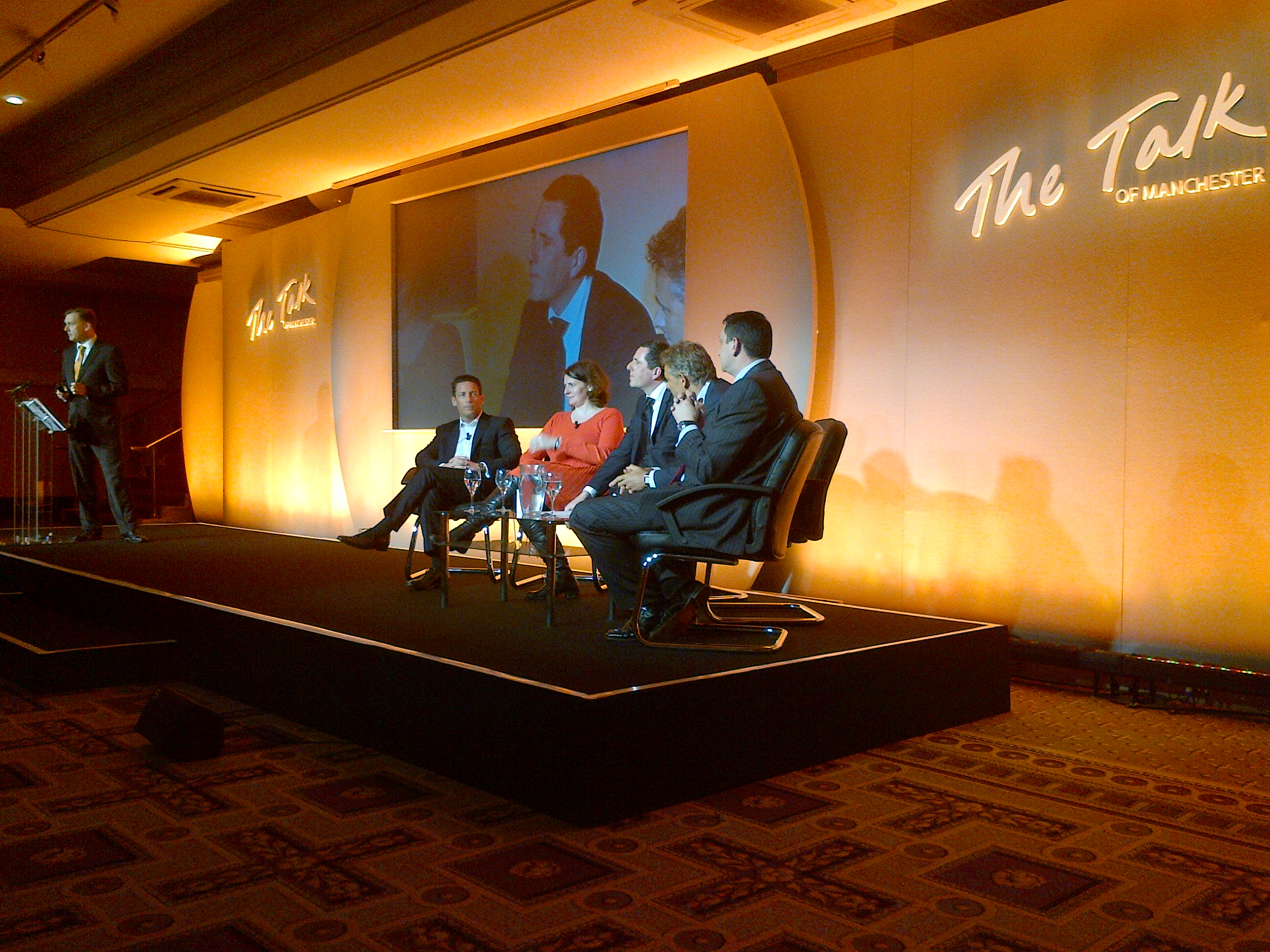 that is great about Manchester….and the North West.
The event opened with the perennially incredible, motivational and energetic Michael Finnegan, CEO of i2i – the Peter Kay of business speaking. Michael is always a great orator whether on stage or one-to-one, speaking immense sense about the benefit of self belief, positive energy and the fact that YOU can do anything YOU want. Very much reiterating my blog of earlier this week: Your Life, Your Business, Your Career; Your Hands.
Tales of working with several leading sports stars/teams and taking them to the top of their game, and making us all laugh, a lot, he left the 100s of delegates buzzing, filled with energy having set the tone for a fantastic day, having banished every negative word from their vocabulary and leaving every delegate thinking about where they could hammer their ‘Mary Peters’ nail whilst being adamant that they would never again be a Lord Voldemort.
The day progressed through comedians, lawyers pretending to be comedians, an incredible insight into Media City from former BBC News presenter and FA Exec Paul Newman, then through Question Time and ultimately to the headline speaker: Michelle Mone of Ultimo bras.
Internationally renowned Businesswoman, Entrepreneur and Glaswegian straight-talker. Whether we knew about her or not, the room fell in love from the second she opened her set with her heart on her sleeve, tackling head-on her recent ‘events’ and why they were merely serving to make her stronger.
Michelle’s rags to riches story is compelling, the practical evidentiary case study to everything Michael Finnegan had said 4 hours earlier. Michelle proved that she has taken her two prime assets and created an internationally successful, market leading business. Her assets were very evident yesterday (I’m talking about her Attitude and ability to spot Opportunities….?).
From her early entrepreneurial days running a newspaper gang in the tenement buildings of Glasgow, at the age of 11, to her £500, £mutli-million product launch into Selfridges. From mailing product to Hollywood stars (and becoming Julia Roberts’ key Supporting star in Erin Brockovich) to telling the CEO of Saks 5th Avenue to ‘leave her alone’ in a style that only someone from the East end of Glasgow could; Michelle proved that anything is possible if you emulate her assets (still talking about Attitude/Opportunity….).
Our bit, Question Time, was the chance to engage with 200 business leaders. My fellow panel members had an incredible pedigree, all controlled by event compare extraordinaire, Dimbleby beating, host Michael Taylor.
Jennie Johnson, CEO and founder of Kids Allowed, undoubtedly the most forward thinking childcare/nursery provider around; Tim Bacon, Living Ventures CEO and brains behind many of the region’s top restaurants; Marc Duschenes, former city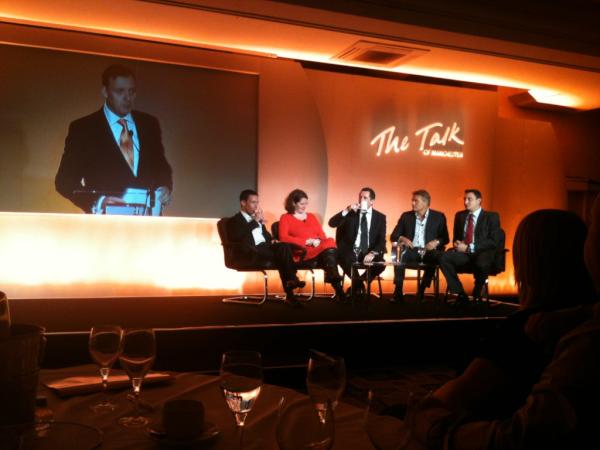 wunderkind and now CEO of Bayfield Capital; and last but far from least, my good friend in lycra, Phil Jones, preeminent business brain, technologist, opportunity engineer and MD of Brother UK….and of course me whose tags seemed to be ‘Notorious’ & ‘Outspoken’ as well as ‘HeadHunter’ & ‘Business Commentator’.
Despite mostly all knowing each other beforehand, the panel gelled and were hopefully able to give great opinion, insight and business advice to the room. Discussing everything from our decision not to take part in the recession; women on boards of directors; whether to listen to or ignore customers; and the advance of technology. It was great fun, but with a very serious undertone.
The whole event was an unmitigated success, and great testament to the founder & organiser , Paul Kilroe. The whole event also typified what is great about Manchester and Manchester business: It’s People.
As a Head-Hunter, I have seen, been immersed in and promoted the notion that people are the most important resource and component in any business and thus the attraction of the best people for your business has to be a prime focus for any business with any desire to improve or change for the better.
As any person climbs the corporate ladder and increases their influence and responsibility, their personality becomes ever more critical, and their attitude becomes as important as any of their specific skills or experience. As Michael Finnegan exemplified with his Lord Voldemort story, a manager/leader’s demeanour first thing can set the tone for the entire business for a day – potentially 1000s of man hours.
But even more so, their overall attitude to life is often the most critical factor behind success. As we touched on in Your Life, Your Business, Your Career; Your Hands, Your seat in either the “We can do this” camp or the “I’m not sure” camp is business, and life critical. Henry Ford: Whether you believe you will succeed or not, you are probably right.
As parents/managers/leaders, we all have a duty of care to ensure that those who we influence are immersed in positive thought; Encouraged “they can do anything” more than told they are can’t. No-one can under-estimate the massive, beneficial future impact that will have on them, and on you. It’s all about a positive attitude.
Judging on yesterday, Manchester and the North-West has it in buckets, and it is without doubt a major factor in our regions success….and it will be a critical component to ignoring the current technical recession the country is in. Reminding ourselves that every minute spent obsessing about a 0.2% drop in UK GDP is a minute we are not focussing on our own businesses. Let your competitors worry about incremental movements in GDP while you steal their market share. Business as usual.
If in doubt, just think about Michelle Mone’s assets!
Another blog on last night can be found here from Phil Jones
Michael Taylor’s thoughts on the event can be found here
What happened to the ‘Job For Life’?
Posted on March 8, 2012 8 Comments
It’s my wedding anniversary today; four years, no time at all in the halls of marriage….. but in career terms, four years is now a well above average tenure. What happened to the ‘job for life’?
Times move on, businesses move on and careers have certainly moved on. The average (median) tenure for people’s current jobs in the UK is now significantly less than 4 years, yet only 25 years ago it was almost 10 years. The average number of different jobs held in a lifetime is now 11.8 for men and 10.6 for women (the female ratio increases to be higher than men once you take out the effect of ‘family’).
For young professionals, the stats are even more surprising. Professionally qualified individuals under the age of 35 move jobs, on average, every 2 years 2 months. Once that age profile moves to 35-45 it improves, but only to 3 years 1 month.
If we wind back a generation, the ‘job for life’ was very common place. Wind back two generations and it was positively expected. My father in law stayed with his employer from his very first day of employment, right up until he retired. My grandfather began working for the civil service at the age of 15 and concluded his employment, in 1977, after almost 45 years….and he took ‘early’ retirement.
We do still see some people getting to 25, 30 and even over 35 years service, but the realistic chance of someone entering the workplace today and staying with that employer for 40 years is almost nil. Is it the people, the businesses, the nature of work or the world in general? Or a combination of all four?
The world is turning a lot faster, in just about every conceivable way. Man’s ability to get around the world is increasing exponentially. Countries ability to shift their economic positioning is accelerating like our forefather would never imagine (See China and Greece as diametrically opposed examples). The world’s appetite for change and development is on an accelerative path like we can’t begin to comprehend – and technological advancements are responding to that desire (or are they fuelling it?)
Businesses are different. Very few businesses genuinely stay in the same, recognisable form for a decade, let alone for a generation. That is a comparatively new phenomenon. Genuine Blue-Chip businesses that dominated decades of this country’s commercial power up until 20 years ago are now few and far between, one could argue that there are no such things as Blue-Chip businesses, in this country at least – save except for the major banks, as controversially proved in the last 4 years. The pace of shift in the make-up of the FTSE-100 is further proof of that.
The nature of work has evolved. 50 years ago, over ¾ of the employed population were employed in what would been deemed blue-collar employment, or unskilled labour. Today that number is estimated at 43%. Blue collar workers are 3 times more likely to be in their job for in excess of 20 years, but that again is falling.
People are probably the biggest element though. Our appetite for change, our hunger for development and our unwillingness to tread-water are like we have never seen, and it is only getting worse. The global appetite and impatience every time Apple launches a new product are again proof of that – despite each hyped build up is less than a year since the last amazing developmental launch of a ground breaking product that by tomorrow will be outdated and to some at least, worthless. After a year.
The ‘playstation generation’ have grown up on immediacy. Instantaneous internet and computer speed, the immediate playback digital music and video provides. They have become used to yesterdays launch being outdated before they hear about it – their attention constantly focussed several phases ahead. How do you expect someone to do the same job for 20 years when they get impatient over the annoying wait until a video game starts or a streamed movie loads?
Add in modern day human’s transitory mindset – nothing lasts forever, and fewer things are expected to last more than a few years (marriage included!). Virtually every purchase we make is seen as almost disposable. White goods expected to last maybe 5 years, tech products less than that. There are even fewer and fewer younger people staying in the same house/location for much more than this magical 4 years.
Given all of the above, it isn’t difficult to see why the average tenure of jobs is getting shorter and shorter, fast forward 15-20 years when current ‘lifers’ fall off the end of the employment statistics, expect that figure to plummet yet further.
There are however financial and career development reasons for such short job tenures. The average ‘job for life’ worker can expect their earnings to increase just 2% above inflation/cost of living, this compares to the average pay increase for those moving jobs of 12% over the last decade (impressive when there has been downward pressure on earnings over the last 3 years). Those getting internal promotions will typically see just an average of just 7% increase.
Two of conversations I had yesterday were with people I placed into similar level finance jobs in the late 1990s. Both with sizable organisations. One has only recently departed that same job, he has had 3 promotions and his exit salary was just 30% higher than his starting salary 14 years ago – in physical terms – in real terms, it is probably no higher. The other individual has had 5 jobs, 3 of which I have put him into. His current remuneration level is over 3 times what it was 13 years ago, and his package value well over 5 times that of 13 years ago. Moving works.
It’s also my fault.
There is a final reason though – the recruitment industry, and specifically Head-Hunters. Professionals taking the decision to consider looking for a new role, and thus asking me for advise on doing so will typically do so when they are naturally ready for a fresh challenge (whether driven by carrot or stick). However, the Head-Hunting/Exec Search sector will approach people well before that time.
This may be somewhat unpalatable from an employer perspective, but our clients want the best – and the best will seldom be actively looking on the job market, and are highly unlikely to be sat on a recruitment business’s active database.
This is also the reason the Exec Search market is growing so quickly, as businesses realise that in order to capture the best talent before they go public, they need to get someone to map, search, approach and lure the best talent for them….and that’s where we come in.
….Alas whilst our actions are driving our clients’ businesses forward every quicker, they are also putting the gold-pocket-watch industry under threat.
How much growth is enough?
Posted on March 7, 2012 Leave a Comment
We appear to be obsessed with growth. It’s the subject of just about every board meeting and strategic discussion. It is also often topic number one in the ‘broadsheets’ and even in the tabloids.
Will the economy grow by 2% this year? Or will we face disaster and barely make 1%? But what is growth? And crucially, how much do we really want?
Macro economic growth is what we hear about, incessantly it seems, from politicians, media and commentators – especially the doom and gloom merchants. Positive growth is good, negative growth is bad. Quarterly [GDP] growth figures are the barometer for just about everything it would appear – two consecutive quarters of negative growth means we are in recession.
The obsession over these growth figures is almost as great over that of Bankers and Banker’s remuneration. When we saw a negative growth figure for Q4 2011 the political doom-merchants and economic nay-sayers went into overdrive, panicking over the prospect of the dreaded double-dip. Seemingly a fate worse than being offered the Chelsea FC manager’s job. All of that due to a 0.2% contraction – that’s right, a fifth of one percent. In school that would comfortably be rounded up to zero.
Over the course of the 08/09 recession, the UK economy (output) contracted by 7%. Not 70%, not even 17%, but 7%. This was bad, and more severe than any recession in living memory, but one could argue, not as bad as several other factors currently dogging the UK – especially the UK’s debt position which currently stands at somewhere between £1trillion and £3trillion (dependant on whose figures you listen to, and whether you include all liabilities, including pensions).
Yet it is still growth that we are obsessed with, largely because the media tell us to be, while building the negative case, spreading doom and gloom. This is the reason that a massive number of the general public think we are currently in recession – despite us having not been in recession for approaching 3 years.
Economists predict growth will be approx 1% this year (downgraded from the dizzily high expectation of nearly 1.4%) and not much above 2% per year for the rest of this decade – considered poor compared to an average of less than 3% for the last decade. This seemingly miniscule difference is still managing to fill 1000s of pages of media commentary, as well as fuelling immense political debate.
Everyone is striving for macro economic growth – but how much do we want? Do we really want the UK economy growing at 5%? Or 10%? Growth would see the demands on key materials stretched (witness some commodities and raw materials rocket in price purely on that back of China’s 9% growth), critical pricing indices rocket (witness house prices in times of economic ‘boom’) and risk attitudes relaxed to potentially dangerous levels (witness pre-2007 leverage levels).
Lessons from the East
Even China, through Wen Jiabao, has lowered their growth targets for 2012 to a mere 7.5%, their 10/11% growth having caused them long-term issues. China without doubt has prospered by industrialising rapidly. Chinese workers formerly employed in agriculture have been lured to cities to produce goods for export. The export demand for such goods, coupled with an undervalued currency, ensured that China built up a huge surplus of savings. But did it become a fateful consequence.
Inexpensive imports kept inflation low. The central banks thus had leeway to ‘play’ with interest rates. Easy monetary policy, combined with lax banking regulations, sparked a credit boom that turned to bust (does all this sound familiar yet?). However, because of the underdeveloped state of the Chinese banking system, much of the country’s immense foreign currency reserves were recycled in the US debt markets…. The rest is history.
Now it could be highlighted that China’s recent robust growth has helped the western world escape a double-dip recession, and that if the pace of Chinese growth decelerates, that may make such western recovery more difficult.
Chinese growth had led to greater economic strength, but having expanded through exports, China now has an emerging middle class and a demand for services and imported products, rather than indigenous manufactured products. Service sectors do not have the same potential for productivity gains as manufacturing. Ergo: Chinese growth over the medium term will probably be more geared to domestic demand and slower than it has been in the past decade. Victim of its own success.
Furthermore, with pressure for wage rises (that have been lagging behind production growth) on the back of such tremendous economic growth, the pressure on the (weakening?) economy will increase. All because of high growth. Minor concerns compared to the Eurozone, and the rest of the world, but it still goes to highlight an inherent risk in comparatively high growth (macro) economies.
The UK would have a further challenge against high growth. Chinese growth levels in this country would likewise see business prosper, likewise see the rich get richer, likewise see wages lag behind business growth (and business owner earnings)….which would in turn inflame the same media commentators that deride our lack of growth today.
SO is there a level of Macro Economic Growth with which we would see universal acceptance and happiness?…and maybe even a smile appear on Robert Peston’s face?
What about YOUR business.
What about Micro-Economic Growth? For a start, forget the GDP figures. Fractions-of-a-percent changes in Macro-Economic growth are utterly meaningless to an SME. Even whole percentages have very, very little relevance to most businesses, and obsessing on it will mean you are not in turn spending the relevant time on your own growth. Forget the growth outside your business; make sure your metrics are heading in the right direction.
Clearly, even within micro-economic environments, growth at all costs is equally foolish. Witness a well known business, famed for meteoric growth during and despite the recession, doubled its turnover over the course of 3 years, launched new products, entered new markets, began supplying top-tier customers…but forgot fundamentals such as cash, margin and crucially ensuring that profit didn’t shift in the opposite way to turnover. Its administration and subsequent break-up will be announced over the next 6 weeks.
Top-line growth is easy. As the old euphemism goes, any fool can sell something at a loss. Profitable growth is harder, maintaining positive cash-flow through profitable growth even harder still. But sustainable, profitable growth should be, in theory, uncapped.
Plenty of businesses witness annual top and bottom line growth in excess of 50%, many greater than 100% but they do so with planning, intelligent leadership and a growth strategy (see my guest blog on the Business Growth Hub website about ensuring People are at the centre of your growth strategy)
“It’s not knowing what to do, it’s doing what you know”
The answer to both business and country/GDP (Micro and Macro Economic) growth is to know your ‘business’. Tony Robbins’ quote above may sound flippant, but anyone who had led a business to a specific level, knows what that business needs to do – even if what they need to do is replace themselves with a right leader for their business’s next phase.
Too many leaders spend time re-inventing what they need to do, rather than just following what they know needs doing. These leaders forget the notion of having two ears and one mouth for a reason. Understand where you want to be, decide how you are going to get there, design the path/route/strategy to follow (and be open to others suggests on route-planning) and follow it.
Governments can’t do this, they have politics/media/opposition benches/less-informed public opinion to pander to…..but businesses don’t have that excuse.
Grow within your capabilities, by design, by plan, by strategy. Push yourself, drive yourself to achieve more but know when your growth targets are enough.
Fur Coat, No Knickers.
Posted on March 5, 2012 1 Comment
Style over substance.
“Image is everything”. We spend £1,000s on clothes, skin care, hair products every year (and women can be even worse) all in the quest of improving our image. Dozens of entire industries have been born out of humans desire to maximise how others see and perceive us – irrespective of what the reality is underneath.
We are all guilty of assessing people based on their image, and those opinions formed are seldom changed easily. The way someone looks, talks, smells – their body language, their vocabulary, their clothing, their perceived Body-Mass-Index. Some will term them prejudices, others just being human. And it is just human.
One of the worst examples of a snap shot assessment of individuals is in an interview situation. “You pass or fail an interview in the first 5 minutes” is incorrect – you have nothing like as long as five minutes. Visual assessment of an interviewee (and interviewer) – 10 Seconds? 20 seconds? Full opinion formed – 2 minutes? As long as it takes to assess their handshake? You get the idea.
NB: This is where your Head-Hunter/Consultant should really earn their stripes: Interview preparation (expect a future Blog, but contact me in the meantime for further info). Understanding the person you are meeting and ensuring that crucial first impression is maximised is vital. Chemistry is everything in recruitment. Beyond that you become more technical and enter the amazing world of Neuro-Linguistic-Programming (NLP) – but more of that in a future Blog as well; in the meantime Google Richard Bandler or Tony Robbins (twitter: @TonyRobbins) for more on NLP.
But what about in broader life and crucially, in business?
Image/Style is important. Everyone likes to see and be in a smart office. The law firm with a prestigious Downtown/City/New York address, or their professional advisor that is ‘obviously so good/successful’ that he arrives in a £150,000 executive car (and negating the weak “your fees are obviously too high” retort – see Celebrating Success for more details), but where does substance fit in?
The internet, and dare I say it, Social Media has made Style easy to maximise. Anyone with a reasonable £4-figure budget can build an impressive looking website; even better, with wordpress sites (such as this one) and a bit of time, patience and flair you can build a passable website for nothing. Add in a reasonable social media understanding, strategy and presence, even the smallest entrepreneur can look like a global enterprise – ever wondered why some search businesses perennially have ’25 staff’ yet you only ever hear about 5 of them?
But style is short lived. Even impressive looking websites, owned by drivers of £150k executive cars with a flash City address will be left wanting as soon as you dig beneath the surface. No-where is this more prevalent that in recruitment, and particular in executive search. With minimal barriers to entry, the industry is awash with businesses and business leaders for whom style is greater than substance. Fortunately the majority of these are comparatively easy to spot. Anything that appears too good to be true, especially with cost, is usually cause for alarm bells.
Many head-hunters have made great careers out of promising masses at minimal percentages, but delivering very little, and wasting weeks and weeks of client time in the process. But by then the head-hunter has two-thirds of his fee, without any contractual refund or even rebate clause, and he can move his slick sales patter on to the next. Style over substance.
So it’s all substance?
Substance (delivery) is important, again especially in a recruitment context. People serious about attracting the best talent are focussed on the acquisition and delivery of that talent – it’s all about the candidate. Ergo; the ability to deliver, to successfully complete becomes the critical factor. Those few head hunters with a 100% successful track record have an unparalleled USP – having maintained a 100% success track record on retained mandates throughout my career is still my biggest USP, and the element that wins more business than any other. It is all about delivery.
Beyond that, both individual and client companies will benefit from a substance biased advisor. Straight talking, knowledgeable, direct and in control. Passion is also a vital component. The last two mandates I won were hugely influenced by the fact that both contacts saw how much I wanted the business, and how tirelessly I would work to ensure delivery, and not just to maintain my 100% record.
However…..If you are serious about finding THE best candidate, and not just the best candidate on cheaper recruiter’s database, substance will need style to be successful. In a world where we have to sell your opportunity and your business, at times more than selling candidates to you, it is essential you have an advisor that has the ability to manage your PR, understand your business, and then sell your business, and gain significant interest, without over-selling it.
If we accept that the bulk of the higher quality talent will have to be headhunted – they don’t sit on recruitment databases – then for many such prospective senior managers, their first introduction to your business will be the head-hunt call they get. Much like the interview situation, the initial impressions are formed in seconds. Style has a place. Likewise through the process, every impression gained of you/your business prior to interview will be in the hands of your Head-Hunter. You don’t want a beige cardigan (miss)selling your business.
Money where our mouth is
Ceteris Paribus – ensuring a delivery focus (substance) solution is still the most important objective for the best recruitment and executive search firms. Doing so in the most client focussed manner is what has driven me to work differently. Eliminating risk from Executive Search and rebutting the criticisms levied against our sector.
Guaranteeing successful conclusion within 6 weeks (against an industry average of 4 times that) or your money back – not a rebate/credit note, cash wired to your account immediately, such is our confidence in our ability to deliver. Furthermore, offering a free-replacement for a YEAR after placement should the individual leave. No one else in the recruitment sector has the confidence in their substance to offer the same.
The Final Caution
The final caution on employing style over substance is the most common reason why in-house recruitment solutions fail. Remember our interview comment above – the first impression. Many businesses forget or simply don’t bother to dig beneath the surface of those they interview. In short, recruiting people they personally like and could be friends with, rather than matching both skillset and organisation chemistry fit. Without the control of an independent head-hunter, many businesses not only fall into the Fur Coat/No Knickers trap, they get caught fully exposed.
Be Serious.
Posted on February 27, 2012 7 Comments
For weeks on end, for almost 10 years, millions of TV viewers have watched Simon Cowell publicly berate dozens and dozens of people, all with a quest to exploit their talent in the name of success. Many people proudly stride onto the X-Factor stage, convinced their talent is world class only to be ripped to shreds and tossed on the unwanted pile. Yet despite perfect knowledge that over 90% of applicants end in that same way, 100,000s of people arrive each year to be subjected to the high-waisted-trousered music mogul’s critique. Are they just wanting fame through public humiliation?
Or do they recognise that praise and acceptance from someone so straight-talking and so serious about his business really means something? (as opposed to the Louis Walsh ‘PC’ model of just loving everyone, especially the underdog).
For many it is the fame at all costs approach…..but those who are serious about furthering a career in the music industry recognise that if you get accepted by Simon Cowell, you really do have talent and really do have a chance at furthering your career. What’s more, if Simon likes you so much as to offer advice as to how to improve your chances yet further, the serious person will take such counsel as gospel, and benefit from it. Serious approach, honest appraiser, straight-talking feedback, believable outcome.
Is that only relevant for those wishing to further a music career? Or is it true, and available in any profession?
This side of finding the “Simon Cowell of Recruitment” and creating a career-accelerating reality TV show, the options would appear limited.
Walk into any high-street agency and you will typically get a faceless individual offering you a generic application form with 99 questions, the majority of which are more concerned with demonstrating an anti-discrimination stance through questioning your ethnicity and overall demographic profile. You may get to meet a real human being, who may give you some actual attention and may even spout some well-rehearsed corporate lines to you about the state of the market and how great they are at getting people a job and how your skills are so fantastic there really is no need to go and see a competitor. You might even hear from them again afterwards.
Or you can find a credible, highly experienced Executive Search business/consultant. Anyone realistically approaching such a Head-Hunter will typically be seeking a £six-figure salary. That in itself is serious, and warrants a serious response. No time for lip-service, just direct feedback.
A serious approach will elicit a serious response, and a serious service. Bluntly objective and honest feedback on you, your realistic chances of progression through a process, and of the outcome of every stage. Find an exceptional and highly connected Head-Hunter, you will also get introduced to high-quality, synergistic business leaders within their network to open further doors for you and as minimum, extend your own network. But such a service will demand commitment from the job seeker. If your head-hunter is prepared to meet you at all hours of the day, and more usually, all hours of the night, and introduce you to key members of his/her network of contacts he/she will expect commitment and a high level of seriousness in your approach and a desire to look for alternative opportunities.
Unlike the X-Factor applicant, with the crowd sat behind Simon Cowell, you will not have public support from the comments made by your blunt and starkly objective appraiser, nor do you get the chance of 3-out-of-4 yes votes. But again, getting positive comments and an acceptance to work with you, qualified praise and overall commitment from your straight-talking head-hunter is a great accolade.
That same serious, objective approach is an immense and vital asset when you are recruiting. Over 60% of mandates I have undertaken have been vastly altered through consultation with the Hiring Manager, HR Director or entire Board of Directors. Challenging the realism of procuring the skills you want at the remuneration level you are prepared to pay is the easy bit, gaining a true understanding of what is being sought and more crucially, what the role/individual is to deliver can be a highly contentious process.
Consulting (and at times arguing) on appointee backgrounds, levels, reporting lines, qualifications, demographic background needs a straight-talking partnership between head-hunter and client. It also needs a serious attitude and above all commitment from the hiring manager. Salaries, packages and employment costs of a Senior Exec can be well into Capital Expenditure levels – commitment and bluntly objective discussion is essential from both parties.
Recruiting business leaders is serious business. Accept 80% in place of 100% and you water down the quality of your leadership team. Allow these 80%-ers to recruit at 80% of their competence and before you know it, your next generation of management will be only 50% as capable as you want, and need.
Easy to see why then the bulk of the country’s leading head-hunters, and leading businessmen, are bluntly objective, place substance over style and above all demand seriousness from their partners.
Demonstrate a lack of seriousness and commitment at that vital initial impression stage and you can expect to be kicked off before you even reach ‘Boot-Camp’, let alone the ‘Live Finals’.
To Get Serious about your search, contact me
PRESS RELEASE: Gary Chaplin scoops charity award after prize pitch to Dragon Theo
Posted on February 10, 2012 3 Comments
Corporate HeadHunter Gary Chaplin delivered a winning pitch to Dragon’s Den entrepreneur Theo Paphitis to scoop the Many Hands Charity Campaign Award earlier this month.
The business owner impressed a panel of judges, which included Ryman’s chairman Theo, by giving his winning speech while cycling on his bike!
Gary was the only individual up against four businesses shortlisted for the award which comes after he organised a bike ride from London to Manchester that raised more than £14,000 for Royal Manchester Children’s Hospital Charity (RMCH).
Congratulating Gary on his win, Theo said: “Gary’s award was very well deserved. He raised a massive £14,000 which was a phenomenal achievement.“
“His pitch on the deciding night was unforgettable because the entire presentation was given while cycling- that in itself was a first.” [Presentation can be seen here]
“It is great to see small businesses such as Gary’s get behind such initiatives. Well done Gary!”
Gary was inspired to fundraise for RMCH after nurses from a hospital linked to the charity saved his daughter Ava’s life when she was born six weeks premature.
He said: “Ava contracted an infection when she was five-days-old and as any parent will testify, seeing your child very ill is everyone’s worst nightmare.
“It is thanks to those nurses that my daughter is now a very lively, robust, vocal three-year-old,”
As part of his prize, Gary will also receive a day’s training and coaching from leading business coach, Nick Robinson and spend time with Theo.
He added: “It is extremely humbling to be the winner of the Many Hands Award, especially against such stiff competition and fantastic charity initiatives by some great businesses”
“The ride was a great achievement, not only in the amount it raised and the incredible support we received from so many businesses, but also in the camaraderie and positive spirit all the riders felt working so hard for such a worthwhile cause.”
Maurice Watkins, Chairman of RMCH, said: “All of the finalists did a fantastic job with their pitches, but it was Gary’s determination and commitment that really shone through on the night.
“We were impressed with the effort he put in to organising the bike ride and the awareness he achieved to help make a difference to children at Royal Manchester Children’s Hospital.”


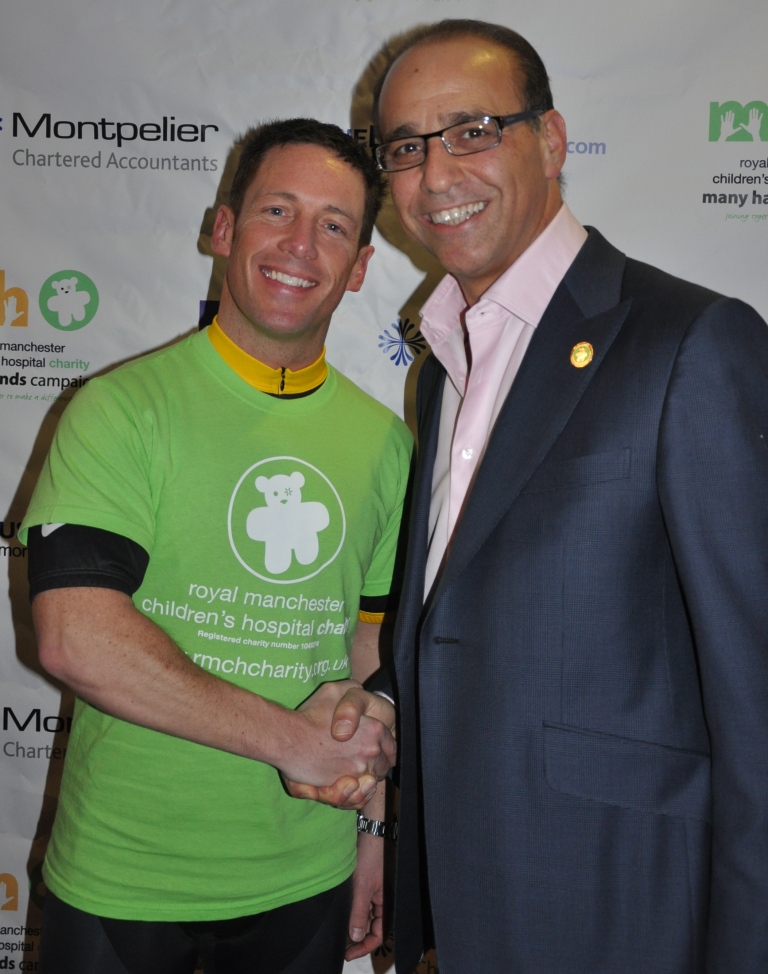
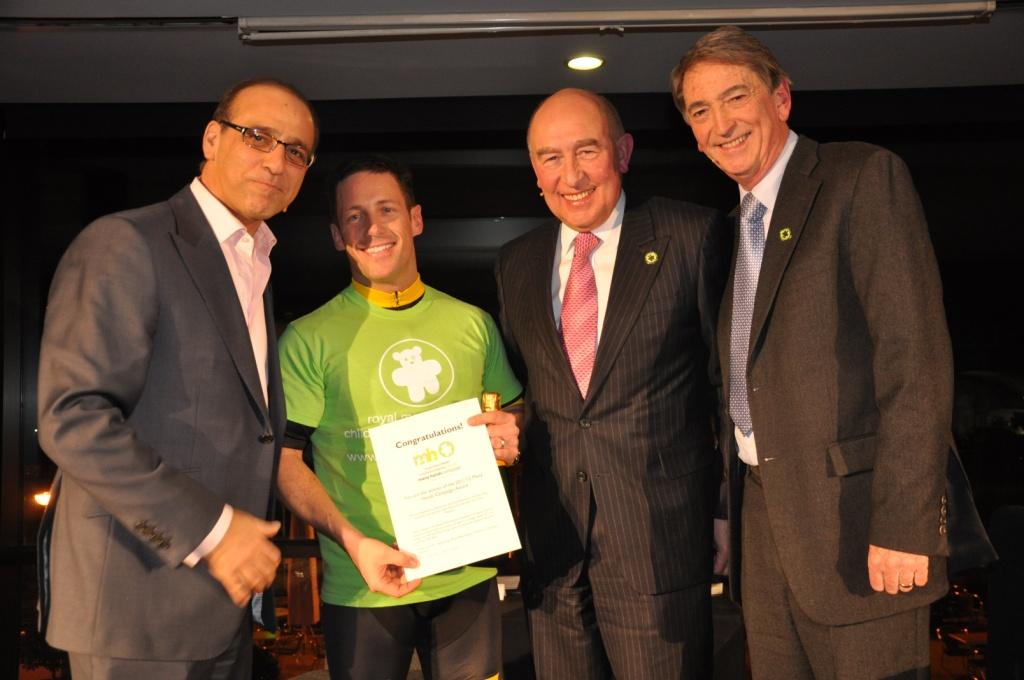
Charity Award Win – The Presentation
Posted on February 3, 2012 2 Comments
Last night, I was announced as the winner of the Royal Manchester Children’s Hospital Many Hands award in recognition of last September’s Charity Bike Ride. Details of the ride itself can be found HERE
Getting recognition for your efforts is always welcome, but this was particularly emotive: The Charity and the Children’s Hospital as a whole are very close to my heart, and the support and team spirit were unlike I have ever seen before.
Never mind organising the ride, signing riders up, engaging dozens of business, gaining 100s of donations…and the small matter cycling 213 miles – arguably the biggest challenge was after the shortlisting. The 5 shortlisted Many-Handers had to perform a three minute pitch Dragon Den style, to the lead Dragon himself – Theo Paphitis along with Charity Chairman Maurice Watkins, Business Coach Nick Robinson, Business Desk Editor Chris Barry and Kath Martin from Montpellier Accountants as well as compare Gordon Burns and 130 guests. …and we were told to be original.
Original? I did it on my bike. In Lycra.
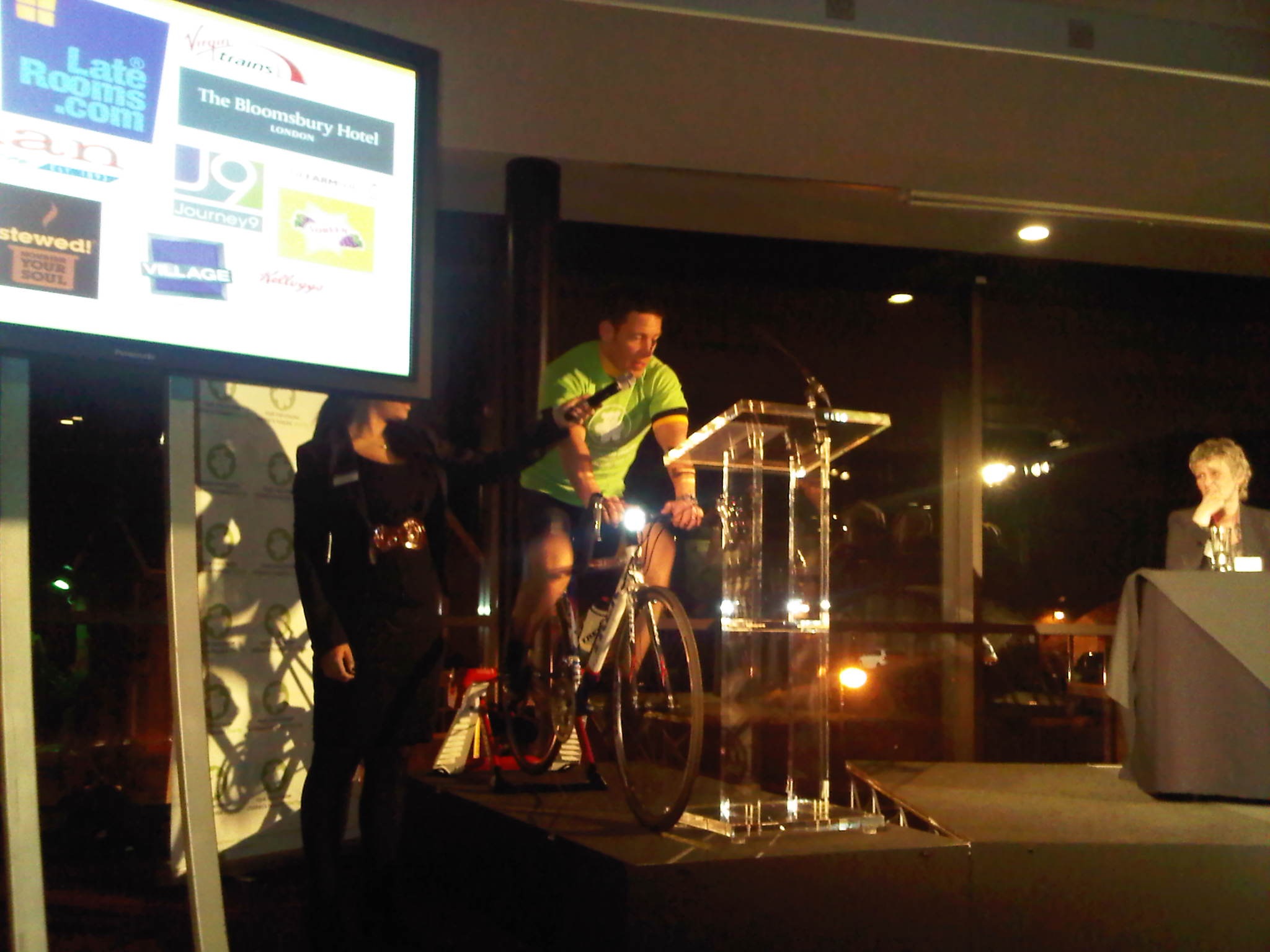
But it worked. I am as humbled by the outcome as I am by the enormous amount of support we got for the ride. But it was a team effort. The organisation, as well as the ride itself. I had a lot of support. The riders, all the businesses (see logo’s below), everyone that helped with the organisation (not least of which Paul Carruthers for the route planning) and everyone that donated getting us to the incredible total of over £14,000. Thank you.
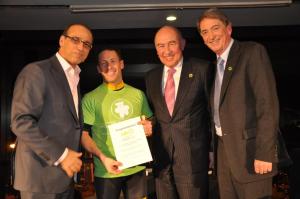
The 3 minute presentation:
It was all Laura Wolfe’s fault. It was a year ago tomorrow, after last year’s Many Hands launch event, she called me, at 6am, wanting make sure I was taking part. Now Laura was heavily pregnant at the time, and I’ve learnt not to upset women in her condition.
“Yes” I replied quickly.
“Great, what are you going to do?”
“Er……..I’ll organise a bike ride, we’ll get a few riders and ride from Manchester to….er….. Theo’s house?”
“Great!” she replied. “We’ll help”….and hung up.
6 hours later, after conversations with Jenny from the Charity, Tina from Ryman and a dozen or so contacts/clients, it was happening. ….I had to try and find my bike – it hadn’t been touched since we moved house, 3 years earlier.
The ride ended up going from The Ryman store on the Strand to the Velodrome in Manchester, via the hospital.
2 days
213 miles
8547 feet of climbs
15,000 calories per rider.
And crucially, over £14,000 in fundraising.
I gained some colleagues help fairly easily, despite most admitting they hadn’t ridden for over 5 years, others took more persuasion. But they took part and ironically the ride probably ended up being a bigger team building exercise than anything the business had organised itself.
But I needed more. I needed to engage clients as riders, and sponsors!
I opened my Head-Hunter’s little black book and despite very few people having knowledge of the Hospital or the Charity, the support was fantastic. That education became a key part to our fundraising.
My contacts came good – 12 of the riders were clients/contacts, and we also got support from over 20 businesses giving food, transport, accommodation, stationary and general support.
That done, we had to spread the word for sponsorship and physical support. I had 5000 hits on the bike ride website, 300 separate donations and over 500 messages of support – all noting the strength and validity of the Charity as a cause to support.
We engaged social marketing, especially Twitter. Tweets went viral and were mentioned and re-tweeted over 1000 times, including by celebrities and other notable individuals such as Bradley Wiggins and Lance Armstrong. This elicited donations from around the world as people heard about the event and crucially, the charity.
One of the biggest wins of the social media exercise was through one of our supports, the infamous ‘Slick Skin’ anti-chaffing product (a product every single rider became very passionate about….it protected our ‘assets’ – literally). Having seen all the tweets about the ride, Help for Heroes picked up on the product and discovered it was perfect for amputees returning from Afghanistan – they now supply it by the truck load.
Looking back there were many achievements. Riding 213 miles (and 130 on the first day) was immense. Of course the total raised was a great achievement but probably the most important – it brought together a group of like-minded, motivated individuals, working as an immensely effective yet highly selfless team – focussed on just one thing, the delivery of an ambitious project to benefit the Royal Manchester Children’s hospital.
The positive spirit was incredible and drove every single rider mile after mile.
I believe every aspect of the ride perfectly embodies what the Many Hands appeal stands for. An idea from one person, engaging 25 riders, 100s of supporters, all to the benefit of 1000s of Children.
Interfering Bankers
Posted on January 30, 2012 8 Comments
It used to be that the hunting season began in August, on the ‘glorious 12th’, with Grouse, before moving onto Partridge and Pheasant. Nowadays, however, it begins several months earlier with Bankers bonuses. A hugely political hotbed, fuelled by politicians (who have demonstrated absolutely no moral compass when it comes to remuneration/expenses) and tabloid media (from whom even the reported date has questionable factual content).
Cue Stephen Hester who had the sheer audacity to accept a (reduced) bonus awarded in return for his performance, under the contract set up by the very people who have spent days criticising him vehemently (see the ‘moral compass’ brigade above). The same people who have now forced him to waive his bonus.
This is a bad thing. Leaders need to be left to lead, not interfered with by people who sit in a position of ignorance, repeatedly reminding us why they are unable to lead. Anyone else accepting a position under specified terms would have cried foul if those terms were suddenly posthumously altered for political gain – heaven forbid if it happened to a unionised worker, the stampede following the call to walk out would have been deafening.
I had a bonus refused to be paid last year from my (now former) employer. No reasons, just a load of excuses. The detrimental effect was immense. Most bankers are perhaps not as beholden to their bonuses as I was last summer, but to have a bonus removed despite (over)achieving will cause fall-out. RBS can’t afford for its key talent to depart to competitor businesses.
Hester has been widely credited with doing a very good job. He wasn’t part of the old guard at RBS – a small matter that has got in the way of the salacious reporting, politician posturing, tabloid pomposity and subsequent ignorant hysteria. He was hired to run and turn-around a thoroughly knackered bank, a bank that had been decimated mercilessly by a number of people (largely self-serving bankers, usually fuelled through greed but also including Teflon politicians amongst the mob).
Despite new capital rules introduced by global regulators changing the economics of Investment Banking virtually neutering one of the RBS’s prime profit generators, and the difficulties imposed by the Independent Commission on Banking to split banks (and of course the small matter of the Eurozone crisis bringing share trading to a virtual standstill as well as killing off deal, IPO, fundraising and M&A activity) …..He has returned the bank to a multi-billion profit. That is good news.
He has re-focussed RBS’s operations; divested many of the non-core assets that partly led to its over-exposed downfall; trimmed a mass of excess; and reduced it’s balance sheet by £600bn (not £600m as several pot-shotters have mistakenly said – more reasons as to why not everyone can run a bank).
When Stephen Hester took on the poisoned chalice role, he did so on a significantly lesser remuneration than he could have gained elsewhere. This man, who with a humble background, educated through a comprehensive school, has worked bloody hard to put himself in the exceptionally exclusive club of people who really *can* run a global financial services organisation.
He also had the guts and appropriate attitude to take on this largely state-owned (read that as continually ‘politically interfered with’) bank and turn it around, arguably the UKs single biggest barometer of the financial services crisis that triggered a global meltdown.
He took on the job that he could never win at. No matter how quickly he restructured the bank, restructured the balance sheet, restructured the operational structure….and returned the bank to the level of performance and profitability that gave it its position as one of the very very few genuine UK Blue-Chip companies (to say nothing of returning to it’s gargantuan tax payments).
Having done all that, he was still being vilified for accepting the already reduced bonus he is rightly owed…..a bonus that wasn’t a bonus anyway – it was a share award, ensuring he had a vested interest in the long term position of the business. A vested interest shared by all 60 million ‘shareholders’, the UK General Public.
And the final ignominy, he had Ed Miliband and a bunch of other bandwagon-jumping rudderless politicians and left-wing ignoramuses turning their perpetual whinging on to him (which would be reason enough to accept the bonus and collect the share certificates with two fingers).
Politicians tried to cry that Hester should ‘remember’ he is little more than a quasi-public servant and as such, should refuse his bonus accordingly. Shame such a strong moral stance from full-public-servants didn’t rear its head during the expenses fiasco. Will these same politicians put yet more pressure on genuine public servants to waive large elements of their remuneration?
Large organisations need good, strong, resolute leaders. The bigger the organisation, the bigger the leader needed….the bigger Kahuna needed. As an RBS shareholder, I had great respect for Hester for sticking to his guns and taking his bonus (Unlike RBS Chairman Philip Hampton who has played the political game and refused the £1.4m bonus he wouldn’t actually have been awarded). Hester’s pre-interfered-with strength and resolution of leadership is a trait that RBS crucially needs right now.
Hester has further demonstrated his strength of leadership by sticking to his guns over lending. The (clearly well qualified) media cite RBS’s lack of lending as a failing – ignoring the fact that lending has increased massively…and forgetting that lending to less ‘appropriate’ businesses/people was the catalyst that led so many banks into meltdown across the globe. So much for political ability in business.
With every ignorant voice coming out of either Westminster House, Whitehall, ‘Fleet Street’ or Union Offices crying for political intervention, they were missing two vital elements – firstly, UK politicians are, with very few exceptions, stupendously unsuitable/incapable to run businesses (they are largely incapable of doing their own jobs). Secondly , the UK Government has just spent an age Vetoing an EU treaty to protect the City as a hub of global capital – to then seek to heavily influence (nay interfere with) a global bank is beyond hypocritical.
RBS has a very good leader in Stephen Hester. He costs them, handsomely. But he is still working well below his market rate and is repaying his comparatively modest remuneration many times over. He needs to be left to do his job.
The risk is that letting the Ed Miliband’s of the world (whose leadership prowess is at the opposite end of the scale) have a voice, is that Mr Hester may just call it a day and leave to return to the arboretum on his now famous 350 acre Oxfordshire estate….and leave RBS (and the taxpayers investment) to flounder.
Miliband will claim credit for this, his gloating ‘interests of the British people’ message just show’s further how out of touch he is with the nation, let alone his own party. It is in the interests of the people that Hester turns up this morning and does a good job rather than dreaming of his arboretum whilst thumbing through travel brochures.
In the current economic climate, businesses desperately need strong, motivated, competent leaders. Look at the vast number of businesses that have failed recently, especially the number of retail businesses, one of the common themes has been lack of strong leadership. Conversely, the businesses that ARE thriving in a tough market are those who do have strong leaders.
But strong leaders need rewards, and that includes financial rewards. In a world of supply and demand, the rewards get greater for the better leaders. The same argument is used for footballers – how can a 25 year old be worth £10m per year when a leader of a global bank (and cornerstone of an economy) be derided for earning a fraction of that figure? Even managers of some footballs teams earn more than Mr Hester – before the bungs.
Bonuses figure in all walks of life. Docklands train operators have recently been award a (politically supported) bonus for achieving….nothing…or at least nothing beyond turning up to work. If a greater political authority suddenly came along and removed their bonus, there would be uproar and (yet more) union calls for mass walk-outs.
When the people concerned are business leaders, the stakes are higher in all regards. “Pay peanuts, get monkeys” is an overused phrase, but talent costs both in terms of attracting but also in retention. I have spent a large part of my professional life finding outstanding talent; outstanding leaders for businesses.
Too many people major on the minor things
All but the smartest businesses get too hung up on comparatively small details. Wanting the best, but arguing over tiny percentages of the initial costs. I have had businesses jeopardise the recruit of key personnel; individuals tasked with £multi-million deliverables, by choosing a recruiter based purely on cost – seemingly saving a couple of thousand pounds….until they have to re-engage a proper head-hunter to rectify the poor job delivered, or not delivered as the case may be.
RBS are lucky to have Stephen Hester, and they know it. His peers earn far more for doing far less, and with far less resolve. Only the lesser qualified (or more ignorant) individuals fail to see the need for strength of leadership and importance of the job strong leaders do.
Having presided over the ruination of RBS and others, and now interfering with (and bullying) the very people brought in to clear up the mess, politicians need to get back to their own jobs and leave the proper leaders of the country to do theirs.
Turning 40
Posted on January 27, 2012 1 Comment
I turn 40 today. I would be lying if I dismissed it as ‘just a number’. It has been a milestone that has been on my mind for some time, but a source of positive reflection rather than mortal dread. Mostly.
I vividly remember my father’s 40th birthday. I was 11 yrs old and 40 seemed ancient. Yet here I am, staring ancientness up the rear pipe. Am I ‘younger’ than my father? Without question – my outlook, my physical fitness/daily gym obsession, my energy and overall zest all help – but my father in turn is ‘younger’ than his father was. Such is the pace of life.
So how do I look back on life now? Mostly, it makes me smile. I don’t really believe in regret. Sure, some isolated events I would approach differently, but then I wouldn’t get the lessons in life from those events. Overall everything I’ve done leads to the person I am today.
25 years ago I was so green you could mow me, studying for GCSEs, thinking I could take on the world.
20 years ago I was at University, studying to be an accountant, playing rugby, drinking and juggling jobs in both a local gym and as a DJ (where I spent several evenings dressed in drag….less said the better).
15 years ago I was 3 years into my recruitment career, learning the trade that would dominate my life, working for a hugely motivational person that is still a positive influence to me today.
10 years ago was pivotal. The loss of a baby during pregnancy and the subsequent relationship breakdown led me to evaluate life a little more, understand the power of the mind and introduced me to NLP. I grew up a lot that year.
5 years ago I was about to start the most significant phase of my career, joining a business that really saw me further my broader development and overall commercial awareness. I was also planning a trip to take my now wife to New York, and to Tiffany & Co. 5Th Avenue, to propose. It was a big year.
As Sinatra sang: “I’ve lived, a life that’s full”. I’ve met some amazing people, I’ve been skinny-dipping with Royalty, I’ve raced cars (including on the infamous Nurburgring), I’ve ridden horses into the Egyptian desert, I’ve modelled for Calvin Klein, ….I’ve been splashed across the Tabloids….
…..Far more importantly, I’ve pushed boundaries, especially my own. I’ve raised tens-of-thousands for Charity, I’ve helped 100’s of people get a new job and advised 1,000s of others. I’ve become a husband. I’ve become a father. And I’ve fully understood the value of people and personal relationships.
But good or bad, it’s all now ancient history. Just as with business (and life) in general, it is today and tomorrow that is important. That which we do today is because of the past, the lessons learnt, the experiences experienced and the achievements achieved, but it doesn’t have to dictate what we do tomorrow. Far from it.
January is a good month to reflect, but unlike Janus, we cannot look backward and forwards. If we spend all our time looking backwards, reflecting on what has happened, focussing on the history, and obsessing on historical facts/data we will at best never move forwards, at worst we will fail to spot the better route, or worst still, crash and cease to exist through not changing course when something impedes our path.
My today is very different from my yesterday. In the last month I have become a business owner. But the bigger shift is to join a business that is itself looking to the future, innovating what it does, looking at better routes to better serve customers and clients. Listening to those clients, being flexible in the approach and planning for the future; a brighter future. Contrast that with businesses that are so obsessed with the past, their past, that they fail to notice new opportunities, let alone have the desire to embrace those opportunities and innovative.
That forward looking attitude has seen the business grow exponentially. In a time when most businesses have failed to grow, and many have indeed decreased, plenty grown, massively. Rather than obsessing with their heritage and where they all were 10/15/20 years ago, intelligent business leaders visualise where they will be in 10/15/20 years time.
The same lessons are true of businesses view of the macro-economic environment. Obsessing over GDP and the movements therein is a fools pursuit. Historic data, highlighting what happened between one and four months ago helps no business. Q4 2011 saw GDP shrink by 0.2%….a ⅕ of a percent. If that had been ten times worse, it would have been no more material for the majority of businesses.
Crucially though, it is old data. The world last October was a far worse place. Business confidence was rock bottom and worsening, the markets were depressed the outlook looked bleak. Four months on, confidence is higher, the markets are at a medium term high and the outlook is suddenly a lot brighter. Leave historic data in the past.
Looking to the future needs strategy, not hope. I have the next three years of my business carefully mapped out. The markets we are in, the clients we deal with, the ways we work and crucially the people we need (contact me if you want to be part of it!). The main reasons business leaders cite for their success is the people around them. The biggest hindrance to business growth is likewise cited as finding the best people…..yet one of the biggest failings of most businesses is failing to plan their staffing needs.
Many of my clients not only focus their energies into the future, but they engage us on an ongoing basis to understand the current market, keep abreast of outstanding talent available and ensure that by the time they need key talent, they have it in hand. Unsurprisingly, these are the businesses that are growing.
Having the right people around you will ensure you surmount your challenges and sail past your key milestones. Much like a 40th Birthday.
Wanted: Disabled Black Lesbian?
Posted on January 22, 2012 7 Comments
Over the last few days we’ve had a number of people bleating about the lack of Salfordians getting jobs at the BBC’s new ‘Manchester’ base…..in Salford. The MEN, The Guardian, Hazel Blears MP (spot a trend?) have all thrown their moans in, after only 24 successful applicants out of over 3,000 applicants came from Salford, and only around a third of the non-internal hires came from Greater Manchester.
Last year, we saw Lord Davies of Abersoch preach to businesses about the lack of women around the boardroom table and signing up a number of politically malleable Head-Hunting firms to a charter to opening discriminate to get more women included in short-lists – despite a wealth of data to highlight that the lack of female representation at the higher grades was down to supply, not prejudice.
Put this against a backdrop of comments from Entrepreneurs and business leaders who consistently cite one of the biggest hindrances to [their] business growth is finding, attracting and engaging the right/best talent.
Spot the issue yet?
Businesses crave and critically need the best talent. The right Head-Hunter will go and find the best talent. Perfect solution…..until the bed-wetters arrive with their rule books, charters, demographic breakdowns, political agendas, diversity policies and enormous range of criteria for you to avoid any potential, vague of-chance of perceived discrimination and/or inequality…..and countering it by openly discriminating.
But it’s ok because this Discrimination is Positive Discrimination (usually as decreed by the same bed-wetters that hold the rule books, and political agendas). The trouble is, it is seldom genuinely positive.
Businesses need the best people to drive their business forward. The BBC in Manchester Salford needs the best people to ensure that the highly contentious move to Manchester Salford is an overwhelming success not only for the BBC and its customers, but also for Salford, Manchester and Greater Manchester.
Appeasing the naysayers, by giving the locals jobs en masse over those better qualified will not help achieve that.
Likewise, telling me that the shortlist I have presented to my client is not good enough because it doesn’t contain sufficient diversity is lunacy – yet thanks to Lord Davies et al., this is the way it is going.
We have already had Europe stamp their feet where they are largely unwelcome, deciding that such wildly discriminatory phrases such as ‘dynamic’, ‘hungry’, ‘fast-paced’, ‘energetic’ etc might not be the best way to attract Mr/Ms Uninspiring/Unmotivated/Underachieving and thus should be outlawed. If they had their way, “Person seeks Accountant” might be as specific as you are allowed to be, publically.
No-one I know would argue against the need to ensure fairness and eradicate discrimination from recruitment and business as a whole, but doing so through further unfairness and further discrimination is not the way to do it.
The only time I have been asked to openly discriminate for any mandate has been to increase the number of a deemed under-populated demograph – including a proudly all-female board that wanted it to stay that way (but ended up hiring a male Finance Director!) Can you imagine if a ‘proudly all-male board’ led business advertised itself as such? And openly searched for a male colleague?
Lord Davies’ well-qualified intervention has increased the number of female directors in the country’s largest companies from 12.5% to almost 15%. Doubtless a positive move in the eyes of the Lord [Davies], but how many better qualified individuals have been discriminated against to ensure a short-list contains its requisite make-up?
The Head-Hunters I have spoken to quietly fly-in-the-face of their employer’s corporate line and admit that they have disregarded better candidates to ensure they hit this politically motivated, arbitrary set level of 25% of shortlists being female.
What then happens when a different Lord decides that a further 25% should come from a different under-represented demographic background? And then a third thinks of a further under represented group? Or geographic location? Or specified hair-colour? Or regional accent?
Imagine delivering the best candidate to your client when over 75% of a 5 person short-list *has* to be from these pre-ordained, irrelevant backgrounds. Are you really delivering the best? Or merely the best within an every lengthening set of constraints? And do you want your business, and it’s performance constrained?
Political correctness or not, I deliver the best shortlist, and the best candidates to my clients. I openly disregard the voluntary charter to ensure X% of shortlists contain arbitrary levels of certain people. I deliver the best.
…..yet ironically, over the past 3 years, more than Lord Davies’ magical 25% of the shortlists I have presented have been female. Because each time, they have been amongst the best candidates for the job.
Great Britain. GREATER Manchester.
Posted on January 18, 2012 13 Comments
This morning, at North-West Business Insider’s latest economic forum, one of the two ‘Dons’ of Manchester, the great Sir Richard Leese, was joined by Mike Emmerich; CEO of New Economy, Rachel Combie; Director of Strategic Marketing at Marketing Manchester along with event host, presenter and eloquent narrator – the eternally youthful Michael Taylor; Outgoing Editor of North West Business Insider
The Economic Forum (#MCRForum) was, as always, a great session, looking at the region’s future, and specifically the economic leadership in the city region. It also touched on ‘The Family’.
Manchester has done amazingly well. Under Sir Richard and Sir Howard’s tutelage, and testament to their commitment and hard work, Manchester has cemented it’s place as not only the UK’s second city, but also a blue-print that many cities do (and/or should) follow, to say nothing of it’s position of an international brand – few corners of the earth do not know “Manchester”, even if they think the Mayor is a chap named ‘Beckham’.
But the strength of Brand Manchester isn’t just the two Manchester Dons, Leese and Bernstein, though. “The Family” (Midas, Marketing Manchester, Manchester Solutions and New Economy Manchester) have become central to the region’s intellect, power and impact – the achievements in all areas, not least in inward investment and regeneration, are immense.
The City region’s, and specifically Sirs Richard and Howard’s embrace of the private sector and of commerciality as a whole, is widely applauded and seemingly still ahead of the game compared to more traditional, more political, more ‘them-and-us’ style regional stances. The promotion of enterprise (genuine enterprise and the support of Entrepreneurs, not just political posturing) has been a big part of the region’s success story – but continuing that is now key, especially in more austere times.
This is the risk as I see it. The best businesses listen to their customers. Witness my various ramblings on twitter about the retail sector. There have been no surprises about which businesses have failed and which have blossomed (and it is the Northern businesses that appear to have benefitted – see HERE. No Longer Grim up North!). It is the businesses that engage with and listen to their customers….then learn from them and act accordingly.
“Never tell anyone outside the Family what you’re thinking again”
The Manchester Family can give the impression of a closed-shop. The interaction, and working relationship between the agencies is great – even moreso when you consider they act for 10 local authorities and the differing political and hidden agendas that could elicit, but the perceived barriers to inclusion are significant: The phrase closed-shop was heard from several people on the way out of yesterday’s forum. Very ‘Family’.
I’m sure they do listen. The intellectual firepower The Family can muster is immense, but is it innovating? Is it keeping up with the times? We have some immense minds in Manchester; some leading Entrepreneurs, visionary leaders and business leviathans. But do we hear them speak of, or be engaged by The Family?
We’ve not suffered so far, as mentioned above, no-one can decry the achievements made to date – but even innovators have to keen innovating, or at least keep-up to survive, let alone thrive…witness the announcement being played on Sky News‘ evening programme as I write this, that the inventor of the Hand-Held Camera, Kodak, has filed for Chapter Eleven protection due to the evolved success of it’s own product.
One area this appears to be most evident is in business support for SMEs. The question of small business support was asked yesterday, twice, in different ways. The only definition of support that appeared to be understood was financial. Grants. Hand-outs. The highlighting that the NWDA and Business Link was soon to be no more, and certainly didn’t have funds available was the mainstay of the response. Replacement investment support options being the answer.
The overall support structure appears outdated and thus often overlooked by the Entrepreneurial/SME sectors. Most entrepreneurs I know don’t crave government money; they don’t need business versions of social handouts. They want access to opportunities; They want access to those people who have developed in the areas they seek to emulate; They want relevant first hand support from bodies with the power of The Family.
Perhaps that would be the offer they can’t refuse?
No Longer Grim Up North
Posted on January 10, 2012 3 Comments
It’s a good day to run a business in the North.
Of all the businesses announcing figures in the last two days, the Northern businesses have cleared the table.
Bentley: Record sales announced. Pets at Home: New stores announced. Morrisons: Increased sales. Booths Supermarkets: 3% rise like-for-like. JD Sports: Increased sales, now announced acquisition of Blacks. KPMG North: Revenue increase. ShopDirect: Sales Increase. ….even legacy Northern-at-heart business, Rolls-Royce Motor Cars have announced record sales.
Contrast that with the woes of Blacks, La Senza, Hawkins Bazaar and even the poor & flat performances from Debenhams, GAME and M&S.
So is the north rebutting the economic gloom? Or is the economy not as bad as people (you can choose to exchange the word ‘people’ for ‘media’, ‘Robert Peston’ or ‘Rachel Reeves’) think and keep telling us?
Macro indicators are ‘OK’, and equities in particular are holding up really quite well. The FTSE-100 has risen 14% since October’s low and is now 4% higher than early 2008. Factor in UK & US equities performance against Euro Zone and Emerging Market and the performance looks yet stronger (both down, 33% & 23% respectively).
Equities are back as an attractive investment proposition: OK, a 3.5% dividend yield isn’t breaking records – but it is almost double that being offered on 10 year UK Govt Bonds. (and businesses with a strong balance sheet and good revenues are arguably a safer long-term bet than bonds of highly indebted governments?)
Equities aren’t the be all and end all, far from it – but if they keep performing, maybe even the Robert Peston’s of the world might start to feel, and be a little less gloomy.
North-Star shining
So back to the Northern performance. Why is the North seemingly shining? Yesterday’s Business Desk / DLA Piper / PwC State of the Market report made for interesting reading (report can be found here).
Two-Thirds of businesses expected turnover to increase in 2012. Crucially for a Head-Hunter, the number of businesses expecting to increase staff number has increased by 250% on a year ago to just under 40%.
Even funding is becoming less of an issue – two-thirds of Northern businesses believing they have adequate access to finance to cope with economic pressures.
Even the Private Equity market has bounced back with significant increases in transaction numbers and overall transaction values – 2001 seeing a 5-fold increase in transaction value compared to 2009.
Contrast that with the plethora of gloom coming from elsewhere in the country – today’s Chamber of Commerce national findings that ”Britain’s limp recovery is grinding to a halt” a prime example, portraying a picture of gloom. EuroZone crisis being a key blame, with funding and concerns over unemployment coming closely afterwards (in stark contrast to the NW survey findings above).
Espionage
I’m a proud Northerner currently sitting in a hotel in Westminster, London; and spending two days a week down here. I call it missionary work, but it is also interesting to observe the North/South split, particularly in attitude. I’m reluctantly becoming a big of a fan of London – early morning runs along the Embankment, sampling the city scene – but getting to speak with random London business(wo)men is equally enjoyable, and enlightening. Despite success, good news and obvious wealth, the talk is all about macro-economic gloom.
Northern Grit
So why? Why is the North, and in particular the North-West fairing so comparatively well? Part of it is hinted at in the final sentence of the Business Desk article. “Most private businesses in the region have set their sights on growth despite recognising that significant challenges lie ahead.”
Many northern businesses have just set their sights on ‘getting on with it’. As the straight-talking Entrepreneurial hero Scott Fletcher said “Recession? I’ve just decided I’m not taking part”.
It’s Attitude. Northern businesses are just ‘getting on with it’, not blaming everyone else. “JFDI” (Google it). The SME sector in particular is largely immune from the Macro-Economic environment. Fluctuations of 0.1% in GDP are utterly irrelevant to small businesses and even most large businesses.
Even ‘catastrophic’ 7% drops in GDP don’t really make a massive difference to the SME sector, so the smarter businesses are ignoring it and focusing on their own top and bottom lines rather than using irrelevant, pseudo-political macro-economic data as an excuse for their own short-comings, or inability to respond to challenges.
This attitude often results in less reliance on funding – taking the Shakespearian missive, “Never a borrower or a lender be”. Northern businesses are far more likely to self-fund.
Northern Soul
But there’s more than just Northern Grit. The personalities in the north….the People. The south has some big business successful personalities: Alan Sugar/Theo Paphitis/etc but the north has a huge number of natural, down-to-earth, leaders, driving the SME sector.
The north is famous for strong, inspirational business leaders – right back to Titus Salt, but it is the plethora of entrepreneurial ventures, led by great modern leaders that are helping to really drive the north.
The respect for these leaders from their colleagues and staff is unique, the benefit to the businesses is enormous. Their personalities and leadership style breeds an empowered, motivating culture throughout the business – their prime challenge being to find the best talent to maintain that culture and not allow dilution as the business grows.
High Speed Links to the North
It is easy to see why national, and international talent is migrating north. Every sector has massive representation in the North, and increasing representation. The talent is following.
HS2 might be offering high-speed links to the North, but some of us are already here, 14 years (and £33bn) earlier.
The Man That (shouldn’t have) Pressed Send
Posted on December 29, 2011 8 Comments
“Success is the result of good judgment, good judgment is the result of experience; Experience is often the result of bad judgment.” — Tony Robbins
We all have moments of bad judgement. We all make mistakes. My mistake was allowing a set of negative circumstances to affect behaviour and judgement. Mistakes are part of being human, recognising the mistake is the often less-human part.
“Regrets, I’ve had a few…..”
I reacted to one person’s professional approach and others’ decisions to use that approach to spam and solicit. Regret? You bet. Irrespective of the benign intent of the retort, (distorted through gross exaggeration and tabloid reporting) the result has been as unpleasant as the almost salacious reporting of the event – my time spent in solicitors offices to commence legal proceedings being the least of the ill-effects. Whilst a large number of the 49 actual recipients (not 4000) saw it in the more light-hearted vein in which it was intended, and replied to that effect, a handful of the other recipients were obviously offended, and/or took issue with me/my intent. To those people, I apologise again.
“Bit off more than I could chew….”
On the subject of intent, I’ve been asked “why” several times, not least of which a question self-posed. The easy, yet perfectly factual answer is that it was a mistake, a moment of weakness and a misguided, sarcastic retort; a combination of a sleep-less night due to an ill 2-year old daughter, a fruitless online recruitment portal and a raw nerve.
But there is a deeper response to the question “WHY”.
I am immensely passionate about my industry, as I am about business. I am passionate about doing recruitment properly, and seeing the benefit doing so brings to the businesses of this country, and beyond. In a world where people are everything, the search and selection of those people into the businesses that lead this country, drive the economy and fuel our entrepreneurial spirit should be seen as vitally important. It should be taken seriously.
The recruitment industry is an oft maligned sector. Easily clubbed together with Double Glazing Sales/Estate Agent. But the people that do so have never experienced the true Executive Search sector, and certainly don’t understand what a Head-Hunter actually does; nor what it takes to be one (read more on that here).
The Executive Search sector is a $6bn industry (Source: Association of Executive Search Consultants). That doesn’t happen by accident. Many people see no difference between the CV-shifting ‘High-Street’ agencies, and career experienced Executive Search Consultancies; Head-Hunters. But those that have used such an individual, and recognise the skills they possess to say nothing of the contact bases they offer, certainly do appreciate the difference.
One of the starkest differences is the seriousness Executive Search consultants, Head-Hunters, employ to complement their passion for recruitment – and the seriousness they expect to see to from people they deal with. “Tyre kickers” whether job seekers or prospective hiring managers become that bane of the Head-Hunters life. In a week that usually extends past 60 hours and frequently past 80, time-wasting (and time-wasters) become toxic.
We demand people take their quest for a new role, or for a new Executive seriously. No other professional advisor is treated with in the same blasé attitude. I’ve spent enough time with solicitors in the last 2 weeks to know that a lazy approach and a non-serious attitude wouldn’t have gotten me anywhere. Yet people will seek to engage a Head-Hunter, get him or her to undertake dozens of hours of work without any commitment to continue or perceived need to remunerate for those services.
“Saw it through without exception…”
The third attribute you will often find in a Head-Hunter, to compliment passion and seriousness is the ability to be bluntly objective. To be straight-talking.
Every B2B sector business claims to be straight-talking; every professional advisor will insist they are candid and forthright, yet many will shy away from saying what they really mean or be fearful of giving bad news, or even just saying “no”. Yet the bluntness of my approach, my ability to be straight talking is the attribute my clients and contacts voice as being the strongest of my characteristics, along with the size of my network and my ability to spot potential chemistry between two parties.
Straight-Talking leads to controversy. Few people like being told the naked truth, to be given negative responses, but without this level of honesty, the reality we sit within is false. Much as the Queen thinks the world smells of fresh paint [due to someone painting every surface 100 feet in front of her]; likewise the person that is never told that their approach is wrong, their expectations farcical, their spelling dreadful and their interview style atrocious, will continue in blissful ignorance in Emperor’s New Clothes style.
“My Way…..”
Does any of the above excuse my (well reported) actions? No matter how grossly exaggerated? Of course not.
Has it had a profound effect on my life? And a detrimental effect on my family? Like you could not even begin to imagine.
Will it change my principles? Or my effectiveness as a Head-Hunter? Absolutely not. As James Joyce said “A man’s errors are his portals of discovery”.
Anyone who is serious about recruiting, finding high quality talent, or themselves finding a career defining new role will get full attention, they will get honest feedback; like it or not and once engaged, they will get an absolute commitment to deliver, no matter how hard the work involved.
…..But come without realistic expectations, an un-commercial proposition, an unserious approach or without commitment to recruit (or find a realistic, high quality executive role) and whilst you most certainly won’t be told to “**** Off”, you can expect to be told as to the error of your approach, commitment and expectations.
Do not brood over your past mistakes and failures as this will only fill your mind with grief, regret and depression. Just do not repeat them in the future.” — Swami Sivananda
Steve Jobs: 20 Lessons in Life.
Posted on December 21, 2011 Leave a Comment
Lance Ulanoff’s great observations on Steve Jobs: I spent 10 minutes reading this first thing this morning; then promptly ripped-up my To-Do list and made it more challenging.
Don’t Wait
When the young Steve Jobs wanted to build something and needed a piece of equipment, he went straight to the source.
“He began by recalling that he had wanted to build a frequency counter when he was twelve, and he was able to look up Bill Hewlett, the founder of HP, in the phone book and call him to get parts.”
Make Your Own Reality
Steve Jobs learned early that when you don’t like how things are in your life or in your world, change them, either through action or sheer force of will.
“As Hoffman later lamented, “The reality distortion field can serve as a spur, but then reality itself hits.” – Joanna Hoffman, part of Apple’s early Macintosh team.
“I didn’t want to be a father, so I wasn’t,” Jobs later said, with only a touch of remorse in his voice.
Control Everything You Can
Steve Jobs was, to a certain degree, a hippie. However, unlike most free spirits of the 1960s-to-1970s love-in era, Jobs was a detail-oriented control freak.
“He wants to control his environment, and he sees the product as an extension of himself.”
Own Your Mistakes
Jobs could be harsh and even thoughtless. Perhaps nowhere was that more in evidence than with his first daughter. Still, as Jobs grew older and began to face mortality, he more readily admitted his mistakes.
“I’ve done a lot of things I’m not proud of, such as getting my girlfriend pregnant when I was twenty-three and the way I handled that,” Jobs said.”
Know Yourself
While not always aware of how those around him were reacting to his appearance or demeanor, Jobs had no illusions about his own formidable intellectual skills.
“Then a more disconcerting discovery began to dawn on him: He was smarter than his parents.”
Leave the Door Open for the Fantastic
Jobs was a seeker, pursuing spiritual enlightenment and body purification throughout his life. He wasn’t a particularly religious person, but did not dismiss the existence or something beyond our earth-bound realm.
“I think different religions are different doors to the same house. Sometimes I think the house exists, and sometimes I don’t. It’s the great mystery.” — Steve Jobs
Don’t Hold Back
Apple’s founder was famous for his outbursts and sometimes over-emotional responses. In product development, things were often amazing or sh*t.
“He was an enlightened being who was cruel,” she recalled. “That’s a strange combination.”– former girlfriend and mother of Jobs’ first daughter, Chrisann Brennan
Surround Yourself with Brilliance
Whether he was willing to admit it or not, Steve Jobs could not do everything. Yes, he could have a huge impact on every product and marketing campaign, but he also knew that there were others in the world with skills he did not possess. Jobs’ early partnership with Apple co-founder Steve Wozniak perfectly illustrated this fact. His early success with Wozniak provided the template for future collaborations.
“After a couple of months he was ready to test it. ‘I typed a few keys on the keyboard and I was shocked! The letters were displayed on the screen.’ It was Sunday, June 29, 1975, a milestone for the personal computer. “It was the first time in history,” Wozniak later said, “anyone had typed a character on a keyboard and seen it show up on their own computer’s screen right in front of them.”
Build a Team of A Players
Far too often, companies and managers settle for average employees. Steve Jobs recognized talent and decided that any conflict that might arise from a company full of “A”-level players would be counterbalanced by awesome output. He may have been right.
“For most things in life, the range between best and average is 30% or so. The best airplane flight, the best meal, they may be 30% better than your average one. What I saw with Woz was somebody who was fifty times better than the average engineer. He could have meetings in his head. The Mac team was an attempt to build a whole team like that, A players. People said they wouldn’t get along, they’d hate working with each other. But I realized that A players like to work with A players, they just didn’t like working with C players.”– Steve Jobs
“I’ve learned over the years that when you have really good people you don’t have to baby them,” Jobs later explained. “By expecting them to do great things, you can get them to do great things.”
Be Yourself
Steve Jobs was often so busy being himself that he had no idea how people saw him, especially in his early, dirty-hippie days.
“At meetings we had to look at his dirty feet. Sometimes, to relieve stress, he would soak his feet in the toilet, a practice that was not as soothing for his colleagues.”—Mike Markkula, Apple’s first chairman.
Be Persuasive
While it’s true that early Steve Jobs was a somewhat smelly and unpleasant person to be around, this same Steve Jobs also trained himself to stare without blinking for long periods of time and found that he could persuade people to do the seemingly impossible.
“If it could save a person’s life, would you find a way to shave ten seconds off the boot time?” he asked. Kenyon allowed that he probably could. Jobs went to a whiteboard and showed that if there were five million people using the Mac, and it took ten seconds extra to turn it on every day, that added up to three hundred million or so hours per year that people would save, which was the equivalent of at least one hundred lifetimes saved per year.”
Show Others the Way
Jobs wasn’t truly a programmer or technologist, certainly not in the way that Microsoft founder Bill Gates is, yet he had an intuitive understanding for technology and design that ended up altering the world’s expectations for computers and, more importantly, consumer electronics.
“To be honest, we didn’t know what it meant for a computer to be ‘friendly’ until Steve told us.” — Terry Oyama, part of the early Macintosh design team.
Trust Your Instincts
I have, in my own career, navigated by gut on more than one occasion. Steve Jobs, though, had a deep and abiding belief in his own tastes and believed with utter certainty that if he liked something, the public would as well. He was almost invariably right.
“Did Alexander Graham Bell do any market research before he invented the telephone?” — Steve Jobs
Take Risks
Throughout his career, Steve Jobs took chances, first with the launch of Apple, then in walking away from it and then returning in 1997. In an era when most companies were figuring out ways to diversify, Apple — under Job’s leadership — shed businesses and products, and focused on relatively few areas. He was also willing to steer the entire Apple ship (or at least some aspects of it) in a single direction if he thought it would generate future success.
“One of Jobs’ management philosophies was that it is crucial, every now and then, to roll the dice and ‘bet the company’ on some new idea or technology.”
“I had this crazy idea that we could sell just as many Macs by advertising the iPod. In addition, the iPod would position Apple as evoking innovation and youth. So I moved $75 million of advertising money to the iPod, even though the category didn’t justify one hundredth of that. That meant that we completely dominated the market for music players. We outspent everybody by a factor of about a hundred.” — Steve Jobs.
Follow Great with Great
In everything from products to movies, Steve Jobs sought to create great follow-ups. He wasn’t so successful in the early part of his career (see Lisa), but his third acts to Pixar and Apple proved he had the sequel touch.
“There’s a classic thing in business, which is the second-product syndrome,” Jobs later said. It comes from not understanding what made your first product so successful. “I lived through that at Apple. My feeling was, if we got through our second film, we’d make it.”
Make Tough Decisions
Good managers and leaders are willing to do hard work and, often, make unpopular decisions. Jobs apparently had little concern about being liked and therefore was well-equipped to make tough choices.
“The most visible decision he made was to kill, once and for all, the Newton, the personal digital assistant with the almost-good handwriting-recognition system.”
Presentation Can Make a World of Difference
The Apple founder hated PowerPoint presentations, but perhaps somewhat uncharacteristically, believed elegant product presentation was critical.
“Packaging can be theater, it can create a story.” — Jony Ive, Apple designer.
Find a Way to Balance Your Intensity
It’s unclear if Steve Jobs ever truly mellowed, but he did learn that a buffer between him and the rest of Apple could be useful.
“In a company that was led by a CEO prone to tantrums and withering blasts, Cook commanded situations with a calm demeanor, a soothing Alabama accent, and silent stares.”
Live for Today
Even as Steve Jobs struggled with cancer, he rarely slowed down. If anything, the disease helped him focus his efforts and pursue some of his grandest dreams.
“Remembering that I’ll be dead soon is the most important tool I’ve ever encountered to help me make the big choices in life.” — Steve Jobs
“Remembering that you are going to die is the best way I know to avoid the trap of thinking you have something to lose. You are already naked. There is no reason not to follow your heart.” — Steve Jobs
Share Your Wisdom
Steve Jobs was not a philanthropic soul. He had a passion for products and success, but it wasn’t until he became quite ill that he started reaching out and offering his wisdom to others in the tech community.
“I will continue to do that with people like Mark Zuckerberg too. That’s how I’m going to spend part of the time I have left. I can help the next generation remember the lineage of great companies here and how to continue the tradition. The Valley has been very supportive of me. I should do my best to repay.” — Steve Jobs
RIP Steve
Director Movements
Posted on November 20, 2011 1 Comment
Recent survey of the countries leading businesses gave interesting results.
A number of unsurprising trends emerged from the survey:
NEDs: UP
Women: DOWN
CEO NEDs: DOWN
Directors: DOWN
Risk Committees: UP
It is no surprise that the number of risk committees has doubled in the past two years, and that the increase has taken place both among banks and other companies.
Again, not a surprise to see board sizes continue to decline, following the trend seen for over 10 years that smaller groups of more expert directors are more effective than the larger boards that used to prevail.
Downward Shifts
Female Leaders
Despite Lord Davies of Abersoch’s ascertains that there should be more women on Boards, there are less than there were when his report was published – only 20 in the FTSE-150 and only 43 in the FTSE-350, equating to just 4%! A slightly more encouraging 14.3 per cent of non-executive directors are female though. Easy to see why the pressure for reform is increasing, with the general recognition that diverse boards simply perform better – but it is realistic? Are there enough women to go round?
HOWEVER, the number of Female CEOs has more than DOUBLED in the last 12 months – leading female CEOs being Angela Ahrendts (Burberry), Cynthia Carroll (Anglo American), Alison Cooper (Imperial Tobacco), Katherine Garrett-Cox (Alliance Trust), Caroline McCall (easyJet), Heidi Mottram (Northumbrian Water) and Marjorie Scardino (Pearson).
Board Sizes Decreasing
The number of Boards with 12 or more members in the FTSE-150 is now only 22%, down from 30% just last year. The inevitable result of Boards getting smaller is that they include fewer executives. However, this means there must be sufficient non-executives to populate Board committees appropriately as work becomes more scrutinised and time consuming. A trend backed up by our Non-Executive Practice seeing a 600% increase in NED appointment!
Foreign Directors
In 2005, the proportion of foreign directors on FTSE 150 Boards was 32%. This year’s number represents a significant drop of more than a-third and suggests there may be a post-crisis reluctance on the part of foreign executives to commit the time to serving on an overseas Board when their own businesses need their full attention. UK Boards have until recently been among the most culturally diverse in the world, which has been a source of competitive advantage. A trend that needs very close monitoring over the next few years.
CEO NEDs
Chairmen are increasingly reluctant to allow their CEOs to take on outside Boards, with only 41% of CEOs having non-executive interests. This can be attributed for two related reasons:
- Time commitment expected of non-executives has grown steadily in recent years (See Board Sizes Decreasing Above!)
- In the present economic climate CEOs have pressing needs to deal with in their own businesses.
The proportion of CFOs serving on an outside Board is also just over 40%. The reasons will be similar, but with the countering fact that CFOs are in great demand as audit committee chairmen, which demands a very significant time commitment. It is a concern that so much experience and talent is unavailable to large company Boards, to say nothing of the benefits that executives can gain themselves from serving on an outside Board.
Transferable Skills?
Posted on November 13, 2011 5 Comments
“Whilst I don’t technically have the experience you requested, I feel my Transferable Skills enable me to fulfil the role”.
All of a sudden every other job applicant appears to have Transferable Skills. So transferable and relevant, that they feel the need to highlight them……and then explain what they are……and then explain why they are transferable….and then explain why they are relevant….and why I should immediately shortlist them regardless.
The phrase is used in a fashion to be something similar to a cross between the ‘Get Out Of Jail Free’ in the board game Monopoly, and Diplomatic Immunity.
“I know my history as a career paper-shuffling administrator with no accountability or human contact doesn’t immediately appear particularly relevant for a Commercial Director opportunity dealing with real people, but my transferable skills mean I’m worth considering anyway….”
I’m not sure who came up with the term ‘Transferable Skills’ and suggested that irrelevant job applicants should immediately plaster the word all over their CVs and covering letters, but whoever it was needs punishing, preferably Middle-Ages style, locked in the stocks, pelted with fruit – ideally tinned.
If skills ARE both transferable and relevant, it will be fairly obvious from your CV. If it’s not, then either your skills are not transferable or your CV is poorly written (too much time repeating the phrase Transferable Skills in your CV and trying to reduce font size to miniscule levels to hit the pointless, mystical 2-page limit).
This boils down to common sense. If you do not fit the job specification or advertisement, don’t apply. Don’t blame the advert. Don’t blame the belligerent, bigoted author for asking for skills other than your own. Just accept it isn’t a relevant job for you.
Recruiting the Best People
This phenomenon has worsened dramatically since the Public Sector Spending Cuts. With the cessation of many people’s Gravy Trains, the attempted migration to the private sector has been immense. Alas so has the increase in angry job applicants – or rather angry, rejected job applicants.
We have been told, ad nauseum, that the private sector is evil for being unwilling to engage public sector workers, that the private sector is not playing its part in ensuring ‘fairness’ in the workplace by favouring those with commercial, private sector experience for their commercial, private sector jobs rather than the non-commercially exposed, public sector workforce.
The fact is that majority of Public Sector employers aren’t suitable for the majority of Private Sector positions we handle….. But then the majority of Private Sector employees aren’t suitable for the same Private Sector positions we handle.
The prime difference is that the number of angry responses we get from (former) Public Sector employees is many times greater….usually because we have ignored their Transferable Skills. These are the Transferable Skills they have had to point out because they weren’t obvious.
It doesn’t matter how hard someone explains that Betty in Procurement was a tough as any customer could be, or how Frank in Accounts was so devious it prepared you for the toughest strategic planning challenge.
Businesses come to me because they want to recruit the best people. Proven methodologies and the ability to focus on chemistry have ensured that I have never failed to fill a mandated role in 18 years – including some farcically unusual mandates.
I’ve never sold Transferable Skills as part of a solution. I’ve just put the Best People into the Best Jobs.
It’s not fair
Posted on November 10, 2011 1 Comment
Same old statistics/same old complaints?
Another report citing that the proportion of total income earned by the top 1% of earners in the UK has grown from 6% to 14% in the last 30 years. (8% to 18% in the US in the same period).
Yet…..
An OECD study in 2010 showed that Real Income grew 110% in the 30 years to 1980, but only 11% in the following 30 years.
Are the Hard-Working of the current generation really being that hard done-by?
Or are the Fat Cats taking the cream and letting the other 99% squander?
30 years ago, the average Blue-Chip CEO remuneration was approximately 20 times the average UK earnings. Today it is nearer 200 times.
Why?
A genuine global market has seen high-skill professions explode. Coupled with massive, accelerated global growth in both the number of businesses and in the scale of businesses, the demand for highly skilled business leaders with a track record of achievement has never been higher – The supply of ‘the best’ however has not kept pace. Rudimentary supply/demand economics dictate that prices increase.
Salary Decreases
Despite huge increases in Blue-Chip, Top Table remuneration, salaries have typically decreased; Gains made instead through performance incentives, pension contributions and significantly, LTIP/Wealth Creations Vehicles.
So today’s CEOs are a lucky bunch.
Not really. Today’s large company ‘Blue-Chip’ CEO have a very big role and immense responsibility. Gone are the days of the company Rolls-Royce waiting, ready warmed, for you at 5.30pm sharp with your driver stood to attention in his peaked cap. The average CEO we spoke to works between 80 & 100 hours per week, spread over 7 days. What’s more, the majority of them have had such a work life for over 20 years to get to that position.
We asked Lord Sugar about his work/life balance. “Work Life Balance? I’ve been a s**t Father and a s**t husband. I’ve worked just about every working hour and it’s getting worse and worse. To be successful in business, you have to make compromises.”
No smooth path to Success.
Overall earnings may be better for the very top earners, justified or otherwise, but those climbing the corporate ladder aren’t having it any easier. Salary pressures are still heavily evident for the bulk of professions, and whilst outstanding opportunities are certainly returning, the expectations placed on applicants throughout the recruitment process and even more so, from Day 1 of employment are immense. Employers are seeking their pound of flesh from their aspirational high earners.
So it’s just professionals that are seeing salary/earnings pressures?
No. The lower paid are fairing even worse. Despite the introduction of the UK national wage, and the subsequent rises to £6.08 from this year, the lower income brackets are still fairing worse.
Largely through rising immigration, offshoring and the rise of new technology, semi and inskilled workers have seen their fortunes worsen. For example, since 1997, the number of foreign nationals working in the UK has risen by 2 million, far more than the 766,000 rise in employment among UK nationals. All giving downward demand/downward salary pressures (and leading to UK National attitude issues…..but thats a whole different subject)
DINKYS driving the gulf?
The final element that is causing the gulf between the Top earners and the low earners is the changing structure of Households in the UK.
The growth of one-person/single parent households typically inhibits the ability to become one of the 80-100 hour per week CEOs from above, whilst also reducing the scope for such families to benefit from the savings associated with pooling resources and sharing expenditures.
The converse element of the household structure is attributed to professional couples “assortative mating”: Top earners are increasingly pairing up. Today, c40% of working couples/partners belong to the same or neighbouring earnings deciles compared to less than 25% in 1981
So what can you do?
It really is up to you. You could do nothing. “Some guys (or girls) simply get all the breaks”.
…..Or you could speak to a recruitment specialist that can ensure you get the best chances to ensure your business, your recruitment strategy and your interests are aligned and optimised. You know where I am.
Darwin in 2011: Survival of the…..Average Jo(anne)?
Posted on October 20, 2011 Leave a Comment
Be the best you can be. Once upon a time, we were all encouraged to work hard, to excel, to maximise our natural talent (nature or nurture), race to win, go the extra mile. The brightest students in school were put in the top class/set so they could maximise their potential. Meritocracy was part of life, part of our schools and part of the workplace. The best did the best and were encouraged to do better.
Then we became frightfully British and were told, that it was the taking part that mattered.
We then ‘evolved’ further (some would say became ‘European’) and winning somehow was frowned on. The best should help those who were not as good – now branded the less fortunate. Equality was the new meritocracy. And someone else told us what was important….What was best. All for our own good, of course.
The same thing happened in the workplace. And more importantly in people’s careers. 10, 20, 30+ years ago there were super employers. Blue-Chip businesses that didn’t wait for the University Milk Round, they pulled strings and got the best students, from the best Universities, well before the Milk-Rounds (back when Universities were still allowed to take just the best students that they wanted). They took these best-of-the-best, paid them to do better, groomed them through placements, and then put them on the Elite Graduate Training schemes turning them into the Super-Execs of the future. Go and count the number of FTSE-100 Main Board Directors that have been through that route and the merits of such an approach are well demonstrated.
These Fast-Track schemes, Executive advancement schemes, dozens of other similar schemes polished the future stars, working the hard working, harder. Making the bright, brighter.
This meant employers and head-hunters instantly knew, anyone from ‘X’ was going to be a top candidate. In the 70s/80s (in the North-West) it was ICI, Unilever etc. In the 90s it was Airtours, Zeneca etc. But once we got into the ‘noughties’, there was no longer that automatic star training ground.
Our ‘It’s the taking part that matters’ has weakened the flow of people through education, and now weakened it into the workplace.
John Caudwell recognised this, and very famously sought to recruit the top graduates from the top Universities. Being John, he did so through TV coverage and offering 21yr olds £60,000 salaries and £six-figure packages. This was done at the same time as offering already blossoming stars from competing businesses, great careers, in a business exploding with growth….and earnings potential well beyond their current levels. One look at where some of his protégés now sit. Business leaders, PLC board directors, Entrepreneurs….dozens and dozens of Millionaires. Created not BY Caudwell, but by giving the naturally talented the unlimited power, resource and motivation to excel. To be the best they can be.
But who has picked up that mantle? What one business today has got such a plethora of talent, and such a proven development scheme that they are the breeding grounds for the stars of 2021?
Lord Sugar is having to turn ‘Media ‘ to find his future stars in The Apprentice. Even Richard Branson ran his own version, “The Rebel Billionaire” to find his future President(s).
We are not even allowed to decide what is best for our business, or ourselves. Who are the best people, what the best structure is or how we can design a leadership function for our businesses. With untold laws, guidelines and suggestions forcing businesses/organisations/schools to recruit X% from specific areas….all in the name of Equality, but placing Equality above Darwinism – the natural selection of The Best. Even Lord Davies of Abersoch – former Trade Minister, Former Banker, has waded in suggesting that all FTSE-100 companies should have 25% Female Board of Directors. Not ensuring Shareholders choice of the best candidate, just the blanket stipulation that it should be and arbitrary level of 25%. Not 50%, not 20%, not 24%…..25%. So what about the 4th Director recruitment process – IF the strongest candidate happens to be male, but gets rejected on the grounds of gender?
Back to our graduates. The Macro-Economic Environment has hurt businesses in many ways, directly and indirectly. One hidden area is the cessation, or at least slowing down of Fast-Track Graduate Management Training Programmes. The best no longer have the vehicle to push them.
There is still the appetite for personal development.. 1000s of self-help books, motivational seminars etc sold each day demonstrate that. So where can the Brightest Future Stars Shine?
This is why I work with the brightest future stars, offering a free career and guidance service for the brightest young professionals. Typically clients’ family/friends, or nominated by their peers and/or their employers, assisting them in the management of their career. Helping them understand the path to their futures, helping them design that future in the first place. Giving them access to those who they aspire to follow, to learn from them.
Celebrating Success
Posted on October 12, 2011 1 Comment
In a session with a business mentor last week, he posed an interesting question: What is Success? It got us all thinking.
Success appears to be an increasingly unused term, and the celebration of it ever rarer. A by-product of the current macro-economic environment? It certainly shouldn’t be. Success is no more difficult to attain in tougher climates, and the celebration of it is more important. So why the reluctance to celebrate? Even to aim for, and vocalise the drive for success?
The world has become accepting of mediocrity. “Aim for the Stars and at least you’ll reach the mountain peak”. Why? Why is attaining a small percentage of the journey suddenly acceptable? How is “Never mind, 1% of the journey is a good result” a motivational statement?
The fittest may survive, but it is seen as their duty to help the less fit. Admirable, appropriate and the foundation of a modern world, Perhaps – but does that mean that success is to be ignored…and not even aimed for?
Images of success are now very passé and almost unacceptable in public. I recently showed a group of professionals a number of images and got their immediate reaction.
* A group of professionals in a bar opening a bottle of Champagne? Overpaid bankers.
* Two men ‘high-five’ing? Cheesy
* One person leaping up, punching the air? Show-off.
* Two people punching knuckles? Crass
Yet these were all images of success?
Ask anyone if they want to be successful, most will answer “Yes”. Ask them what success is and they will think. Ask them what they are going to do tomorrow to attain that success and chances are they won’t have an answer. We want success but most don’t want to actually have to work at it.
So back to our question. What is success? The truth is, it doesn’t matter. It is different for all people. For some it’s a goal achieved. (For some its work avoided!) For most it is the attainment of a task or challenge concluded. For even more it has financial connotations. It’s what makes you smile when you get in your car at the end of the day, its what gives you a glow of satisfaction. The issue is striving for success under whatever definition you choose, and acknowledging that success by celebrating it.
Success bred from above
We have two clients, two very similar clients. Similar structures, similar sizes, similar impressive growth histories. Both are led by a single CEO, supported by a well qualified board. But behind the scenes, the two are very different.
They both think they strive for unilateral success, but only one actually does. One seeks motivated people, the other seeks motivatING people. One promotes a need to earn; the other promotes a desire to earn. One uses the fear of failure to elicit performance; the other uses a wide suite of incentives to encourage performance. One employs measures to minimise interruptions to their office staff’s day, the other has measures to break-up their staff’s day. One has very high staff turnover, the other doesn’t. One spends over £1m on recruitment fees per year; the other spends less than £100,000.
Naturally success-craving people don’t need a success striving environment to shine, but they will work harder, stay longer and achieve greater success within one.
Find a driven, success-hungry person and place them in a success striving environment, the results will be explosive. Encourage their motivation, feed their desire for success, stretch their goals, but above all, give them guidance, give them support, give them the want to succeed, not the need to succeed.
If you can’t you must: If you must you can
Create a positive, success encouraging environment and your stars will shine, and even your average Joe’s will surprise. Set Goals with them. Reward in more ways that financial. Make them WANT to do well, and they will. You don’t have to lay on Champagne, or weekend’s in Verbier by Private Jet – just acknowledge success, acknowledge higher performance….and never underestimate the power of ‘Thank you’ and ‘Well Done’.
Q3: What Happened? What can we do?
Posted on September 30, 2011 Leave a Comment
Growth slowed: The pace of US, UK and German growth slowed sharply in the quarter.
Gloomier outlook: OECD significantly revised down its forecasts for the global economy. ONS downgraded UK Q2 growth to 0.1%
Emerging markets cooled: India’s GDP grew at the slowest pace in more than a year, China’s equity market underperformed the US market despite the economic turmoil in the US.
Volatility jumped: Equities gyrated, torn between fears of a double dip and hopes of more quantitative easing. The VIX index, a measure of stock market volatility, averaged 35, twice the level of the previous seven months. Equity prices are 20% lower than the end of Q2.
Inflation stayed high: US and UK inflation rates rose again and are close to a three year highs.
Quantative Easing: The BoE issued another £75bn to help small businesses
Market expectations for interest rates dropped back: Financial markets now assume that interest rates across the industrialised world will stay lower for longer; until late 2012.
Sovereign debt concerns rose: S & P downgraded USA’s credit rating by one notch to AA from AAA.
Retailers Collapsed: Habitat, Jane Norman, Focus DIY, OddBins all locked up for the final time
Domestic Market: The Q3 domestic balances recorded disturbing declines; weak for both manufacturing and services.
Export Market: Despite attractive currency positions, Export balances worsened in Q3, for both manufacturingand services dropping to the lowest level for 2 years.
Investment: The Q3 plant and machinery investment balances worsened for both sectors although investment in training rose slightly.
Cashflow: Businesses in both manufacturing and service sectors reported negative positions at -8% and -6% respectively
Capacity Utilisation and Cashflow: The percentage of manufacturing firms operating at full capacity is unchanged, at 34%, with the percentage of Service firms operating at full capacity falling four points to 34%.
Summary?
The Q3 results point to a deterioration in the economic situation, with worrying signs of stagnation in the domestic economy. The disappointing balances for exports, and for investment in plant and machinery, suggest that the much-needed rebalancing of the UK economy is not yet occurring. Negative cashflow balances indicate financial pressures. Given the worsening global economic prospects and the acute problems facing the Eurozone, there was a clear need for the MPC and the Government to make every effort to avert risks of recession – hopefully now seen through the recent increase in the QE programme to £275 billion which while welcomed, sees more radical measures needed; these should be mainly concentrated on purchasing securitised SME loans and other private sector assets.
On its part, the Government is under pressure to introduce a comprehensive deregulation programme, and re-prioritise its spending plans to promote growth, investment and exports. The Government must seemingly persevere with the deficit-cutting plan, to stabilise our public finances and protect our AAA credit rating. But radical changes are needed within the overall spending envelope, to avoid setbacks and sustain the recovery.
However…. At a Micro-Economic level it can be a very different tale. We are seeing plenty of businesses that are fairing well, and even more that are doing OK. Even this week we have started working with three different businesses that are experiencing in excess of 50% per annum growth, one of which is planning a £bn IPO.
Some of these businesses have the benefit of a product advantage, others have raw commercial advantage, but for most it is a combination of sound controls and solid, real-world, commercial acumen.
This all boils down to people. Strong, common sense, driven Leaders – understanding their strengths, covering their weaknesses with others strengths. But not just Leaders: ensuring that all the people in your business are engaged and motivated – and informed of where the business is, and is heading. A spread of behavioural profiles, and good element of entrepreneurialism and a well communicated strategy is vital. People being king…..that’s why the best recruitment businesses and head-hunters are continuing to buck the trend.
Charity Bike Ride
Posted on September 19, 2011 Leave a Comment
***Latest News: We have now been shortlisted for the RMCH Many Hands Award***
On 17th September a team of 15 cyclists, led by Gary Chaplin, set off from The Strand, London at 7.30am on a bike ride to Manchester.
Spurred on by Theo Paphitis, following the Dragon’s launch of the Manchester Children’s Hospital ‘Many Hands’ appeal, the riders were raising money for the appeal. The initiative is very poignant to a number of the riders, especially Gary himself after the heroism of the nurses that saved the life of his 5 day old daughter.
Never one to shy away from a challenge, and with a true understanding that it’s the taking part that counts, Gary organised a charity bike ride, starting 17th September, finishing the following day.
The Ride – Day One

With all riders present and correct, thanks to Virgin Trains for the transport down there and the hospitality of the fabulous Bloomsbury Hotel, London, adrenaline was gradually replaced with trepidation. We had 130 miles to ride that day.
130 miles is a long way to drive. On a bike it meant at least 12 hours in the saddle. Safe in the knowledge that even experienced and fit cyclists hit a ‘wall’ at 70 miles, we gathered outside the Ryman store on The Strand. We were joined by Ryman PR Director Tina Fotherby and Ryman CEO, Kypros Kyprianou, who not only presented a generous cheque on behalf of the Paphitis Charitable Trust, but also rode the first few stages with us.

As the clock ticked past 7.30am, 16 riders and two support vehicles set off through the streets of London. Slow progress, even at 7.30am the miles gradually passed.
By the infamous ‘hitting the wall’ point of 70 miles, we were almost at our lunch-break point, just outside Towcester. We were ready for it. 70 miles, 3000ft of climbs, headwinds and frequent showers made a tough ride tougher – but crucially, we were half-way ….for Day One. The bad news was we had another 60 miles to ride. Hot stew courtesy of Stewed gave us the energy we needed to once again ‘saddle-up’ and hit the road.

With legs already very tired, we began the afternoon – knowing that a couple of unforeseen stops, and pace hampered by bad weather, meant we were running behind and already tight schedule.
The miles ticked by slowly. By the time we crossed the M6, a sign that our overnight stop in Walsall was only 20 miles away, the light was beginning to fade….just as the icy rain began to fall.
That last 20 miles tested the best of us. Temperature plummeting, legs shot after having already completed Tour-de-France stage rivalling 110 miles+, we ploughed on towards our overnight stop.
By the time we arrived at the Village Hotel, 130 miles and 13 hours after leaving The Strand, it was dark and well below the 10 degrees we had expected. Luckily with 30 Piccolino pizzas to welcome us and the day two riders to cheer us in, spirits soon returned.
We slept well that night!
The Ride – Day Two
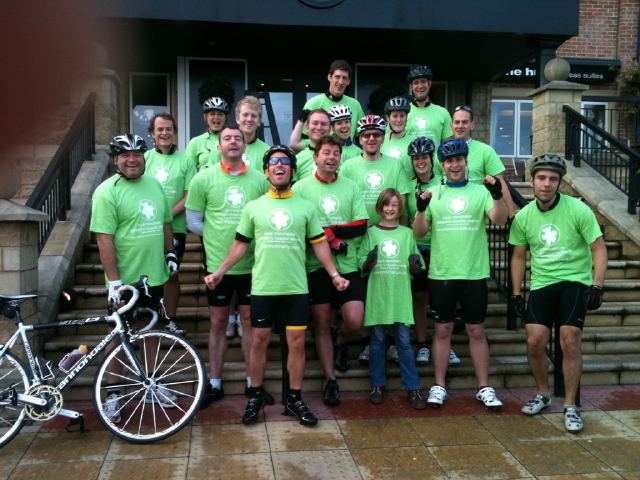 A positively leisurely start of 8am greeted the riders, now with numbers swelled to 22 , and the threat of headwinds and storm-force rain, we set our course for Manchester.
A less hilly day in the saddle, we quickly made good progress and within 4 hours had passed Stoke and rendezvoused with the final group of cyclists – 6 experienced riders including our route designer, Paul Carruthers of Journey9, Chris Byrne, Rupert Cornford, Anthony Turner and cycling Blog supremo, Phil Jones.
The Peleton of 27 riders and 5 support vehicles made quick work of the afternoons miles and arrived at our penultimate stop, Royales bike shop in Wilmslow where an impressive group of over 20 friends and supporter waited for us, along with a well deserved, and frightfully British, cup of afternoon Tea!
The rain held off, and even the most inexperienced of legs managed faultlessly – and after a couple of nasty surprise hills coming through Styal, we soon found ourselves riding through Manchester. Given cheers of support, and some ad-hoc donations, coming through Didsbury, we finally reached our drop in at the Royal Manchester Children’s Hospital…..

……before the slow processional ride to the Velodrome and the finish line.
The Last corner, into the Velodrome car-park, brought sunshine and a rousing reception from the 40+ people there to greet us – including Humphrey the Bear (the RMCH Mascot).
The final element of organisation dispensed with – cold beers all round, we posed for photographs before bidding farewell to our new close friends with vows of a repeat adventure next year(!)….and a night out in October to celebrate.
Stats from the ride
Ride distance – 213 miles
Total climb – 8547 ft
Total ride time – 20hours 23mins
Calories burned per rider – c12,000
The Riders
Di the Relentless – Who despite only realising the enormity of what she had signed up for 10 miles out of London (and the first hill)…kept going and had an immensely strong 2nd day.
Kypros the Brave – Ryman CEO who generously gave up his Saturday morning to ride with us and demonstrate quite how bad London is to ride through. We should have got the hint from the Florescent Body Armour he sported.
Mark the Polygamist – Who in gypsy-like fashion, systematically rode just about every bike on the event after his bike broke, twice. Once 10 miles from London, once 10 miles from Manchester. And then managed the most of the first day on ‘the Steam Roller’ – a hybrid commuter spare bike.
Meirion the Fixer – Completing the ride was immensely tough – to do the whole thing on a fix-wheel borders sheer lunacy. Not only that he was resident mechanic and was often seen up and down the pack acting as riding coach.
Mike the Face – Another amazing ride from an inexperienced rider who powered through both days. Mike manage to complete the entire 210 miles ride with the exact same thoroughly “p*ssed-off/anguished” look on his face until he saw the cold beer, then cracked a smile.
Padraic the Slippery one – Mr SlickSkin. Most riders have two VERY close ‘friends’ that will be eternally grateful to Padraic for his ‘Zero Boundaries’ anti-chaffing product (some of whom seem to be enjoying ‘very’ liberal application as if the cool-tingle was the prime benefit). Amazing ride as well, always at or near the front of the pack setting the pace….no mean feat with smaller legs (and I should know….).
Paul the Machine – Just when you thought you were doing ok up a hill or leaving a junction, Paul would power past, three cogs smaller, and remind you where you stood. Amazing power and ride leading ability. Rumour has it he had to be talked out of cycling back to Sheffield….with his kids on his back.
Phil the Hurl – Barely recovered from man-flu, Phil fought back bouts of sickness to fight on valiantly, consistently there in the group, relentless in his ability to maintain cadence and power on.
Sarah the Dynamo – Amazing rider, powered on all day, both days. Never seemed tired, never let spirits drop, put many of the far more experienced, far older guys to shame with her ability to consistently power on mile after mile.
Steve the Trainer – Strong selfless ride from Steve, despite being knocked off his bike by a car just 48 hours before the ride, inspired all riders whilst also providing technical tips, and pressuring the hotel to open the gym to lead a stretch session when the rest of us were dying after day one.
Steve the Juggernaut – Big Stevie, usually seen twisting his bike frame under the stress, sprinting past everyone “Like a ****ing Bullet”, often seen pushing other cyclists up hills and several times seen drafting for not other riders, but often the support cars as well.
Tom the Fruit – Another inexperienced rider (admitted to only getting on a bike 2 weeks before after his ‘training’ in Magaluf), Powerhouse Tom was always leading the pack and lest we forget provided our support van and 75,000 organic bananas! Helped motivate some of the female riders too…..
Wyndham the Merkin – Like being on the set of Four Weddings & a Funeral, baggy-short-shod Wyndham, powered on and never seemed tired or phased whilst constantly entertaining us all with his furry seat cover, nicknamed ‘The Merkin’ (just go careful with the SlickSkin)
….and of course Gary the ****** who had put the whole thing together in the first place.
The Support Team
Ruth, Alexis & Paul – the real heroes of the days. Fantastic support drivers, kept us on track (literally), kept us fed, watered, sane, safe and smiling. All the riders owe them such immense gratitude – thank you!!
Pete & Annabelle – who joined the support crew for day two to manage the larger numbers.
The Fundraising
This was the main reason for doing it – altogether, the fundraising as exceeded £14,000 and looks to be heading towards £15,000 which is a tremendous achievement….but as all the riders will testify, we did earn your support over the 210 miles!!
And it’s not too late to support us! The main page can be found here:
http://www.justgiving.com/GaryChaplin-TheoPaphitis-BikeRide
You can also donate by text message. Simply text the code RMCH50 and the amount (with £ sign) to 70070 – bob a few words of encouragement on there too!
Thank you!
 garychaplin.com